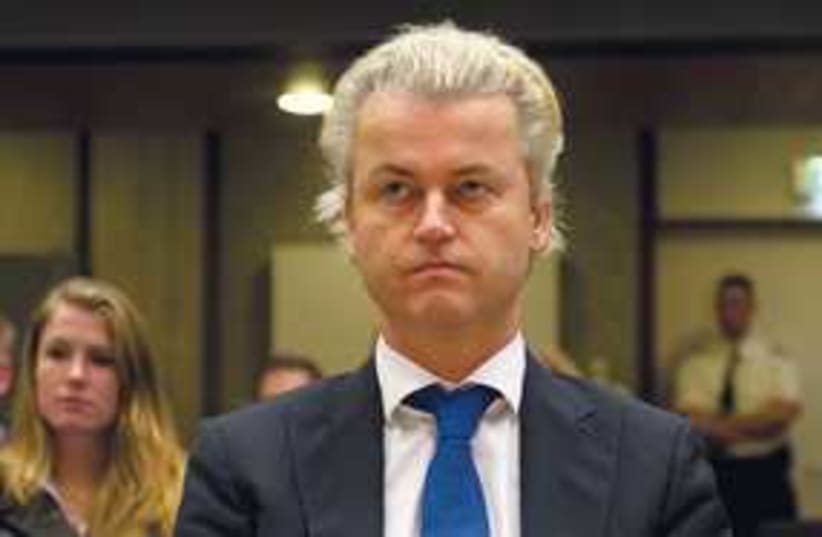
While many regard controversial Dutch politician Geert Wilders as alarmist, others say he has deep perception of perils of radical Islam; West should heed his warnings.
By ISRAEL KASNETTGeert Wilders serious 311(photo credit: Marcel Antonisse/AP)
Some call him “flamboyant and extremist,” while others regard him as the “second best politician” in the Netherlands. Geert Wilders, the controversial leader of the Dutch “Party for Freedom,” which became the third most dominant political party in the June 9 elections, is on trial for allegedly inciting racial hatred against Muslims.Wilders has repeatedly called for the Koran to be banned, comparing it to Adolf Hitler’s Mein Kampf, and faces a hefty fine or a maximum of one year and three months imprisonment if convicted by the Amsterdam court.The Koran may feature incendiary messages and calls for bloody murder in numerous verses, his critics say, but Wilders’ approach that all of Islam is radical and violent is flawed. Rather, it is the extremists who selectively choose the Koran verses that fit their worldview, while blatantly ignoring the nonviolent passages that call for harmony and conciliation.Here are just a few examples – offensive and conciliatory – from among a multitude of each nature found throughout the Koran: Sura 47, 4 cries, “When ye encounter the infidels, strike off their heads till ye have made a great slaughter among them...” And Sura 25, 54 demands, “Give not way therefore to the infidels, but by means of this Koran strive against them with a mighty strife.”But Sura 60, 8 clearly confirms “God doth not forbid you to deal with kindness and fairness toward those who have not made war upon you on account of your religion...” The Koran further emphasizes in Sura 8, 63: “And if they lean to peace, lean thou also to it...”Clearly, the text is extremely offensive to infidels (whoever they may be) but at the same time calls on Muslims to value and respect them.Bernard Lewis, a renowned authority on Islamic affairs, notes that extremists are “highly selective in their choice and interpretation of sacred texts,” and “accept or reject even sacred texts according to whether they support or contradict their own dogmatic and militant positions.”WILDERS IS known for his anti-Islam, antiimmigration views and has argued that if Muslims would like to remain in the Netherlands, they must first “tear out half the Koran and toss it.”He is not the first to suggest tightening immigration laws. Prime Minister Binyamin Netanyahu, in his 1995 book Fighting Terrorism, argued that “the possibility of expulsion must be a threat hovering over all terrorist and proterrorist activity in the democracies.”Taking a hard line, Wilders has proposed a tax on women who wear a Muslim head scarf, called for a ban on Muslim immigration and compared Islam to fascism. In 2008, Wilders produced Fitna, a short film highlighting the connection between Islam and violence, the combination of which he claims is often imparted by Muslim extremists. One of its many disturbing scenes shows a Muslim preacher declaring, “We have ruled the world before and, by Allah, the day will come when we will rule the entire world again!” Another preacher cries to his followers, “You will take over the USA! You will take over the UK! You will take over Europe! You will defeat them all!” In Wilders’ view, Ayatollah Ruhollah Khomeini’s fatwa against Salman Rushdie in 1989, the murder of Theo van Gogh in 2004, violent protests in 2005 against the 12 cartoons depicting the prophet Muhammad by Danish newspaper Jyllands-Posten and demonstrations in 2008 against his own film, Fitna, clearly point to Muslim extremist violence against Western values and freedom of speech.Large scale Muslim immigration to Europe has resulted in no-go areas for non-Muslims in Britain, France and Germany. European leaders are aware of this phenomenon but lack the resolve to act, he argues, choosing instead to welcome and appease radical Muslims.In a recent speech in Berlin, Wilders quoted German Chancellor Angela Merkel as having said, “The Islamization of Germany is inevitable.” Wilders also quoted Maxime Verhagen, the Dutch Christian- Democrat leader, who said: “More than before mosques will be an integral part of our cities.” To these and other European leaders, the preservation of their unique language, culture and lifestyle appears to have lost all meaning, he claims.In a 9/11 memorial speech in New York on September 11, Wilders said of the new proposed mosque near Ground Zero, “Its promoter and his wealthy sponsors have never suggested building a center to promote tolerance and interfaith understanding where it is really needed: In Mecca, a town where non-Muslims are not even allowed to enter, let alone build churches, synagogues, temples or community centers... Ordinary Americans object to the mosque project because currently no fewer than 10 major multimillion dollar mosque projects are being planned in the United States as well as dozens in Europe, while not a single church is allowed in the kingdom of Saudi Arabia, while Jews are not even allowed to move their lips in prayer on the Temple Mount in Jerusalem... What happens in New York must be seen in the perspective of the world.”WILDERS’ REMARKS, while too extreme for many, demonstrate for his defenders a more realistic understanding of radical Islam. It is clear that Muslim fundamentalists are turning Islam into a religion of perceived violence and hatred. They focus on the reduction of liberties and the expansion of repressive Shari’a law.Whether or not Wilders is guilty of incitement according to Dutch law is up to the court to decide.Meanwhile, Western governments will need to focus not on banning the Koran entirely, but rather, on thwarting those extremists who selectively use parts of it to incite to violence. Those who fight against radical Islam cannot sit in the dock while radical provocateurs remain in the viewers’ gallery.
if(catID != 151){
var cont = `Take Israel home with the new Jerusalem Post Store