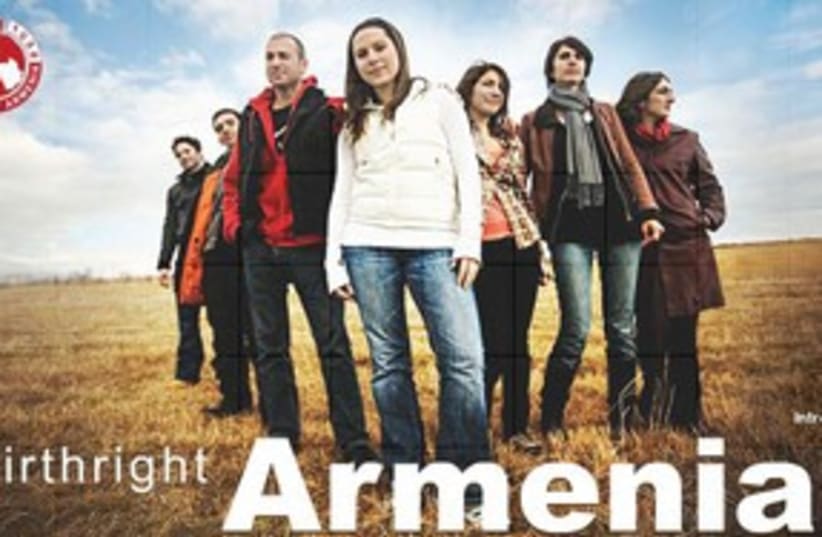
Birthright Armenia includes excursions around the country, visits to cultural, historical sites, meetings with local Armenian youth.
By BEN HARTMANArmenia 311(photo credit: Courtesy)
A small, ancient people, dispersed across the world, hounded by genocide and tragedy, with a successful global Diaspora that remains loyal to its ancestral homeland. Sound familiar? Though it’s not too difficult to make a compelling comparison between Armenians and Jews, the Armenian Diaspora’s “Birthright Armenia” program is both somewhat inspired by and radically different from the Jewish world’s highly successful Birthright Israel program.Founded in 2003, the program brings young people between the ages of 20 and 32 with at least one Armenian grandparent to the country for visits ranging from two months to a year.According to the organization, the experience is meant to foster a deeper connection to the country, and to allow for a longer, more hands-on trip than a whirlwind visit could offer.Since it was founded, the program has hosted over 500 Armenian Diaspora youth from over 25 countries.Sevan Kabakian, country director for the program in Armenia, says participants spend a minimum of two months to a year, volunteering around 30 hours a week.
“They basically participate in the life of the country, so their days aren’t spent doing what a tourist would do, but what a typical countryman would do; going to work, and then going home at the end of the day,” he says.After participants’ work days are over, he continues, the program’s services kick in, including language classes provided by a series of teachers and tutors, customized to fit the students’ needs. It also provides lecture forums where they are introduced to different aspects of the country, from economic and environmental issues to meetings with government officials.Much like Birthright Israel, Birthright Armenia includes excursions around the country, visits to cultural and historical sites, and meetings with local Armenian youth.Back stateside, the organization’s executive director, Linda Yepoyan, runs the program with a staff of five, including herself.Originally from Pittsburgh, Yepoyan came to Armenia as a young student following the devastating earthquake of 1989, and lived there for the next two years through independence from the Soviet Union in 1991 and fighting with Azerbaijan.Asked if the organizers ever considered making the program a 10-day trip like Birthright Israel, which would be a less intense experience but might attract more participants, she says that “one of our mantras is immersion, and the longer the stay, the deeper the roots.”She also doesn’t want people to leave Armenia with “a Disneyland, superficial understanding of what life is like here.”While they don’t receive financial support from the Armenian government, they do receive what she refers to as moral support, as well as easy access to government and military officials for lectures and round-table discussions with participants.Yepoyan describes Armenia as having “a lot of development to go. It’s not in its infancy anymore, but still in its teen years.” Still, she adds, “there’s something here in the water and here in the air; you just cant make a trip here to Armenia and not get roped into it.”The program’s founder, Edele Hovnanian, says that when the initiative was begun in 2003, she contacted Birthright Israel to ask permission to use the name and received approval.She also met with some people from the Israel program, who explained the ideas and principles behind it.Hovnanian, whose family owns a well-known construction company in the United States, says her family’s foundation pays for about half of the program’s $500,000 annual budget.The rest is raised in the Armenian Diaspora, which she says has many foundations but not to the extent that the Jewish Diaspora does.She describes how many young Armenians went to the country after independence in 1991. While they often had a romantic view of the country beforehand, “they would often come back disappointed, and I thought it was important to have a generation that grew up with a very realistic view of Armenia.”According to Hovnanian, “there are a ton of programs that take kids to Armenia for short-term purposes, but that is a very different experience than what we do. We want you to stay in homes, live there at least two months and really immerse yourself in the community, and take the local transportation.”PARTICIPANTS ARE also required to fill out an exit survey, outlining how they’ll contribute to the Armenian community back home.When asked if the program takes a political point of view, like the pro- Israel view put forward on many Birthright Israel programs, she says, “I can see the importance of what they’re trying to accomplish, which is to explain [Israel’s] point of view and only [Israel’s] point of view. We don’t do that, so some would say we’re apolitical, but as a longer program, it’s a lot harder to control the experience.Birthright Israel is more strict about schedule, and that can only happen if you’re on a short program.”She did say, though, that it is important for participants to learn the Armenian point of view – for instance, in regard to issues like the Nagorno-Karabakh conflict with Azerbaijan.As opposed to a standard studyabroad program, Hovnanian says her program is “much more like the Peace Corps with a very clear intent – you live in any country for three to four months, you’re going to bond with the country and those people. We want you to identify with Armenia, and when you get back to the Diaspora and people ask you what its like, you won’t just say it’s just post-Soviet corruption or non-democratic... they can become ambassadors for the country of Armenia. I don’t think that Armenia does a good job of public relations for the country abroad, so these young people become ambassadors... on a real human interest level.”Greg Bilazarian, 27, is one participant who has gotten hooked on Armenia, and has found himself leading a somewhat unexpected late-20s sojourn in the country. Bilazarian is also one of the relatively rare young people eligible for both Birthright Israel and Birthright Armenia, having been born to a Jewish mother and an Armenian father. He grew up with and is familiar with both diasporas, and even spent a few years in Hebrew school – though following a summer family trip to Armenia, he made the decision to be baptized into the Armenian church at age 12.He spent several years working as a TV reporter in Gainsville, Florida, and later in Toledo, Ohio, before deciding that he was done with the profession and wanted to try something new.His decision to go to Armenia, he says, rather than being a heart-warming, back-to-his-roots story, came about because he was looking to take a professional sabbatical and had heard about Birthright.Much like young Americans who have moved to Israel, Bilazarian describes his new surroundings as a close-knit country with a good nightlife, where he hardly ever goes for a stroll downtown without bumping into people he knows.Also like in Israel, he says that in Armenia, “people are always answering their cellphones in public and smoking everywhere. In every cab, immediately they ask you if you‘re married.”While he notes that the standard of living is definitely much lower than in the States, the people are incredibly friendly, and the country is fascinating and beautiful. He calls the experience the greatest time he’s had in his life.“It’s an amazing place. I go through every emotion every day, really high and really low,” he says.Bilazarian admits that finding a job he loved was the single most important factor in having a positive experience.Despite choosing a professional sabbatical from the media world, he has found himself working again in media – for an organization called The Civilitas Foundation, where he has joined a team of young people aiming to launch a new media project.He originally only planned to come for a short period, but the company offered him a one-year contract, and he decided to stay.Though he may not have come out of any Armenian roots romanticism, he says his time in the country has had a significant effect on him.“It definitely has helped build a stronger connection [to Armenian roots] and a stronger picture of what it means to be Armenian,” he says.“Here you really get to see the country and the culture and how it really is, instead of just the middle-class and wealthy Diaspora. I certainly feel closer to the country, and I’ll always have that sort of a bond.”
if(catID != 151){
var cont = `Take Israel home with the new Jerusalem Post Store