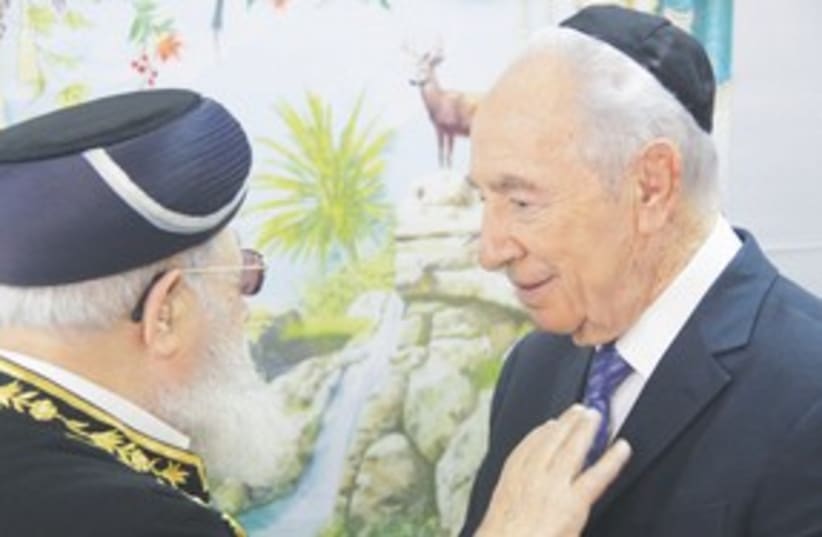
The former Sephardi chief rabbi Ovadia Yosef must be extraordinarily fond of Peres because he gave him not one slap, not two slaps – but three.
By GREER FAY CASHMANPeres and Yosef 311(photo credit: Jossef Avi Yair Engel)
It’s well-known, and not just in Shas circles, that a sign of affection from Shas mentor Rabbi Ovadia Yosef comes by way of a gentle slap on the face. President Shimon Peres makes a point of visiting Rabbi Yosef on the eve of Rosh Hashana and either just before or during the intermediate days of Passover. The former Sephardi chief rabbi must be extraordinarily fond of Peres because he gave him not one slap, not two slaps – but three. It would seem that Rabbi Yosef is the only person in the country who can slap the president’s face and not get pounced on by bodyguards.In the evening, just as he was getting ready to host an intimate dinner for visiting Italian Prime Minister Mario Monti, Peres received a telephone call from Palestinian Authority President Mahmoud Abbas, who opened the conversation in Hebrew by wishing him a happy holiday – “Hag sameach v’moadim le’simha.”Peres and Abbas, who are in frequent contact, reaffirmed their individual commitments to peace, with Peres telling Abbas that the only solution is peace and Abbas replying that the Palestinians have been committed to peace for two decades and are fully aware that there is no alternative to peace.The two leaders agreed on the need to return to the negotiating table to continue the struggle for peace.■ RABBI YOSEF immediately noticed from the manner of her attire that one of the young staff members accompanying Peres was from the national-religious camp. “Are you married?” he asked her – a superfluous question given that she was bare-headed, but for all he knew, she may have been engaged. She isn’t and, when he learned this, the rabbi spontaneously gave her a blessing that she should soon find a bridegroom.■ MOST OF the dinners that Peres hosts in honor of visiting dignitaries include a variety of guests representing academia, business, the arts, religion and the political establishment. This dinner at the King David Hotel was limited to five tables, including the head table and one for the president’s staff and for singer David D’Or, his wife and son. Most of the people at the other tables had some direct or indirect connection with economics.Among them were Finance Minister Yuval Steinitz, Governor of the Bank of Israel Stanley Fischer, Discount Bank chairman Yossi Bachar, Bank Leumi chairman David Brodet, Bank Hapoalim chairman Yair Saroussi, Nobel Prize Laureate Prof. Dan Schachtman, Prof. Sergio DellaPergola, who is considered to be Israel’s leading authority on demographics, and Professor Manuel Trajtenberg, chairman of the Planning and Budgets Committee of the Council for Higher Education.Also in attendance were Italian Ambassador Luigi Mattiolo and his wife, Stefania, and Israel’s ambassador to Italy, Naor Gilon and his wife, Orly.Among the visiting Italians was the familiar face of Italian journalist-turned parliamentarian Fiamma Nirenstein, who spent many years as a correspondent in Jerusalem. Peres has known Italian PM Monti for some 20 years.They meet annually at the World Economic Forum in Davos. Monti is one of Italy’s foremost economists. He is not a politician, he was not elected and he did not seek office, he clarified to his audience. But when, last November, the former European Union commissioner was asked by President Giorgio Napolitano to form a new government following the resignation of Silvio Berlusconi, he could hardly refuse in the face of Italy’s economic and political crises. In the few months in which he has been in office, he has introduced austerity measures and a bold package of economic reforms and re-established the ability of the Italian Treasury to finance itself.Steinitz and Fischer listened most attentively as Monti outlined Italy’s new economic policy.In introducing Monti, Peres, who is inter alia a former finance minister, said that Monti had taken the reins of Italy at a most difficult time, knowing that what happens in Italy will affect all of Europe. Regardless of Italy’s internal economy, Peres noted, trade relations with Israel are in good shape with the volume of trade between the two countries in the range of $4.2 billion.On the political front, Peres expressed appreciation for Italy’s position vis-à-vis Iran Peres commented on the fact that this was Monti’s first visit to Jerusalem, adding “there’s nothing like the first time.” On a personal level, Peres said that Monti is a person who has earned tremendous trust, that he is responsible and that he does not play politics. “Many prime ministers are jealous of him,” said Peres. Monti was equally complimentary and said of Peres that he was “a walking inspiration of leadership and faith in the future.” This was followed by the assurance that “you and the country that you lead are in the hearts of all Italians.” Monti said that he had come to enhance the relationship and the joint commitment on many multilateral issues. After the main course, Peres took Monti around to the tables to introduce him to the guests and the two sat down at Fischer’s table.■ MONTI’S WIFE, Elsa Antonioli Monti, was almost in tears as she listened to David D’Or’s emotional rendition of the most popular Italian song of all time, CARUSO. written by Lucio Dalla, who died a little over a month ago. D’Or had met him in Italy and, with his extraordinary vocal abilities, not only conveyed the beauty of the lyrics and melodic value but also paid a farewell tribute to one of Italy’s most beloved songwriters. The Italians at the dinner sat with rapt expressions on their faces and the Israelis were also caught up in the magic.When D’Or finished the song, the Italians, including the prime minister gave him a roaring standing ovation and the Israelis applauded loud and long. Before singing his Hebrew choice, Avinu Malkeinu (Our Father, our King), D’Or told Monti that he had a large family in Rome which had come to Israel to celebrate the Passover with him. His relatives, he said, had spoken highly of Monti, “and they have great expectations of you.” D’Or who makes a point of including Jewish liturgical works in all his performances, has had offers from some of the world’s leading opera companies, but has politely declined them. One of the reasons, he told this columnist, is because he does not want to become a slave to his career. The other is because he has great respect for the gift that God gave him and he wants to use it to promote Jewish music from both the East and the Eest.■ KNOWN TO be a workaholic, Peres, who was extremely busy during the first intermediate day of Passover and also worked on the second, including his annual task of opening the Ein Gev Festival on Monday, finally took time out on Tuesday for a two-day vacation that, although fun, was not without its work component. Peres, who prior to his election to the presidency was minister for the Development of the Negev and the Galilee, maintains an abiding interest in the southern part of the country, partially because the development of the South was the dream of his mentor, David Ben- Gurion. Accompanied by some of his close aides and their families, Peres decided to promote tourism to the Negev and the Arava through personal example and spent the first night of his vacation in one of the area’s guest houses, just like regular tourist.Peres and his entourage were welcomed by Arava Regional Council chairman Ezra Rabins. They ate locally-grown produce in the common dining room. They also visited local tourist sites, including the crocodile farm. Peres, who can never forget the days in which he was a shepherd on kibbutz, takes every opportunity to relive that experience and his itinerary included a visit to Moshav Idan where the Afiyas family runs an organic farm. Peres will inspect modern dairy techniques and will also feed some of the baby livestock. At Ein Yahav he will participate in a new system of tree planting together with Ein Yahav youngsters who are celebrating Bar and Bat Mitzvahs.He will pick tomatoes, join in a session of community singing and, despite his age, go trekking along Derech Habesamim Fortunately, he will be able to genuinely relax over the weekend.■ PRIZE-WINNING and best-selling author Yoram Kaniuk, who is approaching his 82nd birthday, has stirred up a hornet’s nest over lack of proper respect for the aged and the chaos that exists in hospitals.He poured out some of his frustrations in an article that he wrote this week in Ha’aretz. Although the world belongs to the young, he said in a subsequent interview on Israel Radio, it should be remembered that senior citizens still count for something. Kaniuk, who walks with the aid of a cane, says that when he is in the street, young people do not stand aside for him; he has to find some way of maneuvering around them. When he travels by bus, hardly anyone stands up for him or for any other elderly person.Israel Radio’s Anat Davidov commented that senior citizens collectively form a powerful electoral bloc, which is something that MKs should perhaps take into consideration.Kaniuk, who recently spent some time in hospital, said that while the medical treatment was good, the general attitude toward him and other patients was terrible. This lack of consideration for fellow human beings isn’t specific to the hospital in which he was confined, he said, but is rampant throughout the country. MKs are oblivious to what goes on, he continued, because if they need to be hospitalized, they have special perks which the ordinary citizen does not enjoy. Perhaps the people in charge of nonmilitary National Service should set up a Pollyanna unit for young men and women to serve as administrative helpers in hospitals, assisting with filling out of forms, checking when doctors or nurses will be available, making sure that patients who have been waiting a long time receive some form of nourishment and making contact with the outside world on behalf of those patients who for whatever reason are incapable of doing it themselves.■ BUSY SCHEDULE notwithstanding, US Ambassador Dan Shapiro wanted to do a mitzvah before Passover and met Leket Israel founder and chairman Joseph Gitler while volunteering in the fields picking vegetables before the holiday so as to be able to contribute to Leket’s National Food Bank.Shapiro was one of more than 40,000 annual volunteers who support Leket’s work. In 2011, volunteers rescued 9.5 million kilograms (21 million pounds) of produce and perishable goods for distribution to the poor. Leket Israel works with hundreds of nonprofit organizations caring for the needy and providing food and nutritional support for more than 60,000 people on a daily basis.■ A FEATHER in the cap of the Rabbinical Assembly is that US Vice President Joseph Biden will be the featured speaker at the Rabbinical Assembly Convention to be held May 6-9 in Atlanta, Georgia. He will address the gathering on Tuesday, May 8.. Biden has been a stalwart supporter of Israel for four decades, since his days as a US senator and during which time he served as chair of the Senate Foreign Relations Committee.He has visited Israel numerous times, both as a senator and as vice president. He is known as a friend and supporter of the American Jewish community. The Rabbinical Assembly is the international body of Conservative rabbis with over 1,600 members worldwide and representing approximately 1.5 million Conservative Jews.Its executive vice president is Rabbi Julie Schonfeld, recently named one of the 50 top rabbis by Newsweek.■ ISRAELIS ARE reputed to have a short fuse, yet decision-making and the implementation of decisions is a very drawn-out process. A case in point is the Israel Broadcasting Authority, which for decades has been talking about reforms that are only now on the brink of being implemented and no one can tell what obstacles may yet get in the way. The Government Press Office was another example in that there had long been talk of moving it from Beit Agron on Hillel Street, Jerusalem, a very central address that once housed the bureaus of numerous international media outlets, where the GPO had been located for more than 40 years. But gradually most of the other bureaus moved away and then there was a mass move to Malha. It stood to reason that the GPO would follow the herd, so after 10 years of debates as to whether or not it should be relocated, and if so to where, the day finally arrived.The so-called historic decision for the move was made by Minister for Public Diplomacy Yuli Edelstein and his director-general, Ronen Plot.Prime Minister Binyamin Netanyahu was invited to conduct the first conference in the new state-of-the-art facility using teleprompters instead of reading from a paper, so that he could continue to look straight out at the television cameras. But that wasn’t the only reason that they wanted him there. Netanyahu, regardless of any position that he might hold, is recognized as Israel's best communicator, and since the GPO is under the supervision of the Ministry for Public Diplomacy, nothing could be more appropriate than for the master of public diplomacy to give the first press conference.But before that, Netanyahu had another task, which was to affix the mezuza on the entrance to the new premises – an especially symbolic act since it was so close to Passover.■ SOTHEBY’S ISRAEL has been holding a sales exhibition at the Tel Aviv Hilton of selected works by Marc Chagall under the title “Chagall through the decades.” The exhibition includes 19 works by the great Jewish artist, dating from 1914 through 1982 – thus revealing seven decades of the artist’s oeuvre.The exhibit reflects a wide range of themes that occupied Chagall at various stages of his artistic career, such as auto-portrait, lovers, village scenes and marriage.Price estimates for the various works range from $40,000 to more than $2m.The exhibition will remain on view until Thursday, April 12. Sotheby’s managing director for Israel, Sigal Mordechai has spent a lot of time at the Hilton answering the questions of potential buyers. Chagall’s work is well-represented in Israel’s leading museums and at the Knesset and Hadassah Ein Karem.■ TODAY, APRIL 11, marks the 95th birthday of Mina Rokeach, a Holocaust survivor who died just under a year ago. On the day before Passover, her family dedicated and auditorium in her name to the Interdisciplinary Center Herzliya.Among those attending were IDC founder and president Prof.Uriel Reichman, IDC vice president for external relations Jonathan Davis, Rokeach’s sons Arthur Susskind and Leo Rokeach, her granddaughter Vivienne Rokeach and other members of the family. Vivienne Rokeach lovingly told the story of her grandmother, who was born on April 11, 1917 in the small Polish town of Tarnow. Her maiden name was Mina Blauner. Her first husband was Jakov Süsskind, with whom she had a son Artur, born in October of 1940. The Blauner family, blessed with many children, was religious, but the young Mina went to a regular Polish school.Her schooling was disrupted when her father discovered that she was attending classes on Shabbat. At age 18, she entered into her first marriage.The young woman, her husband and infant son initially lived in the ghetto but as life became increasingly difficult, the Susskinds reluctantly decided to smuggle their 18-month-old son out of the ghetto and managed to find him a haven with a Polish family in Krakow. The family was childless and cared for Artur like he was their own.Jakov Süsskind was arrested at one of the first actions in the ghetto and was deported to Auschwitz. His wife never saw him again. When the ghetto was finally liquidated, she and her family were among the inmates who were also put on a train to Auschwitz.There had been rumors about Auschwitz and everyone on board was aware of the uncertain fate that awaited them. Mina approached her sister and proposed that they jump out of the well-guarded moving train.Her sister was too afraid but Mina was determined. After some men knocked out some boards from the wagon, Mina leapt toward what she hoped was life. The jump caused a back injury that forced her to remain hidden for several days in the field. After the pain subsided, she began walking toward a small town where she knew that her two brothers were hiding beneath the cowshed of a Polish farmer. She could walk only at night.In the daytime she hid in the fields.Eventually, she found her brothers and they hid together for almost two years in a small hole in the ground underneath the barn. After the war, the three crawled out of their hiding place, delighted to breathe the air of freedom. Their part of Poland was now occupied by the Red Army.When her brothers tried to exchange some money. they were beaten to death by Poles. In her despair, Mina sought help from the Red Army commander, who ordered that a search be conducted for the killers. They were found, condemned and executed.Mina returned to Tarnow and waited in vain for family members who might have survived. None did. Of her parents, husband, five sisters, two brothers, their spouses and children, she was the sole survivor. She was 28 years old, a year younger than the granddaughter who now tells her story. The only other survivor was her son Artur, who still lived with the Polish family in Krakow. He had been baptized and was almost five years old when she went to get him. He no longer remembered her. It was a major shock for him, when she told him who she was and even more so when she revealed that they were Jews. He had been taught to believe that Jews were Christ-killers.Toward the end of 1945, her brother- in-law, Chaim Süsskind, found his way back to Tarnow. He had survived the war in Germany with the help of false Polish papers. His wife and his first child were killed in the Allies’ bombing of Fulda. Chaim and Mina married and, in 1948, a very symbolic year, she gave birth to Leo, the father of Vivienne Rokeach. The family missed the opportunity to leave Poland legally for Israel when the state was founded, and was searching for a way to reach the West during the period of the Cold War. One day, Mina heard that it was possible to get Austrian papers that had belonged to deceased citizens at the embassy in Warsaw. She managed to buy those papers for her husband, who then became Norbert Rokeach, and she and Leo automatically gained Austrian citizenship. Artur did not have the same right, so Mina put his name down into her own passport and faked a stamp and signature. Finally, in the winter of 1949, the family could leave Poland legally.At first they went to Vienna and later settled down in Berlin, where they founded a paint factory in 1952.The Susskind family had already had a small paint production plant in Tarnow before the war. Together with her husband, Mina built up the company and when she lost her second husband in 1974, their son Leo took over and continues to head the family business in which Mina Rokeach continued to work until the age of 83.From small beginnings, the business grew to an international company with more than 300 employees. While Mina Rokeach built up her material existence in Germany, she always felt strongly attached to the Jewish people and the State of Israel. This was reflected in her generous donations to WIZO, Beit Hatfutsot – the Museum of the Jewish People and Sheba Medical Center, Tel Hashomer. Toward the end of 1970 she bought an apartment in Tel Aviv so she and her children and later her grandchildren could come to visit. The apartment, the city and the country are her family’s second home, said Vivienne Rokeach.Reichman stated at the ceremony that Mina Rokeach’s story symbolizes the tragedy and the strength of the Jewish people, who somehow manage to overcome hardships and are forever renewing themselves. He pledged that Mina Rokeach’s story would become a part of the IDC curriculum and noted that the inauguration of the Mina Rokeach auditorium was in a sense the closing of a circle in that Artur Susskind was one of the first contributors to IDC, long before the facility had succeeded in building up the reputation that it has today.In thanking the family, Yair Yitzhak Balhovski, the chairman of the IDC students’ union, said that as the grandson of Holocaust survivors himself, he could understand that his generation owes its future to people like Mina Rokeach and other Holocaust survivors who, while not forgetting the past, focused on building a new future.greerfc@gmail.com
Related TagsOvadia Yosef
if(catID != 151){
var cont = `Take Israel home with the new Jerusalem Post Store