As Athens is set to run out of cash and threats mount to kick it out of Eurozone, Greeks seem to think money will "be found."
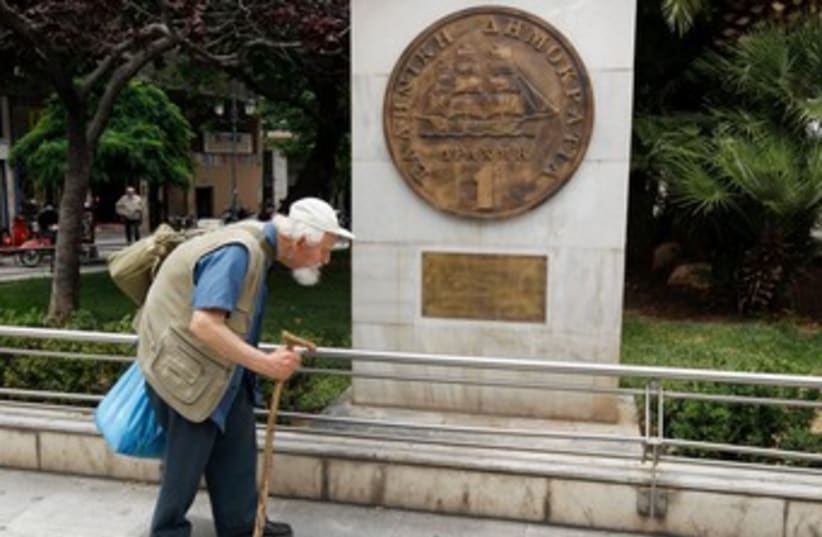
By REUTERSGreek man walks past drachma coin replica in Athens 370 (R)(photo credit: REUTERS/Yorgos Karahalis)
ATHENS - In a land of ancient myths, modern Greeks have created some of their own about their near-bankrupt country's future as an integral part of a Europe that will never kick them out.Solemn warnings from abroad that Athens cannot stay in the euro while rejecting the terms attached to the billions offered to pull Greece out of its financial hole are widely disbelieved in a land that considers itself the envy of foreigners.However bad their prospects, many Greeks seem to think that since money to bail them out was found in the past, it will be found again, whatever politicians say.Nor do they believe that Europe will simply cast them loose, despite growing signs that Greece is heading for the exit from the single currency and towards the economic and social catastrophe that would follow."There's a lot of money in this country, they just need to tax the rich and it would solve so many problems," said seamstress Argiro Maniati, 55.Working furiously at her sewing machine surrounded by tall piles of mended clothes her customers can't afford to collect, Maniati fully embraces the myth that Greece's membership of the euro can never die.Like many Greeks who punished mainstream parties in a fruitless May 6 election that has brought Greece to the edge of a political abyss, she thinks politicians have exaggerated the threat of euro expulsion to scare up votes for failed policies."The big parties brought us here, to poverty and suicide, and they are terrorizing us to make us accept tough measures."In what many foreign partners see as the great Greek paradox, opinion polls show over 75 percent of Greeks want to stay in the euro, but two thirds oppose an international bailout, a lifeline which came with harsh salary, pension and job cuts.Frankfurt and Brussels say it is impossible for Greece to have one without the other: no bailout means no euro and a return to the drachma - "drachmageddon," as some Greeks call it.Enraged with mainstream politicians they blame for the mess, voters backed smaller groups, such as the radical leftist SYRIZA party of 37-year-old Alexis Tsipras, who won a surprise second place on the back of his anti-bailout rhetoric.The parliament elected on May 6 was split between backers and opponents of the 130 billion euro international rescue plan, and could not agree a cabinet. Another election will be held next month, with the result far from clear.The European Union, European Central Bank and International Monetary Fund - who must give Greece money within weeks to pay pensions and salaries - say they will pull the plug if the next government in Athens does not back the bailout. Without the money, they say Greece cannot stay in the common currency."Empty threats!" said Nikos Sokos, 29, who works in a cafe in central Athens. "There's no way they're going to kick us out. There won't be a euro zone if they do that."'A grand illusion'Observers of the Greek political scene say there are serious risks if voters carry such myths to the polls."It's a grand illusion," said Theodore Couloumbis of the ELIAMEP think tank."Parties must pose the basic question - in or out of the euro? It will be tragic if we are thrown off the European bus because our politicians can't send the right message."The main message most Greeks have heard is that politicians have wrecked the economy. At Makis Deligiannis's patisserie on a busy Athens street corner, cake stands are half-empty. People don't buy birthday cakes as they used to, sales have dropped by half and he will vote for an anti-bailout party."No one can force us to leave the euro. Now that they have us, they're stuck with us," he said."If they change the laws to force us out, then there will be no euro zone. They're just barking to scare us but actually they're the ones who are scared," he added.Many parties show no sign of heeding warnings to make clear to a public confused about what is at stake that elections next month are effectively a referendum - euro or drachma.Huddled in meetings to decide strategy for the next vote, they are poring over opinion polls and mapping alliances but their message is little changed from the last election.Even the mainstream parties that negotiated the bailout have campaigned on promises to win better terms, which helps sustain the legend that a substantially improved deal is possible."There is a logic that the bailout, as it is now, doesn't suit us," said Costas Panagopoulos, head of ALCO pollsters. "My view is that parties will amend their message, but all of them will be anti-bailout to a degree."Greek officials have admitted that the state will run out of cash next month. The EU and IMF have warned Athens will get no more funds unless it meets fiscal targets and pushes reforms, including finding about 11 billion euros worth of cuts by June.Many Greeks mistrust such prophecies. Like in the ancient Greek story-teller Aesop's fable "The Boy who Cried Wolf," they have heard warnings before that cash was running out, and money always turned up. But officials say this time the wolf is real: the government has even raided funds set aside for natural disasters."I shudder to think what will happen if a big earthquake or tsunami hits Greece," said a source close to the international lenders earlier this year. "Financially, they couldn't cope."Hunting for votesIn the hunt for voters in the May 6 election, political parties muddled their message. Even the parties that had worked hard to clinch the bailout deal in a coalition government presented it as a great injustice that needed to be amended.The conservative New Democracy leader Antonis Samaras vowed to re-negotiate parts of the bailout deal to boost growth and Socialist PASOK chief Evangelos Venizelos pledged to ease its pain by spreading it over three years instead of two.Tsipras told voters not to be fooled by false dilemmas - Greece could give up the bailout and still stay in the euro, while there was plenty of money if the state was managed properly. He came a surprise second while the big parties that ruled Greece for decades tanked.With about three weeks to go before the next election, there is no sign on the streets of Athens that people are coming to grips with the real choice they face."Even if we go bankrupt we need to tell them clearly that we won't leave the euro in any event. They'll have a bankrupt country in the euro, which means other countries can go bankrupt as well and the whole euro zone will blow up," said electrician Thanasis Zahariadis, 47."So they won't let us go bankrupt, no way. These are just threats. I'm going to vote anti-bailout."
if(catID != 151){
var cont = `Take Israel home with the new Jerusalem Post Store