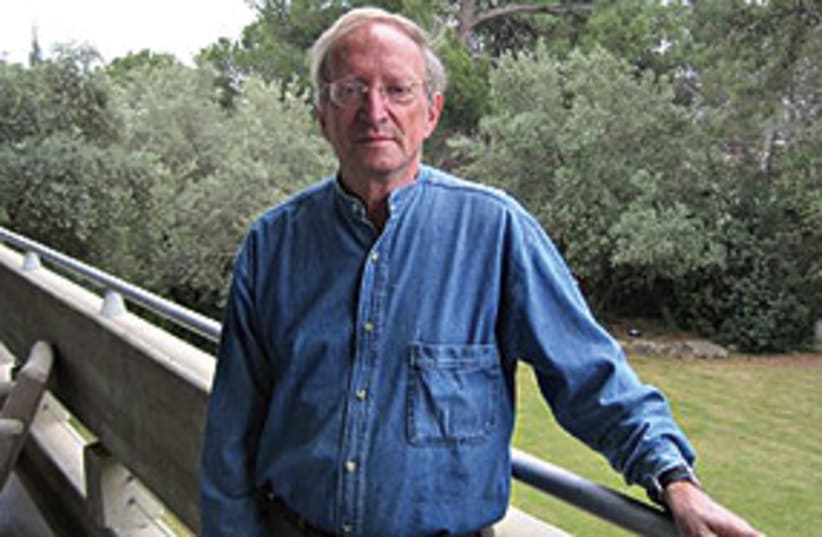
Avishai Margalit says the blockade on Gaza is a disaster.
By STEVE LINDEavishai margalit 311(photo credit: Steve Linde)
Prof. Avishai Margalit is considered to be the country’s foremost philosopher. In granting him this year’s Israel Prize for Philosophy, the prize committee described Margalit as “one of the most important philosophers in the State of Israel and one of the most valued in the world today.”Known as a clear thinker, eloquent speaker and incisive writer, he is on the left of the political spectrum and advocates what he calls a return to “the little Israel” of 1948.While defining the current situation in the Middle East as “a moment of truth,” Margalit doesn’t believe a solution will be imposed on Israel and the Palestinians by the US, although he wishes President Barack Obama would “bump their heads together.”His specific appeal to the government as Israel marks Independence Day is to lift the blockade on Gaza it imposed in June 2007 when Hamas took control of the territory.“To create this huge jail and believe that something good will emerge because now it’s quiet, that’s an illusion,” he says. “Actually, it’s moral bankruptcy and a terrible illusion.”Born in 1939, Margalit grew up and was educated in Jerusalem and did his IDF service in Nahal.He received his BA, MA and PhD summa cum laude (1970) in philosophy from the Hebrew University of Jerusalem, becoming a lecturer and head of the philosophy department at the university before retiring as professor emeritus in 2006.Margalit is currently the George F. Kennon Professor at Princeton’s Institute of Advanced Studies, and has taught at several prestigious universities in the UK and US, including Oxford and Standford.A founding member of Peace Now in 1978, he later served on the board of B’Tselem.He has authored a few highly acclaimed books, including On Compromise and Rotten Compromises, Occidentalism: The West in the Eyes of Its Enemies, The Ethics of Memory and The Decent Society.Margalit has also published articles for The New York Review of Books on a range of social, cultural and political issues, writing profiles on politicians including Yitzhak Rabin, Ariel Sharon and Shimon Peres, as well as on philosophers Baruch Spinoza, Martin Buber and Yeshayahu Leibowitz.He is married to Edna Ullmann-Margalit, who is a professor of philosophy at the Hebrew University, and both of them are members of the university’s Center for Rationality and Decision Theory. They have four children and five grandchildren.Margalit spends much of his time researching and writing at the Van Leer Institute’s library in Jerusalem, where I interviewed him – in English – last week.How would you describe the state of the nation of Israel this Independence Day?I think it’s in a troubled state. I mean life inside Israel, inside the Green Line, is very pleasant at the moment. But I think all recognize that it’s a troubling state of affairs since we face a clear-cut dilemma: If we go on as is, as we did in the last 42 years, from ’67 on, which means one political entity from the Jordan to the Mediterranean – call it whatever you want – it’s clear that this is an entity that most Israelis and most of the world cannot live with. Which means eventually it will emerge into an apartheid state, whether you like it or not, because the only way to keep the Palestinians in line is on more and more repressive terms, and that’s the logic of the situation. I think for Israel it’s the defeat of Zionism in a grand way, and theonly way is basically the small Israel, with all the dangers that itinvolves. We never expected after ’48 to live in a happy state; we knewthat we’d take risks but at least we created a coherent society, andnow I think it’s an incoherent society that either will be morallydefeated or live in an intolerable situation for most of the people init, on whatever grounds. So I think this is actually a moment of truth.In your new book, you write that “rotten compromises are notallowed, even for the sake of peace.” What do you mean bythat?The tenor of my book is that I prefer just a peace over a just peace.Namely, sometimes an imperfect peace that is not just is preferable tostruggling for a just peace that can create tremendous injustice on theway. So the main tenor is to advocate compromise. There are cases inwhich keeping an inhumane regime or making a deal with an inhumaneregime even for the sake of peace is unjustified.I don’t think that if Switzerland or Sweden made peace with Germany,this was justified. This doesn’t mean, necessarily, that they shouldhave gone to war with Germany because maybe they couldn’t afford to goto war. But to make peace with Germany was unjustified. So to make apeace with an inhumane regime which is cruel and humiliating in anunjust way is unjustified.You were born in Jerusalem and have spent most of your life inJerusalem. Has anyone ever turned to you, as Israel’s top philosopher,for a creative solution on Jerusalem?Actually, I was born in a hospital in the Jezreel Valley, but I havelived here all my life. Jerusalem has become a misnomer for so manyagendas.After ’48, there was a consensus in Israel, that the borders of ’48 arethe borders of Israel, including the Galilee, which consists mostly ofArab Israelis. After ’67 there was no consensus and in order to createa consensus, they used the term “Jerusalem.”The Jordanian Jerusalem was less than 2,500 acres. The Jerusalem of nowis an infinite land, which includes 40 villages – and who would call[the Palestinian neighborhood of] Shuafat Jerusalem? Jerusalem is justan appeal to annexation, that will be consensus. That’s what Jerusalemmeans. The holy basis of Jerusalem, the historical core, is less thanone percent of Jerusalem. That’s the historical truth. The whole Cityof David is just 15 acres. That’s what we are talking about.Jerusalem is such a misnomer. People actually swear in the name ofJerusalem who can’t stand the city. The Zionists never liked the city,because it reminded them too much of old Europe, and the city that Ilike they can’t stand. They rush to Tel Aviv on Thursday from theKnesset. Most of them don’t live here. They won’t even send their kidson a field trip with the school to Jerusalem. Yet they swear in thename of “heavenly Jerusalem” – which is utterly non-concrete Jerusalem– with no feel for the city.But do you have a solution to what you call “the historical core of Jerusalem”?There should really be joint sovereignty over this part, and theadministration of it should be by UNESCO. Don’t change the physicalpart of the city, because it’s a treasured heritage of the whole world,and of the Abrahamic religions. The administration should be made up ofboth Israelis and Palestinians.Do you think Netanyahu and Abbas can reach a deal of some kind?There is nothing stable here. Lots of people who were willing to goalong with Oslo have become disenchanted and are not willing to give itanother try. There is tremendous mistrust on both sides. The prospectnow of a deal out of free will of the two sides seems too remote andtoo unrealistic.What will happen if [Palestinian Authority Prime Minister] Salam Fayyaddeclares an independent state along the borders of 1967, but we arewilling to negotiate a swap one on one? And then get recognition fromalmost all the world, and de facto recognition from the United States?Then people will have to talk differently. I believe that on bothsides, including in Gaza, more or less 70 percent of the population cangradually agree to live under the conditions that Clinton outlined. Idon’t say they will do it on their own initiative, but passively theycan live with it and accept it. But then there are 30 percent on bothsides who are more vehemently opposed to this, and there is nopolitical mechanism on both sides to bring it about.I believe we are left with what Yeats said: “The centre cannot hold...The best lack all conviction, while the worst are full of passionateintensity.”And that’s the situation we are in.Do you think Israel should talk to Hamas?About what? There is very little to talk to with Hamas. If you cantalk, you should talk. Indirectly, directly. This is not the issue.What is intolerable is the belief that you can put a million and a halfpeople under siege and believe that something good will come out of it,and this will undermine the Hamas regime. This collective punishment isinhumane. I am surprised that the world accused Israel of doing it andnot Egypt. Obviously Egypt is part of the siege. Both do it.I see the dilemma. You don’t want the Hamas to succeed because that’swhat they want. They want to be the avante-gard of the Palestiniancommunity, to show that they can create a mobile society, and they needone place like Gaza to succeed. And Israel rightly doesn’t want them tosucceed.The other extreme is to push them so hard that something will happen. Ithink in between there are lots of options. They don’t have to succeed.You don’t have to make their lives easy in terms of a success story,but on the other hand to create this huge jail and believe thatsomething good will emerge because now it’s quiet, that’s an illusion.Actually it’s moral bankruptcy and a terrible illusion. In what way? Because collective punishment is unjust. There are kids, there arepeople who want to study and go abroad. There are people who want toconduct some semblance of life. You can’t put a million and a halfpeople, most of them refugees, under siege and then start lamenting thesettlements that were destroyed. After all, we gave them the license tovote. They voted for Hamas with the understanding that it’s acceptable.So your appeal to the government would be to lift the siege?There are things that you should take seriously to make sure that youget as much as you can, but basically, lift the siege, yes! I thinkthat the siege can’t go on, and I think that it is a disaster.Basically, the Hamas smashed the Fatah. They took over Gaza.I believe there was a preemptive strike. I think both the Americans and[former Fatah chief in Gaza Muhammad] Dahlan tried to mount a coup inGaza, which failed. It’s not that the Hamas are squeamish, but theywere quite afraid of taking over by military means, I think.But when they discovered that they were threatened, they became wild. Ithink that the decision to allow the elections was a major disaster, amajor mishandling of the situation.And we went along with it. I think that Bush and Condoleezza Ricewanted to show that democracy in the Middle East is all over, in Iraqand here, and for that fantasy, for this PR showcase, they were willingto do this thing, which was mad on the face of it. There’s no point nowin blaming Sharon, but we went along with it, and the people who votedhad all the reasons to believe at the time that this was acceptable. Noone told them that this is unacceptable, and suddenly because of theresult of the vote, there is a serious problem. What is your reading of the so-called crisis in the relations between Israel and the US? I think there is a change in America which is not a superficial one.For the first time, after 42 years, actually after 62, I think there isan army lobby run by Mullen, Petraeus and McChrystal, and the idea isthe following: We tried Fallujah in Iraq, namely destroying theinsurgency the way Israel did in Gaza. It didn’t work. We have to winover their minds, and the strategy is to separate.The only solution in Afghanistan and Pakistan is to separate theTaliban from al-Qaida. For that we need to win a possible compromisewith the Taliban, and disassociate them from al-Qaida. Since theconflict here became so evocative in recruiting political Islamists allover the world, we have to tone down the conflict or eradicate it.That, I think, is the common wisdom. That’s what Petraeus, in histestimony, said. And for the first time, the Israel lobbies, which isAIPAC and the others that are basically right wing, face a counterlobby which Obama can unleash at any time.That’s a new ball game. In that sense, something dramatic changed, Ibelieve. This doesn’t mean that Obama will impose a solution. I don’t believe that anyone can impose a solution that the two sideswon’t accept. What Eisenhower did in ’56, that was a different era. Idon’t see a direct threat on the Americans, with the Sixth Fleet inHaifa, so to those who wait for Obama to solve the problem for the twosides, I say: He can help, he cannot solve. It’s like waiting for Godot.I don’t believe that’s a realistic expectation. I wish he would imposesomething on the two sides, and bump their heads together, but I don’tbelieve he will do this unless the stakes are high for him, and I don’tsee it that way.Finally, let me ask you, what is your dream for the future? Back to the little Israel that we knew and loved, all of us, and Ithink that we should do it with as much agreement as we can. We shouldgo back, roll back, and concentrate on Israel. Ending the occupation isa moral and Zionist imperative.
if(catID != 151){
var cont = `Take Israel home with the new Jerusalem Post Store