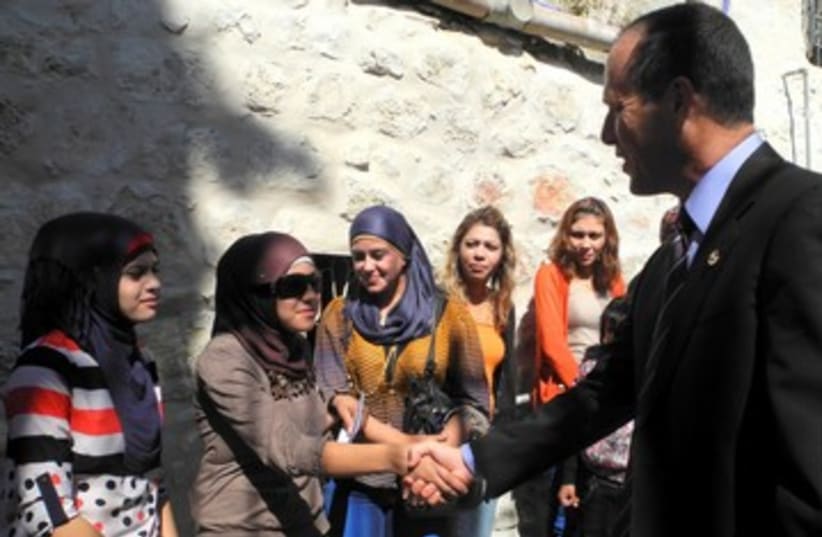
Mayor Barkat visits gypsy community in Old City for Eid al Adha holiday.
By MELANIE LIDMANMayor greets members of J'lem Gypsy community 390(photo credit: MELANIE LIDMAN)
The capital’s 2,000 Muslim Gypsies want to become Israeli citizens, Mukhtar Abed Salim told Jerusalem Mayor Nir Barkat on Sunday.Barkat visited the small and impoverished Gypsy population on Sunday to wish them happy holiday for the Id al-Adha festival.The Gypsies had celebrated the mayor’s 53rd birthday last week with a cake featuring Barkat’s face.The community lives in crowded, dilapidated apartments around the Lion’s Gate in the Old City. Some Gypsies, priced out of the Old City, live in the Shuafat refugee camp in the capital’s north. There is another small community in the Gaza Strip.The Gypsies are Muslim but do not identify as Arabs or Palestinians, Salim said. They have Jerusalem residency, but not citizenship, similar to the majority of east Jerusalem Arabs.“We love the state,” Salim said, explaining that the community wants greater integration into Israel and more municipal services.After they receive citizenship, they will decide whether to serve in the military, he said.Interior Ministry spokeswoman Sabine Hadad said members of the community must individually submit applications for citizenship.Jerusalem’s Gypsies trace their roots back 1,000 years to northern Iraq, where a powerful tribe known as the Bnei Murra lived. A bloody war with a neighboring tribe – according to legend, over the death of a beloved camel belonging to the daughter of the tribal chief – scattered the tribe across the world.Some went to Europe, converted to Christianity, and became the Roma Gypsies. Others traveled across the Middle East and became Muslim.Gypsies arrived in Jerusalem along with the Muslim conqueror Saladin in 1187, and fought against the Crusaders. The Gypsies stayed in the area, living in tents similar to the Beduin but as part of a separate tribe.The Gypsies lived on the slopes of the Mount of Olives for hundreds of years, in what today is part of the A-Suware neighborhood.Following the Six Day War, many Gypsies fled to Jordan. Others moved out of their tents into cramped apartments in the Old City. There are Gypsy populations in Jordan, Lebanon, Egypt, Syria, Yemen and Iraq.Salim explained that just as in Europe, Gypsies have been the object of discrimination and violence.The community does not have good relations with their Arab neighbors.“Al-Nawar!” which now means “dirt” or “cheap,” is an insult Arabs frequently yell at Gypsies, and has entered into colloquial language as a general curse word. Before 2006, only three Gypsy children out of the 2,000- strong community attended school.Many subsequently attended sporadically but left after bullying by their Arab schoolmates.Before the push in the past few years to keep Gypsy children in school, most children spent their days begging in the streets.“We didn’t depend on ourselves,” Salim said on Sunday. “We always waited for others to help us.”The community has remained impoverished. The most common occupation for men is to work in the city’s sanitation services.Women generally do not work, although this is slowly changing as some begin to pursue education.Unemployment is rampant, and most families live with eight or more children in one- or two-room apartments.In 2006, tour guide and teacher Ofra Regev reached out to the group to try to include them in tours of the Muslim Quarter. She was shocked by their poverty, and vowed to help them receive greater recognition from city hall. Now crowned with the title “mukhtarit” (female mukhtar), Regev says she has been adopted by the entire community.Relations with city hall improved dramatically over the past few years. Today, a municipal social worker works to ensure that children are enrolled and staying in school, and participating in afterschool activities through youth groups. A music program is encouraging children to learn traditional music and a women’s empowerment group is studying Hebrew.Now Salim and the rest of the community are trying to leverage their positive relationship with the mayor into an opportunity to improve their neighborhood. Salim wants to build an additional floor over his three-room apartment, where he lives with his wife and nine children, to serve as a reception hall for cultural events and for classes.Gypsy music, singing and dancing is alive in Jerusalem as well, and Salim said the community needs a space to perform in if they want to preserve their traditions.They also want a space to teach their children Dom, their language.Dom is similar to many European Gypsy dialects.Tourist groups from Israel and abroad are beginning to visit Salim’s home to learn more about the Gypsies, and he needs a place to meet with them, he said. Salim also eventually wants to build a girls’ and boys’ school for Dom children to strengthen their cultural pride.On Sunday, Barkat praised the community’s willingness to cooperate with authorities.“Your willingness to work with us, especially in education and improving the quality of life, means we are starting to improve, and it’s a joy to see,” he said. •
if(catID != 151){
var cont = `Take Israel home with the new Jerusalem Post Store