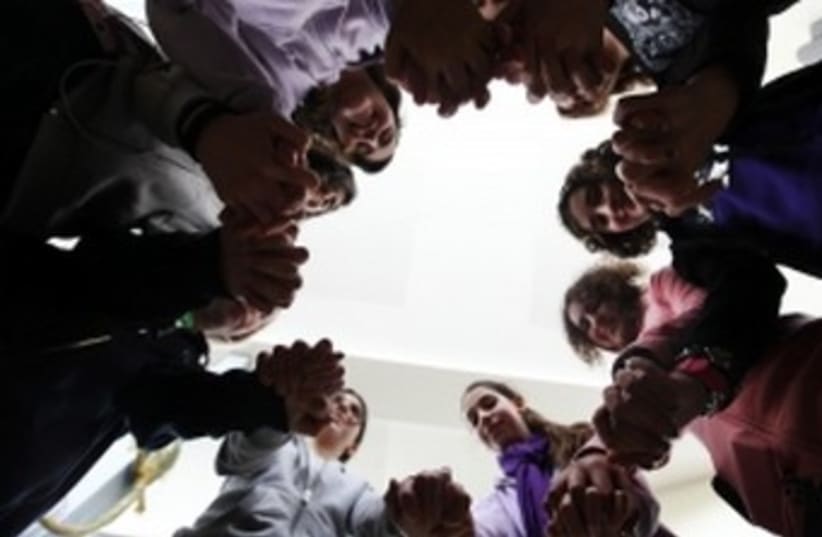
Jewish, Arab students learn to respect differences
Throughout Israel, few opportunities exist for meaningful interaction between Jews and Arabs.
By EETTA PRINCE-GIBSON / JTAStudents at Max Rayne Hand in Hand School DO NOT USE(photo credit: Kobi Gideon / Flash90)
The two seventh-grade girls walk together down the hall, their heads touching as they talk excitedly. Dana's dark auburn hair is pulled back in a ponytail. Waard's head is covered by a hijab, the traditional Arab headscarf, held with a fashionable pin.Dana is Jewish and lives in the German Colony, a few miles away. Waard is Muslim and lives in the nearby neighborhood of Beit Tzaffafa. Best friends since the first grade, they tell JTA that they were talking about Wednesday's upcoming school ceremony to mark Remembrance Day and Independence Day.Selected to read a poem by an Israeli poet, Dana is busy with rehearsals. Waard will not attend the ceremony, but instead will meet with the other Arab students to talk about the day’s meaning for them.Afterward, all the students, Arabs and Jews, together with their Arab and Jewish teachers, will join to discuss the significance of the day for them."It'll be Wednesday for both of us, but it doesn't mean the same thing to us," Dana explains. "One of my great-grandparents died in the War of Independence. And he was fighting people that Waard's great-grandparents probably knew. Maybe he killed some of them. And on Independence Day, I'll be happy because there's a Jewish state.""And I'll be sad because of the Nakba," Waard says, using the Arabic word for "catastrophe" to refer to the military loss and displacement that resulted from Israel's War of Independence in 1948."We're really OK with this," Dana says. "We're friends and it's chill.""You don't have to think the same to be friends," Waard adds.Dana and Waard are students at the Max Rayne Bilingual School in Jerusalem, a K-12 public school with some 530 students, part of the Hand in Hand nonprofit educational organization.Hand in Hand sponsors two more bilingual schools, one in the Wadi Ara valley in central Israel and one in the Galilee in the North. (Two additional bilingual schools in the country are not part of the Hand in Hand network.)Founded in 1998, the schools are funded by private contributions and grants from several international foundations, as well as standard public education allocations from the Education Ministry.Throughout Israel, few opportunities exist for meaningful interaction between Jews and Arabs; schools are almost completely segregated. Bilingual schools, such as this one, seek to foster coexistence through cross-cultural learning."Teaching two languages, nationalities and cultures, together with contradicting historical narratives, requires deep commitment and a sense of mission to meet the challenges," says Max Rayne principal Nadia Kinani, an Arab-Israeli from Nazareth who now lives in Jerusalem.The mission is especially challenging in the weeks that follow the Passover holiday. That’s when Israel marks, in rapid succession, Holocaust Remembrance Day, the Remembrance Day for fallen soldiers and Independence Day. In recent years, Arab-Israelis have been marking the Nakba on May 15."Pedagogically and ideologically, this is a difficult time," Kinani says. "But in truth, we prepare for these days all year in everything we do -- with our vision of equality and understanding, by teaching our children to ask questions, with our pedagogical methods, and by emphasizing that we can deal with differences in a respectful, nonjudgmental and nonviolent way."On Holocaust Remembrance Day, the entire school attends the same ceremony and stands at solemn attention as the sirens wail throughout the country to mark the day."In Arab schools, children learn about the Holocaust as history, but they do not understand what it meant and means for the Jewish people," Kinani explains. "We believe that all students, Arab and Jewish, should learn about the Holocaust. In an age-appropriate way, different for every grade, we teach them about racism, about genocide, about our moral responsibilities as human beings."Suha, an Arab-Israeli lawyer and mother of a sixth-grader, who preferred to give only her first name, sees the impact that joint programming can have. As a child, she says, “I was resentful of how the Jews seemed to always justify everything they do because of the Holocaust. Because my son goes to school here, I understand much more now. I don't always agree with the politics, but I understand and deeply respect the pain."Remembrance Day and Independence Day, however, are more difficult to teach and to observe.Click for special JPost features"These days are filled with symbols that have very different meanings for the two groups: victor and the vanquished, the Jews who won the war and the Arabs who lost the war,” Kinani says. “There is an emphasis on flying the flag and singing the national anthem, 'Hatikvah,' and this is problematic for Arabs because it excludes them and does not relate to their experiences."This is why, she explains, the Hand in Hand schools have devised the separate and then communal ceremonies that Dana and Waard describe. "We are not avoiding the differences. We are teaching our students to acknowledge and respect them," Kinani says.Esther Sivan, the director of a non-governmental organization promoting the rights of the disabled and the mother of two girls in elementary school, says she makes every effort to attend the ceremonies with her daughters."We recognize our differences and we recognize what we share. That is very honest and very powerful."Officially, the Education Ministry-supervised school does not observe the Nakba. The Nakba Law, passed last year, stipulates that the Finance Ministry may withhold or reduce budgets from government-funded bodies that observe the day.Israeli Arab parents, however, often take the initiative, organizing an after-school Nakba program, Kinani says.Many Israeli Jewish parents also attend, says Ron, whose child is in fifth grade and who also did want to give his full name."Going to a Nakba observance doesn't make me less of a Jew, an Israeli or a Zionist," he says. "My grandparents were Holocaust survivors. I love this country and I have fought in its wars and, sadly, my son will also probably have to go to the army when he finishes high school. But none of that prevents me from trying to understand a different point of view."Sivan says that initially she was concerned that the bilingual, bi-cultural education would in some way weaken her daughters' Jewish and Israeli identity."But in fact, the opposite has happened," she observes. "Because they have to learn and understand someone else's culture, they also have to learn and understand their own culture better."Mahmoud, the father of a ninth-grader, says that when he was a child in an Arab village in the North, “We were forced to celebrate Israel's Independence Day, to fly the Israeli flag and even to learn about the different units of the army. But my son is learning about his own culture and history, and that will make him a better Israeli."Kinani concludes, "Some people accuse us of living in a bubble. But I think that the rest of the world is in a bubble and we are living reality, because reality is that Jews and Arabs cannot avoid our differences and we cannot continue to avoid each other."
if(catID != 151){
var cont = `Take Israel home with the new Jerusalem Post Store