US Iraqi pullout whets Iranian appetite for trouble
Exporting turmoil, analysts say, may be the best way for Iran to distract from its internal problems, and throw sand in its rival's face.
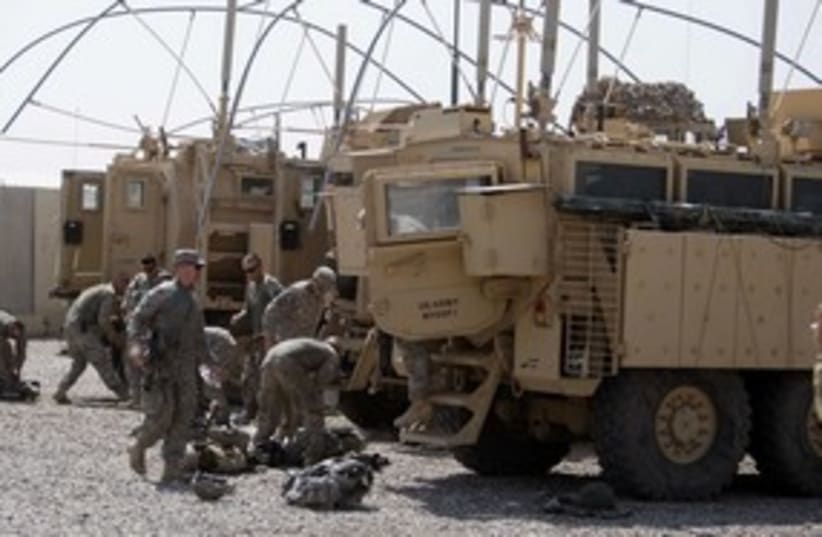
By ARIEH O’SULLIVAN / THE MEDIA LINEUS troops leaving Iraq_311(photo credit: REUTERS)
Even with stern warnings from Washington not to “miscalculate” as American troops begin their pullout from Iraq, Iran will be tempted to foment turmoil in the region, mainly as a diversion to its own internal problems, analysts say. American troops leave behind a volatile Iraq vulnerable to Iranian influence. Iraq’s Kurdish minority have already carved out a semi-autonomous region in the oil-rich north and Tehran may encourage the south, where the population shares Iran’s Shiite Islam. That would leave the Sunnis in control of a truncated state in the middle. RELATED:EU leaders threaten Iran and Syria with more sanctionsAshton: Nuclear talks with Iran could resume soon Iraqi Prime Minister Nuri Al-Maliki recently bemoaned the modern day consequences of the colonial division of the Middle East during the First World War by British and French diplomats Sir Mark Sykes and Francois George-Picot.“The Sykes-Picot Agreement divided us into states, and the premeditated Arab Spring, which is backed by foreign forces, is intended to divide these states into mini-states, so that the only effective large country in the region would be Israel…. Today everybody is saying that regime change – especially in Syria – does not serve anyone’s interest,” Al-Maliki told Hizbullah-run Al-Manar television. US President Barack Obama announced on Friday that nearly all American troops would be withdrawn from Iraq by the end of the year, ending a war begun in 2003 to overthrow Saddam Hussein. Ahead of the pullout, Secretary of State Hillary Clinton gave numerous interviews over the weekend that, far from signaling a reduced American presence in the region, implied US forces would now be freer operationally to act.
“No one should miscalculate America's resolve and commitment to helping support the Iraqi democracy. We have paid too high a price to give the Iraqis this chance. And I hope that Iran and no one else miscalculates that,” Clinton told CNN’s State of the Union.The Arab Spring and the withdrawal of US troops from Iraq ostensibly sidelines the anti-American and anti-Israel sentiments traditionally used to garner popular support in the Arab street as a diversion to domestic unrest. But facing waning regional influence, exacerbated by its inability to save its Shiite ally Syrian President Bashar Al-Assad from a bloody Sunni-led revolution, Tehran still hopes to use its resistance narrative to prevail. “Iran is facing challenges internally, in Syria and in the Gulf, and it aims to export its problems to the outside. The best way to solidify its regime and unite its forces is by an external threat. There’s no greater external threat than the US presence,” Sami al-Faraj, president of the Kuwait Center for Strategic Studies, told The Media Line.Al-Faraj said Teheran believes correctly that the Arab Spring protests are contagious and that the only way to keep them from reaching Iran is to export the problem to the outside by stirring up fights, like in Bahrain, Iraq and the eastern provinces of Saudi Arabia, where there are Shiite majorities have traditionally been subservient to Sunnis. “The Iranians want to create a crisis and they are desperate to set the stage for something really fantastic. They are looking for something really big,” Al-Faraj said. Iran's former president, Mohammad Khatami, recently warned the government of Mahmoud Ahmadinejad that the threats against Iran are real and that the stage is being set for an attack against Iran. He said the US accusations that Iran was behind a plot to assassinate the Saudi Arabian ambassador to Washington has heightened the possibility of a US military attack.“Our political officials should be careful not to give the US any pretext to target our security and territorial integrity,” Khatami told the opposition website Rahesabz.“I don’t think the US forces would be withdrawn to a level that would make it very weakened. They will position materiel all over the area. They will probably have a larger force over the horizon and will substitute large number numbers of troops with strategic capabilities such as naval forces. I assume that the US will maintain its capabilities outside of Iraqi soil,” said Zaki Shalom, a senior researcher on contemporary history at Ben-Gurion University in Israel.“Iran is instigating Shiite militias in Iraq to continue attacks against Americans and they are plotting to assassinate the Saudi Arabian ambassador to Washington. In the US there is an image of Iran as an offensive power in the region,” Shalom told The Media Line. US Defense Secretary Leon Panetta told reporters on Sunday that some 40,000 troops would remain in the region “along with a large number of troops in other countries as well, along with the fact that we have 100,000 troops in Afghanistan. We will always have a force that will be present and that will deal with any threats from Iran.”Nevertheless, Shalom said, Iran is engaging in a policy of brinkmanship and had a keen sense of never crossing red lines that would draw bold US actions.“Their assessment was that the Americans will not take action against Iran because they are concerned about the reaction against US troops in Iraq. But I don’t think [withdrawal] will give the Obama administration bigger maneuvering power to take measures against Iran, and the Iranians know this very well,” Shalom said.He said the US was caught up in presidential elections and the Europeans were bogged down in economic distress, further restricting Western action against the ayatollahs’ regime.“The Iranians are correct in assessing that they can go on with their offensive and provocative actions knowing the US will not take military action against them at least until the US elections are over,” he said. “The Obama administration would very much hesitate to take military action against Iran because it would likely cause chaos.”
if(catID != 151){
var cont = `Take Israel home with the new Jerusalem Post Store