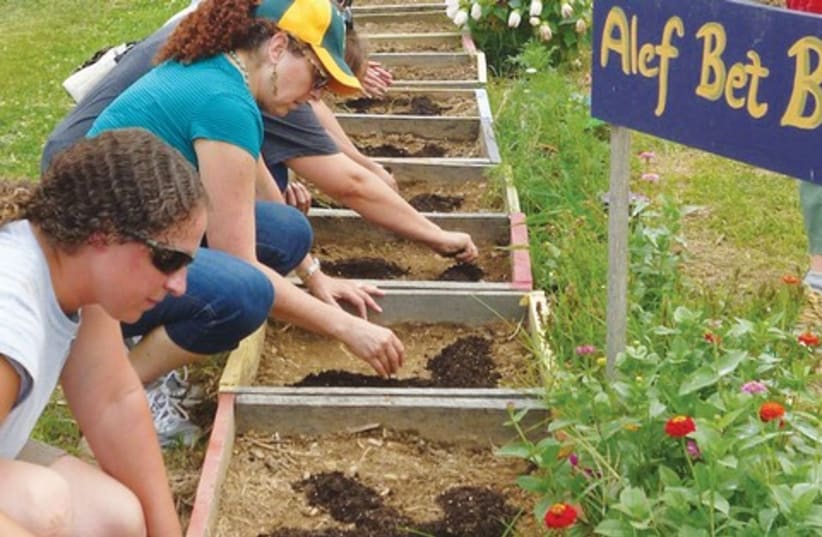
At Adamah and Pearlstone, farming with other Jews is a heimish – but definitely not Amish - experience.
By PAUL FOER / JNS.ORGJewish farming 521(photo credit: Paul Foer)
Nadav Slovin cultivates the fields of potatoes and other crops in the rural Litchfield Hills of northwestern Connecticut. As he moves between the rows, he could be mistaken for an Amish farmer, especially with his reddish beard and straw hat. Then again, maybe he looks more heimish than Amish – especially when you notice the tzitzit protruding from his pants and the kippa beneath his hat.The 22-year-old Slovin, raised in a Conservative Jewish home in Worcester, Massachusetts, is among a new breed of Jewish youth learning farming skills – as well as Jewish sensibilities and teachings – as a fellow with the Adamah Farm, a unit of the Isabella Freedman Center.On a blazing Friday afternoon this summer, about a dozen Adamah fellows joined in a circle in the shade to go over the week’s work and plan for Shabbat and Sunday, the annual farm day open to the public. They went off to the mikve, enjoying a tributary of the Housatonic River that served to irrigate not only the fields but also their souls.Separated from the women, the men stripped down to the suits given to them by nature, slid down a path to the refreshingly cool water and gathered in a deep bend of the river, immersing themselves completely.The river was perfect for a hot July afternoon. That same river, however, had flooded the previous summer, wreaking havoc in the fields around harvest time.Whatever the weather brings, the Adamah staff and fellows work together to produce food for their Community Supported Agriculture (CSA) members, who buy shares in the Adamah Farm produce.In addition to produce, they sell pickles, cheese, berry preserves and other items produced on the farm, and they also provide food for the kitchen of the Freedman Center, which hosts Jewish groups and conferences.Early one morning, Rachel Stern gathers eggs as if she were an old pro – the Goucher College senior did grow up on a small Vermont family farm. However, other than some Passover and Hanukka observances, mainly with her grandmother, she says, “Judaism played a very small role in my upbringing.” She began to explore and study Judaism in college and now majors in religion, which helps her find “more and more meaning in Judaism in my personal life.”“My decision to attend Adamah came out of my personal journey with religion and a craving to experience life in a Jewish community,” she says. “While I was there, my most exciting discovery was the incredible meaning to be within an intentional community that rests upon a spiritual foundation.”Slovin, who arrived at Adamah with a stronger Jewish background than Stern’s, was searching for a deeper relationship with what he calls “my source, myself and my surroundings.”“Connecting with the land, the physical source of my sustenance, is connecting with my Creator,” he says. “Working the soil, for me, has become play, a creative dance that magnifies Hashem’s [God’s] gifts.”But the summer at Adamah “was by no means Pleasantville,” Slovin says.“Conflict grew as profusely as the flowers of a cucumber plant,” he says. “Yet out of the flowers grew cucumbers, glorious relationships and learning experiences that taught me how I fit into a community, how I relate to Judaism compared to my peers, how I can improve upon myself in order to be a more appreciative and caring individual.Ultimately, learning how to be a more responsible, caring, humble person is learning how to be a better Jew. My experiences at Adamah have deepened my connections with my source, my self, and my surroundings.”ADAMAH’S DIRECTOR is Shamu Sadeh, the son of Hungarian Jews, who moved with his family from Washington to a rural area in Maryland, where they enjoyed fresh produce and milk and cheese from their goats. His mother is a weaver; and his father, a writer and horticulturalist, descends from Jews who farmed in Europe.Sadeh, his wife and children live near the farm, but he does much more than merely overseeing the farm. Adamah provides a setting for work, study and reflection for the fellows who come to participate in a three-month leadership-training program called the Adamah Jewish Environmental Fellowship.The program for Jewish adults ages 20 to 32 “integrates organic agriculture, farm-to-table living, Jewish learning, community building and spiritual practice.” Fellows work in the farm, the commercial kitchen and the goat pasture, and in the evenings they learn about Judaism and sustainability, building community and cultivating leadership skills.Adamah says it “connects people to their roots, to the land, to community, to Judaism and to themselves by providing educational programs to build a more sustainable world. Cultivating souls and soils, harvesting people and pickles.”They are not kidding about the pickles. On Adamah’s annual Farm Day, a group gleaned cucumbers from the fields to pickle them in small jars.On Farm Day, Jack Wertenteil and his two children, Pinny and Sara, all observant Jews, enjoyed pizza baked in an outdoor wood-fired oven while learning about a farm truck powered by vegetable oil, and they made pickles to take back home to New Jersey. Other friends and supporters enjoyed fresh fruits and vegetables and milked the goats.Jon Greenberg, an agronomist specializing in the study of plants and nature in Torah and Jewish tradition, led a Torah and Flora tour of the nearby farm fields and orchards, peppering his narration with Midrash and exegesis about the plants they encountered (see www.torahflora.org).Two weeks later, at the similarly Jewish-focused educational farm of the Pearlstone Center just northwest of Baltimore in Reisterstown, Maryland, Morris Panitz – a graduate of Adamah – was showing a group of Jewish educators how to make pickles so they could teach their young students when they returned home.Similar to Adamah’s mission, the Pearlstone farm says that it “embodies and inspires vibrant, healthy and sustainable living through experiential education grounded in Judaism, agriculture and ecology.” Pearlstone is not quite as rural and is more “upscale” than Adamah, but among its staff are graduates of the older and more established Adamah program.That afternoon, about 50 teachers were led past goats and into the fields and greenhouses to gather the evening meal.An hour later they returned with eggplants, tomatoes, peppers and other produce, splitting into groups to prepare Israeli salad, grilled vegetables and other dishes. One group stirred a pot of warming goat’s milk to make cheese seasoned with fresh herbs. Two huge pans of Israeli meatless shashlik, made with freshly gathered eggs, were brought out as the crowd gathered to enjoy a communal farm meal.So what’s more Jewish than Jewish food, especially pickles? At the Adamah and Pearlstone farms, growing, harvesting and enjoying pickles, vegetables and cheese with other Jews in an environmental, educational and spiritual setting makes those activities even more heimish – but definitely not Amish.
if(catID != 151){
var cont = `Take Israel home with the new Jerusalem Post Store