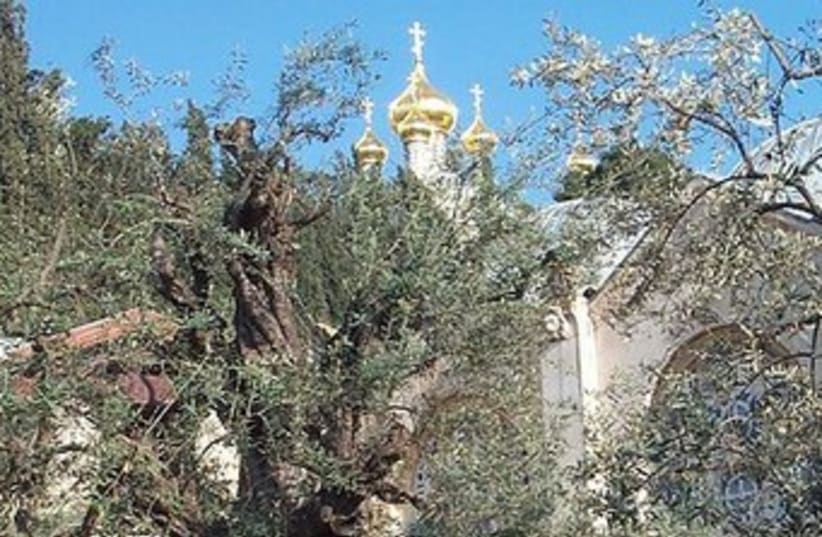
Olive trees in the Jerusalem garden at foot of Mount of Olives has been declared at least 900 years old.
By REUTERSGarden of Gethsemane 370(photo credit: Wikimedia Commons)
VATICAN CITY - Olive trees in the Jerusalem garden revered by Christians as the place where Jesus Christ prayed before he was crucified have been dated to at least 900 years old, a study released on Friday showed.The results of tests on trees in the Garden of Gethsemane have not settled the question of whether the gnarled trees are the very same which sheltered Jesus, where the Bible says he prayed and was later betrayed by Judas, because olive trees can grow back from roots after being cut down, researchers said."We cannot rule out the possibility that there was an intervention to rejuvenate them when they stopped being productive or dried out," Chief Researcher Professor Antonio Cimato said at a presentation of the results in Rome."But let me say: plants of greater age than our olives are not cited in the scientific literature. Our olives are among the oldest broad-leaved trees in the world," Cimato said.Carbon dating showed that samples taken from the oldest part of the trunks of three of the eight trees came from the years 1092, 1166 and 1198, according to the study by the National Research Council of Italy Trees and Timber Institute and academics from five Italian universities.The other five trees at Gethsemane - which means "oil press" in Aramaic, the language spoken by Jesus - could not be tested as they are so gnarled that their trunks have become hollowed out, with only newer growth remaining.Referred to several times in the New Testament, the grove is at the foot of the Mount of Olives in Jerusalem, an important site for the Christian, Jewish and Muslim faiths.Yet despite their great age, the study showed the trees were in excellent health and had not been affected by lead pollution in the area.Analysis of their DNA found they were planted from the same parent plant, possibly in an attempt to preserve a particular lineage, according to researchers.Pierbattista Pizzaballa, who is Custodian of the Holy Land at the Franciscan order that maintains the site, said this could show a deliberate attempt to pass on a precious heritage for future generations."The question is not if these are the very trees, but if this is the place referred to in the gospels. And it is the place, of that there is no doubt," said Pizzaballa
if(catID != 151){
var cont = `Take Israel home with the new Jerusalem Post Store