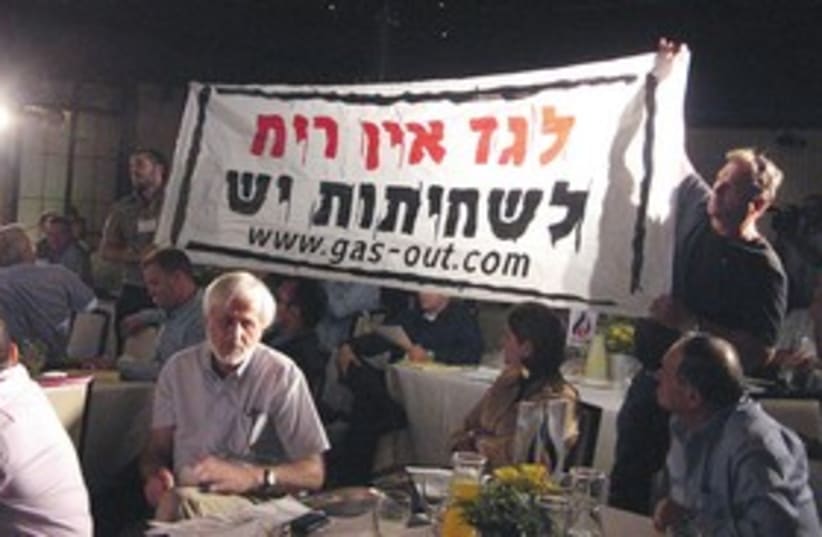
Hof Hacarmel villagers don't want plant near their homes.
By RON FRIEDMANGas 311(photo credit: Ron Friedman)
Exploiting the fact that all the energy industry bigwigs were under the same roof, residents from Hof Hacarmel villages repeatedly disrupted the proceedings of The Marker’s Israel Energy Conference in Ramat Gan on Tuesday to protest the planned construction of a natural gas processing plant near their homes.The protesters shouted out slogans and held up signs and banners as soon as Delek Energy CEO Gideon Tadmor took to the podium to speak about his company’s drilling activities off the northern coast.The proposed processing plant is meant to process natural gas from the Tamar deep sea reservoir, which is jointly owned by Delek and American energy giant Nobel Energy.An additional 150 residents demonstrated outside the hotel where the conference took place, holding up banners and handing out bumper stickers to passersby.The residents Dor, Nahsholim and Ein Ayala, expressed concerns that the plant would present a safety and security risk and urged the state regulators to force the companies to place the plant on an offshore barge, far away from people’s homes.The protesters accused the government of bowing to pressures from the companies and preferring economic interests over the residents’ welfare.The natural gas that was found at the Tamar site, 90 kilometers off the coast, in early 2009, is expected to supply Israel’s natural gas requirements for 20 years.National Infrastructures Minister Uzi Landau chided the protesters for their lack of civility and said that it was up to the National Planning and Construction Committee to decide on the location of the plant.“There are risks no matter where the plant will be. We recommended to the committee to place it in a place where it will cause minimal damage to the environment and pose as little a threat as possible to the residents,” said Landau.“It is in the national interest for the natural gas from Tamar to reach Israel by 2013 at the latest and building the barge at sea would make that impossible.I would also like to remind people that even if we do order an offshore barge, there will still be a need for a land-based receiving station, albeit a smaller one.”In his speech to the conference, Landau presented his ministry’s plans for the Israeli energy market, stating that natural gas was about to play a big role in Israel’s energy independence.Looking to the future, he said, his ministry was assembling a team to look into the introduction of nuclear energy into the local energy market.“We require clean energy.Israel is a small country and doesn’t have enough space for solar panel coverage,” he explained.“An 8,000-watt nuclear power plant is planned to be built near Shivta in the Negev.In the long term there is no escaping the need for building such a station to satisfy Israel’s growing electricity needs and for it to happen in 20 years, we have to start acting now,” said Landau.When eventually allowed to speak, Tadmor said the protesters suffered from the NIMBY (“Not In My Back Yard”) syndrome and had expressed unwillingness to meet with Delek executives to learn the truth about the proposed plant.Speaking about the partners’ recent announcement that they had found what potentially might be an enormous find in a new site called Leviatan, Tadmor said that if their expectations proved to be correct, “It was not only a macro economic contribution to the economy, but a possibility of changing Israel’s geopolitical status.”Experts have said that if the new find proves to be as large as the partners estimate, Israel could become an exporter of natural gas to Europe and Asia.Tadmor also addressed recent reports that the state would change the royalty rates it demanded for the rights to drill for natural gas, saying that such a move would be unjust towards the people who risked money to find the gas.He warned that if the state goes ahead with this, it would scare away potential investors in other sectors, too.“Nobody will invest in a place that projects inconstancy,” said Tadmor.Natural Gas Authority Director- General Shuki Stern said he and his team had done everything to make sure that the gas entering Israel would not endanger residents, no matter where the processing plant will be located.“We have demanded safety mechanisms that meet the highest standards,” he said.“The partners had to change their plans because of our requirements ,and had to find a solution to reducing the pressure of gas flowing in the pipes from 450 Bar to 120 Bar. The plant will not leak pollutants into the air and the soil.”
if(catID != 151){
var cont = `Take Israel home with the new Jerusalem Post Store