Health Ministry's annual report shows a decrease of working professionals in most vital health fields.
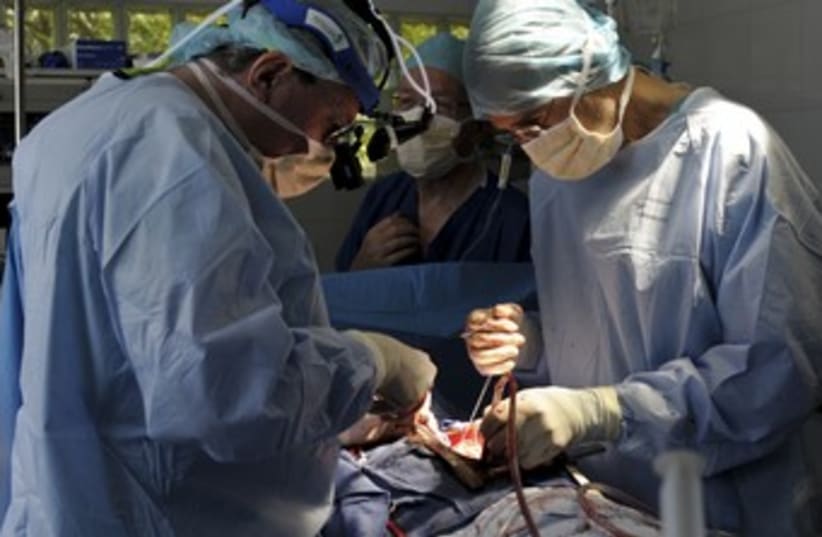
By JUDY SIEGEL-ITZKOVICHDoctors perform surgery (generic) R 370(photo credit: REUTERS/Swoan Parker)
Evidence that last week’s signing of a new wage contract was urgent is provided in the Health Ministry’s annual report on manpower in the health professions for 2011, which was released for publication on Thursday.The report showed a decrease of working professionals in most vital fields, from nurses and doctors to dentists and dental technicians – rates that are significantly lower than that of most Organization for Economic Cooperation and Development (OECD) countries.The data was based on license registration and data banks at the ministry and from the Central Bureau of Statistics.Regarding nurses, the rate of nursing school graduates is low, according to the report – just 12.1 per 100,000 residents, compared to the OECD average of 34.4. The rate of working nurses up to the age of 65 dropped to 5.95 per 100,000 last year, compared to 6.47 at the end of 2000 – an 8 percent decrease.Additionally, the number of new nurses in 2011 was only 941 compared to twice as many, 1,863, in 2002. Another sign of decline in manpower was that the share of nurses up to the age of 45 went down to 41% last year, compared to 53% in 2000. Nursing is the most common type of medical profession in the country.The rate of physicians also declined, but it was higher than the OECD average, with the number of doctors up to the age of 65 given as 3.33 per 1,000 residents at the end of 2011, compared to 3.71 a decade before. The number of Israeli physicians has consistently declined since doctors from the former Soviet Union who immigrated in the 1990s began to retire. As a result, more new medical school graduates here studied in Israel compared to previous years of high immigration.There were 35,000 doctors in the workforce last year, but only 26,000 were under the age of 65. About half of medical licenses are held by women, compared to a third in the 1980s. Women constitute a majority in the fields of family medicine, endocrinology, oncology, medical genetics, pediatric hematology, diagnostic radiology and anatomy.More than a quarter of obstetricians/ gynecologists are women – significantly more than a decade or two ago. But women constitute only 6% of neurosurgeons, 5% of orthopedic surgeons and 1% of cardiothoracic surgeons.Israeli doctors are older than their counterparts in the OECD. The rates of women doctors and of medical specialists (as opposed to general practitioners) showed an upward trend. Almost 60% of Israeli medical specialists were in internal medicine, pediatrics, ob/gyn, family medicine and psychiatry.The rate of Israeli dentists declined during the past decade, but it remains higher than the OECD average, with 1.05 dentists under age 65 per 1,000 people at the end of last year, compared to 1.12 in 2000.About one-third are women, 25% graduates of Israeli dental schools and the rest from Europe, the Americas, Jordan, Syria and Egypt.There are only 0.47 dental technicians of working age per 1,000 Israelis, compared to 0.52 in 2000; the number of pharmacist assistants has also declined.However, the numbers of psychologists, pharmacists, optometrists, physiotherapists and dietitians have increased over the past decade in Israel.Women now constitute 75% of all psychologists – a major demographic shift over the last few decades.
if(catID != 151){
var cont = `Take Israel home with the new Jerusalem Post Store