Health Ministry finds "solution" for evidence saved from 8,200 cases of suspected unnatural death.
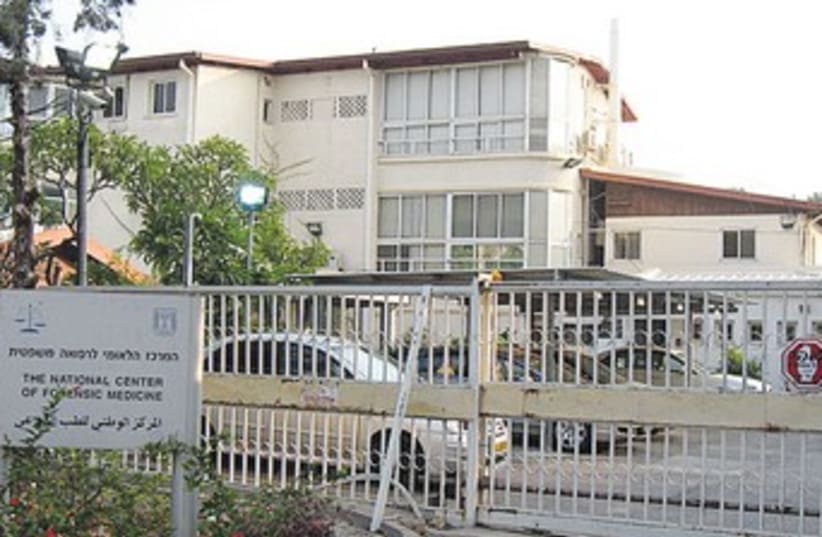
By JUDY SIEGEL-ITZKOVICHTel Aviv Institute for Forensic Medicine(photo credit: Wikimedia Commons)
The L. Greenberg Institute for Forensic Medicine in Tel Aviv hopes to end a lingering dispute with the families of approximately 8,200 people by burying the coin-sized human tissue that had previously been stored in the facility.The institute will instead save a microscopic amount of tissue from people who died an unnatural death between 2000 and 2011.The institute, owned by the Health Ministry, announced on Sunday that families could have the small pieces of tissue buried at no cost to them in a special collective grave at the Yarkon Cemetery (for Jews) or other sites for Muslims and Christians. If they insist on having the small remnants of tissue buried in the deceased person’s own grave, the families would have to cover the cost.The burial societies would charge about NIS 1,000 for this task, but if – in the process – the gravestone would be damaged, it could cost the family much more.Meir Broder, a senior lawyer in the ministry’s legal department – who appeared at Abu Kabir along with ministry director-general Prof. Ronni Gamzu and associate director- general Dr. Boaz Lev – said it was important to the ministry to end this sad controversy.“This campaign is being called Menuha Bekavod [Hebrew for “rest with honor”], and we want to bring it to a conclusion,” he said.The forensic medicine institute run by Prof. Yehuda Hiss has aroused controversy in the past, specifically when it was discovered by a Hebrew newspaper that tissues from internal organs of patients who died of unnatural causes would remain in storage if a legal judgement were called into question and a retrial were held.Then, from 2000, after the Segelson Committee sat to discuss the issue, it was agreed by the legal, medical, forensic and other authorities that taking a small bit of tissue the size of a 10-agora coin was enough to determine and prove the cause of death.When the tissue was stored at Abu Kabir, many families objected to this as well. After experts said a microscopicsized sample is sufficient to prove the cause of death, said Broder, the ministry and Abu Kabir agreed to go along.Regardless, Hiss and colleagues have long had the conservative view that larger samples are needed for absolutely definitive proof.Thus, between 2000 and 2011, almost no tissue samples were buried.“The Health Ministry couldn’t decide policy on this issue, as it would be regarded as interfering with evidence,” said Broder. “Some factors in the issue said the tissue should be kept permanently; others said it should be preserved for 20 years. But while a tiny minority of cases might not be resolved by a microscopic sample of a few microns being preserved on slides at the institute, the vast majority will, and we want the dead to have honor.”Most of the coin-sized samples were taken from bodies of victims of criminal action or terror attacks.According to Jewish law, body tissue from the deceased that is the size of a kezayit (a Talmudic unit of volume approximately equal to the size of an average olive) must be buried. Since the stored samples will be microscopic, they would not have to be buried according to Jewish law.When the families were surveyed, a third said they agreed to the coin-sized tissue samples being buried in a collective grave, but a third insisted that they be buried in their loved ones’ graves.Broder said only a tiny minority of the remains were from haredi or national religious people.Until the end of this week, a panel of professionals – lawyers, psychologists, social workers and clergymen – will man the ministry’s *5400 information hot line between 9 a.m. and 4 p.m. to discuss the campaign with the families.After that, if they leave a message, someone will call them back.“We are acting in full transparency,” said Broder. “I know some will still try to sue the state over this, but we want to bring the tissue samples to burial. We know that there is great sensitivity among Israelis about the burial of all human tissue.”But in the Knesset, three MKs reacted to the ministry announcement by insisting that families should not have to pay for burying their loved ones’ tissue in their own graves.United Torah Judaism MK Uri Maklev, Kadima MK Rachel Adatto and Shas MK Avraham Michaeli said that families must not be penalized for what the forensic institute has done.They called on MK David Rotem (Israel Beiteinu), head of the Knesset Constitution and Law Committee, to convene the panel for an urgent discussion of the decision.Maklev maintained that the decision “partially violates halacha” and proclaimed the coin-sized pieces of tissue as “body parts.”The haredi MK said that no tissue should remain in storage because of the “very rare fear” that there is not enough data in case of a reinvestigation or retrial.Adatto said that the families should not have to pay for reburial due to government ministry failures. Many of the families, she said, weren’t even aware that tissue samples had been taken.
if(catID != 151){
var cont = `Take Israel home with the new Jerusalem Post Store