The Jerusalem Post
Jpost search icon google-icon iphone
  Set as Homepage
Wed, Jun 19, 2013   11 Tammuz, 5773
newspapers magazines
 
    • Breaking News
    • Diplomacy & Politics
    • Defense
    • National
    • Mideast
    • Syria
    • Iran
    • World
    • Business
    • Sports
    • Health & Science
    • Environment
  • Video
  • Opinion
    • Columnists
    • Editorials
    • Op-Eds
    • Letters
  • Jewish World
  • Lifestyle
    • Arts & Culture
    • Food & Wine
    • Travel
  • Features
    • Insights & Features
    • Week in review
    • On the Web
    • Shalva Superheroes
    • Obama in Israel
  • Blogs
    • In the news
    • Judaism
    • From the Middle East
    • Lifestyle
    • Aliya
    • Science and Technology
  • JPost Apps
    • iPhone app
    • iPad app
    • Android app
    • Twitter
    • Facebook
    • RSS feeds
    • JPost Toolbar
    • JPost Newsletter
    • JPost Alert
  • Premium Zone
    • The Jerusalem Report
    • Magazine
    • Metro
    • In Jerusalem
    • ePaper
    • Expert Opinion
    • Q&A
    • Dash
    • Christian Edition
    • Ivrit
  • French
    • Politique & Social
    • Affaires Palestiniennes
    • Diplomatie & Monde
    • Art & Culture
    • Israel
  • Green Israel
JPost Learn Hebrew  
Advertise with us  
Nefesh Guided Aliyah  
Eldan  
AFMDA  
YTA  
Isram Group  
JPost Twitter  
JPost Facebook  
Classifieds  


Breaking News
 
 
  • JPost.com
  • Health & Science
 

Science-fiction brain technology to become reality

By JUDY SIEGEL-ITZKOVICH
06/21/2012 02:57
Tweet

Israeli and foreign researchers present developing technologies for the ill and disabled at the Presidential Conference.

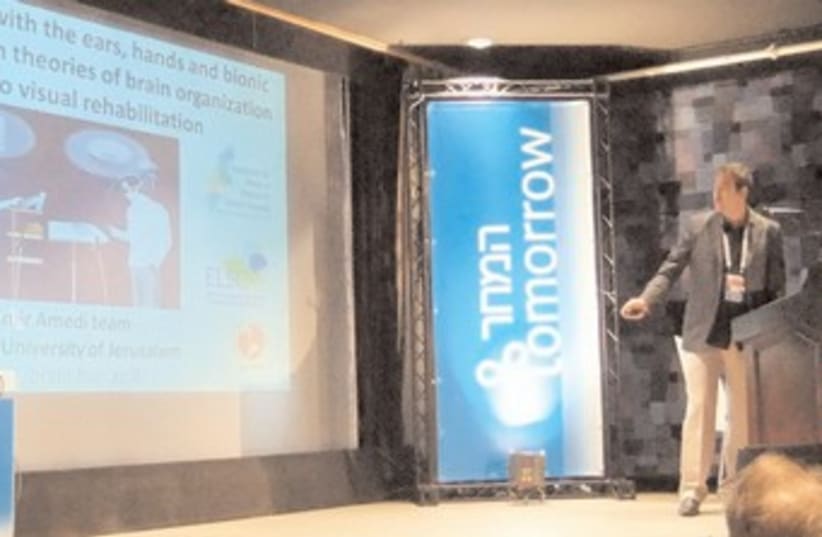
DR. AMIR AMEDI lectures at Presidential Conference
DR. AMIR AMEDI lectures at Presidential Conference Photo: judy siegel-itzkovich
Helping the blind to “see” with their acute sense of hearing, treating schizophrenia patients by electrically stimulating tissue deep in their head, and giving the sense of feeling to those without limbs are all part of the wave of the future in brain science.

Israeli and foreign researchers presented these developing technologies at the Presidential Conference in Jerusalem’s International Convention Center Wednesday.

Prof. Hagai Bergman of the Hebrew University’s neurobiology department described growing progress in Israel and the world in treating severe cases of Parkinson’s disease patients’ palsy by surgically implanting a battery-operated neurostimulator similar to a heart pacemaker to deliver electrical stimulation to specific parts of the brain that control movement.

This tiny device, available to suitable patients in the basket of health services, blocks the abnormal nerve signals that cause the severe shaking and other symptoms.

He noted that some 400 Israelis with debilitating Parkinson’s – out of some 100,000 people worldwide – had already undergone the surgery. But adjusting the system optimally was still not easy, Bergman said, and therefore the next step would be “closed-loop” deep brain stimulation (DBS) that would work automatically in reaction to brain function.

While Parkinson’s usually affects older people, schizophrenia – the most severe psychiatric disease – can affect young people as well.

The same DBS is expected to help victims of schizophrenia once studies on monkeys show the treatment is feasible and it progresses to clinical trials, Bergman said.

He noted that researchers must be very careful, as frontal lobotomies – a practice going back to the 19th century, in which people with psychiatric and developmental diseases would have parts of their brains removed surgically – had proved to be disastrous.

“Frontal lobotomies were a mistake and should not be tried again, but if a loved one had a severe mental disorder, I would think about closed-loop DBS, which would be reversible and adjustable, with minimal side effects. The technique is based on good animal research.”

Swiss cognitive neuroscientist Prof. Olaf Blanke, who has pioneered the neuroscientific study of human self-consciousness and subjectivity, discussed how illusions could be induced in the brain to give a person whose arm was amputated the feeling that it was still there and able to function.

Blanke showed how a person wearing computer-activated goggles could be given missing senses through illusion.

Techniques that surgeons use to perform operations by robot – i.e., moving robotic controls without the surgeon’s hands ever entering the patient’s body – can be adapted to have the patient operate artificial hands.

“It is so intuitive that the prosthesis of a missing upper arm becomes like part of the body,” said Blanke, adding that similar techniques enabled computer gamers to use avatars and feel they were actually moving through artificial scenery.

Moderator Prof. Idan Segev of the HU neurobiology department and Interdisciplinary Center for Neural Computation hypothesized that at some future Presidential Conference, lecturers could remain abroad and yet physically appear to be in Jerusalem, speaking and answering questions through highly sophisticated videoconferencing.

Dr. Amir Amedi of HU’s Safra Brain Research Center showed how blind-from-birth people could be taught to interpret sound signals even as facial expressions that they could never see.

“We were always told the brain is a sensory-specific machine with a visual or auditory cortex, thus implying that specific senses cannot be restored” even if the physical problem were repaired. But now, brain scientists believe there is a different organization of the brain, which is flexible and could adapt. The brain, he explained, can see things that aren’t there.

“Maybe we can help blind people who would hear sounds or be touched, causing the brain to create images as if they were seen. Already, training the blind for 40 to 70 hours can make it possible for them to ‘feel’ facial expressions from sounds and ‘rewire’ the brain,” Amedi said.

Nonetheless, Weizmann Institute of Science robotics expert Prof. Shimon Ullman, who discussed artificial intelligence, cautioned that there were dangers to the “superpowers” that could result from brain research.

“One day, we could ‘look into’ brains and know what people are thinking,” he said. “This could lead to the invasion of privacy. These ethical issues must be discussed and be brought out into the open.”
  • Send
  • Large
  • Small
  • Print
  • Share
This article is by :
Judy Siegel-Itzkovich
Recent stories:
  • 'Dementia will be bigger world plague th...
  • Gamzu pledges more doctors and nurses in...
  • Cancer researcher lauds ruling against g...
  • German willing to consider fortification...
Most Viewed in
1
Gamzu pledges more doctors and nurses in public system
2
Food supplements fight degenerative brain disorders
3
German willing to consider fortification of foods
4
Jewish kidney donation saves Palestinian boy
JPost Community
Tweet
Health Disabled Ill Neuroscience Brain Science
Tweets about "#jpost"
Share this article
Tweet
Share
Send
Your comment must be approved by a moderator before being published on JPost.com. Disqus users can post comments automatically.

Comments must adhere to our Talkback policy. If you believe that a comment has breached the Talkback policy, please press the flag icon to bring it to the attention of our moderation team.
JPost Services
conferenceConference
newsletterNewsletter
iphoneMobile Apps
kotelcamKotel Cam
kolboJPost Alert
premiumPremium
JPost TV News  
Mobile Apps  
Bank Hapoalim  
Meir Panim  
Israel Law Center  
Inbal Hotel Jerusale  
Meier on Rothschild  
Weizmann Institute o  
JPost Premium Zone  
JPost kotel Camera  
         
 
Israel Focus
JPost TV News
Watch Now!  
Donate to Save Lives in Israel
 
Israel Law Center
The ultimate Mission to Israel, October 21 – 28, 2013 Register now!  
Nefesh B'Nefesh Guided Aliyah
Already living in Israel? Enjoy the Benefits of Aliyah!  
One year International MBA
in English, Bar-Ilan University, Israel – Open House July 9, 2013, 17:30  
Give "Freedom" this Passover
to needy Israeli families. Donate now  
YTA – A Yeshiva in Israel…
in English. Come Join Us  
War Threatens
Protect the People of Northern Israel  
Bank Hapoalim
Israeli's number one bank  
Jerusalem Post Lite
Lite Edition of the Jerusalem Post for English improvement  
Learn Hebrew with us
Get 10 minutes free personal coaching in Hebrew through phone or Skype  
JPost newspapers
Sign up for the JPost newspapers and receive one month free subscription  
Kosher English Magazine
English language weekly magazine - especially for religious people  
JReport Kindle Edition
Now you can get the Jerusalem Report directly to your Kindle  
JPost Premium Edition
The very best articles are available only in our Premium edition  
Lifestyle Magazine
 
 
Real Estate
Meier on Rothschild
Tel Aviv's Most Prestigious Address  
Don't Look For a House!
In Israel, our website will do it for you!  
 
Travel
Tourism Magazine
June 2013  
The Inbal Jerusalem Hotel
Hot summer deal, order now!  
Eldan Rent a Car
20% off all Car Rental Reservations in Israel  
Hertz Car Rental
Special Online Discounts!  
The King David Jerusalem Hotel
One of the world's truly iconic hotels, and a Jerusalem landmark  


Sites Of Interest:

Jerusalem Hotels
KKL-JNF
Poalim Online
BreitBart.com
Our Friends
Jerusalem Attractions
Jerusalem Tours
itraveljerusalem.com

JPost sites:

Learn Hebrew
The Jerusalem Report
Our Magazines
JPost Edition Francaise
Green Israel
Christian World
Jerusalem Post Lite

Services:

JPost Mobile Apps
JPost Premium
JPost Newsletter
JPost Toolbar
JPost News Ticker
JPost RSS feeds
JPost Archives
JPost Alert
JPost Kotel Cam

JPost Conferences:

NYC Conference
Diplomatic Conference

Information:

About Us
Feedback
Staff E-mails
Copyright
Sitemap
News Partners
Advertise with Us
Statistics
Ad Specs
Terms Of Service
Jpost.com, the online edition of the Jerusalem Post Newspaper - the most read and best-selling English-language newspaper in Israel. For analysis and opinion from Israel, the Jewish World and the Middle East. Jpost.com offers expert and in-depth reporting from Israel, the Jewish World and the Middle East, including diplomacy and defense, the Palestinian-Israeli conflict, the Arab Spring, the Mideast peace process, politics in Israel, life in Jerusalem, Israel's international affairs, Iran and its nuclear program, Syria and the Syrian civil war, Lebanon, the Palestinian Authority, the West Bank and Gaza Strip, Israel's world of business and finance, and Jewish life in Israel and the Diaspora.
 
About Us | Advertise with Us | Subscribe | Premium | Newsletter | RSS | Contact Us
 
All rights reserved © The Jerusalem Post 1995 - 2012