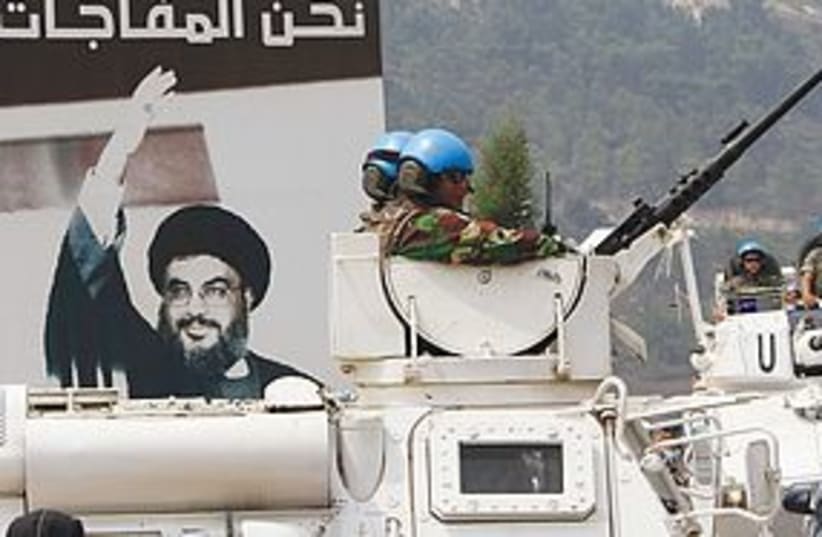
By DAVID SCHENKER, ANDREW J. TABLER, JEFFREY WHlebanon unifil nasrallah 311(photo credit: AP)
On Tuesday, Lebanese soldiers opened fire on an IDF unit removing a tree near the border security fence. In the resulting fighting, a senior IDF officer, two Lebanese soldiers, and a Lebanese journalist were killed, making the clash the most intense military engagement in the north since the 2006 war between Israel and Hizbullah.The spike in border tension coincides with increased concerns about a possible return to sectarian violence in Lebanon. Spurred by reports that the tribunal investigating the 2005 murder of former premier Rafik Hariri will soon indict Hizbullah officials, these concerns prompted an unprecedented joint visit to Beirut a week ago by Saudi Arabia’s King Abdullah and Syrian President Bashar Asad. Saad Hariri – Rafik’s son and current prime minister – praised the visit for bringing “considerable stability to the country.”Despite this optimistic pronouncement, with the border heating up and murder indictments pending, tensions remain high. Also in the background is Iran – Hizbullah’s main supporter, Syria’s ally, and Saudi Arabia’s regional rival.Contradictory accounts have emerged about the border skirmish. Israel said that it informed the UN Interim Force in Lebanon of its intention to remove the tree. Located beyond the security fence adjacent to Kibbutz Misgav Am, the tree was nevertheless on the Israeli side of the internationally recognized Blue Line, the border with Lebanon. When Israel began clearing the tree several hours after submitting the request, Lebanese forces called on the Israeli forces to withdraw.When they refused, Lebanese snipers opened fire, killing battalion commander Lt.-Col. (res.) Dov Harari, who was standing 180 meters inside Israeli territory. Israel responded with light arms fire followed by a helicopter attack on the battalion command center at Taybeh, killing two Lebanese soldiers and a journalist from the pro-Hizbullah Al-Akhbar newspaper.Lebanon claims that it asked Israel to delay the removal process for 24 hours. According to Beirut, when Israeli personnel began removing the tree three hours later, Lebanese forces shouted for them to stop and fired warning shots, to which Israeli forces responded with light arms fire and artillery.The incident is under investigation by UNIFIL and the IDF. So far, the former inquiry has confirmed that Israel precoordinated the tree removal with UNIFIL personnel, who passed the information on to the Lebanese Armed Forces. UNIFIL has also confirmed that the incident took place inside the Blue Bine, on Israeli territory. Meanwhile, the United States has urged both sides to exercise “maximum restraint to avoid an escalation and maintain the cease-fire that is now in place.”Although the incident is the most significant clash between Israel and Lebanon since the Second Lebanon War in 2006, it is not without precedent. In 2007, the Lebanese Armed Forces opened fire on an IDF bulldozer that had crossed the security fence to remove debris south of the Blue Line. The operation had been coordinated with UNIFIL but rejected by the LAF, which fired warning shots at the bulldozer; Israel responded with a single tank round. An IDF soldier was shot dead on the same stretch of road in 2003, reportedly by a Hizbullah sniper.Tuesday’s incident unfolded amid spiraling tensions and a war of words between Israel, Hizbullah and Damascus regarding Syria’s reported transfers of Scud and M600 long-range missiles to Hizbullah. Incidents in Lebanon related to the Hariri tribunal and Hizbullah’s growing influence have only exacerbated these tensions.In the aftermath of the February 2005 Hariri assassination in Beirut, the UN established an International Independent Investigation Commission, which quickly implicated Syria in the killing. More recently, however, the commission and its prosecutorial arm, the Special Tribunal for Lebanon, have focused on Hizbullah’s alleged role.Several media reports since 2009 have confirmed the organization’s involvement, with some sources implicating senior Hizbullah official Mustafa Badreddine, brotherin- law of former top commander Imad Mughniyah.Recent reports assert that between two and six Hizbullah members will be indicted this year.The prospect that the Special Tribunal will accuse Shi’ites of assassinating the leader of Lebanon’s Sunni community has fueled concerns of a return to sectarian violence. Indeed, given the indictment forecasts, it is not difficult to imagine Sunni retaliation against Shi’ite targets similar to the 2006 Samarra mosque bombing in Iraq, which sparked a cycle of bloodshed. Apparently, the prospect of such fighting – in which Hizbullah-led Shi’ites would have the upper hand against Saudi Arabia’s Sunni allies in Lebanon – prompted King Abdullah’s intervention.Although Asad accompanied Abdullah, Syria’s calculation behind the visit was no doubt different. Damascus sees increased tension next door as an opportunity to reestablish itself as the guardian of stability in Lebanon – a situation that many in the region, if not in Washington, appear resigned to accepting.Asad described the visit as “excellent” and, in a speech a few days later at Syria’s Army Day celebrations, said that “the specter of real peace in the region is disappearing, and the possibility of war is increasing.”Another outside actor that should be mentioned is Qatar, which so often seems to play deliberate diplomatic games against Saudi Arabia. Last weekend, for example, Qatari leader Sheikh Hamad bin Khalifa al-Thani visited southern Lebanon.On July 22, Hizbullah secretary-general Hassan Nasrallah held a press conference in response to rumors of pending indictments against members of the group.According to him, a “great scheme” was “targeting the resistance, Lebanon and the region” via the Special Tribunal.Not only was the five-year investigation politically biased, he claimed, but it “brought along false witnesses” and never even considered the possibility that the murder was carried out by Israel, which had “the motive, the capabilities, the control and the interest” to kill Hariri.Alleged Israeli involvement in the assassination has been a focus of Nasrallah’s remarks in recent months, as he has sought to undermine the Special Tribunal and deflect pressure from Hizbullah. During a speech on July 16, for example, he described the Special Tribunal as an “Israeli project” targeting the resistance and creating internal divisions in Lebanon by fabricating a Hizbullah connection to the murder.According to Special Tribunal sources, highly advanced telecommunications analysis will form the basis of indictments. Unsurprisingly, Nasrallah has begun to focus on the credibility of this data, which he says has been manipulated by Israeli spies in the Lebanese telecommunications system. Over the past year, more than 70 alleged Israeli spies have been arrested in Lebanon, including five senior officers in Lebanese telecom firms, most recently a technician at Alfa, a cellphone provider.Nasrallah’s accusations are intended to raise doubts about some of the Special Tribunal’s most compelling technical evidence. Although Hizbullah claims may not dissuade the tribunal from proceeding with indictments, they could undermine domestic support for the process.At least for the short term, peace appears to have returned to the area. The incident is considered over, and the IDF is returning to normal border operations.But any sense of “business as usual” will be absent; in the view of the Israeli military, the Lebanese Armed Forces (or at least its local units) have demonstrated that they are unpredictable.Israel will be prepared to respond with substantial force in the event of further incidents. In completing the brush clearing operation on Wednesday, the IDF deployed strong armored and infantry forces to cover the action, serving as a deterrent to any further LAF action and a signal of what will happen if there is another incident.A potential complication for the United States is that the LAF is supplied with American equipment. Future supplies could be jeopardized if, for example, the LAF is judged to be working closely with Hizbullah.In any case, history shows that events happen fast on the border. As in 2006, a routine activity escalated into a serious clash, although in this case escalation was controlled. Yet the situation could have evolved very differently if Hizbullah had become directly involved, the IDF had taken more casualties, or the LAF had not backed down.This event must also be placed in the context of increasing political tensions within Lebanon and the growing potential for a Hizbullah-Israel conflict. Although it has been relatively quiet for four years, the border is becoming an increasingly dangerous place. This article originally appeared on the The Washington Institute for Near East Policy’s Web site (www.washingtoninstitute.org). David Schenker is the Aufzien fellow and director of the Program on Arab Politics at The Washington Institute for Near East Policy. Andrew J. Tabler is a Next Generation fellow at the institute. Jeffrey White is a defense fellow at the institute.
if(catID != 151){
var cont = `Take Israel home with the new Jerusalem Post Store