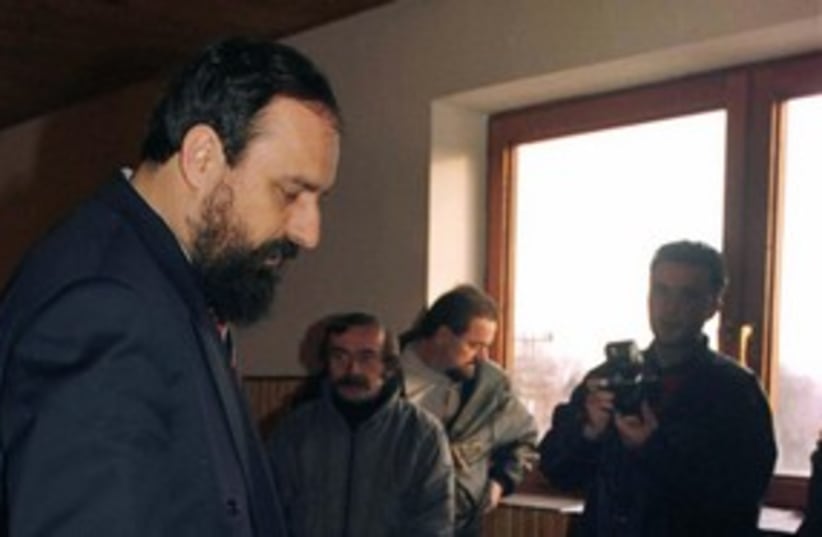
Hadzic is charged with 14 counts of war crimes, crimes against humanity: torture, murder of hundreds of Croat and other non-Serb civilians.
By REUTERSGoran Hadzic 311 R(photo credit: REUTERS)
THE HAGUE - Serbia's last major war crimes suspect refused to enter a plea on charges over the 1991-1995 Croatian war when he made a brief first appearance at the UN's Yugoslavia tribunal on Monday.The arrest of Goran Hadzic, 52, and his transfer to The Hague last week were a symbolic moment for both Serbia and the Balkans region, ending an 18-year manhunt to detain all 161 suspects indicted by the Yugoslavia war crimes court.RELATED:Serbia arrests its last Croatian Serb war crimes fugitive The European Union has insisted that Serbia arrest all wanted war criminals before it grants candidate status for membership. It is due to issue a progress report in October."Mr Hadzic is not going to enter a plea today. He is going to avail himself of the rights granted to him," Hadzic's duty counsel Vladimir Petrovic told the court.Hadzic is charged with 14 counts of war crimes and crimes against humanity. These include the extermination, torture, murder and willful killing of hundreds of Croat and other non-Serb civilians -- in particular, 264 hospital patients who were killed in Vukovar in 1991.In the hearing that lasted just under 15 minutes, Judge O-Gon Kwon said that a second arraignment hearing would be scheduled within 30 days as Hadzic had not entered a plea.Suspects at the International Criminal Tribunal for the former Yugoslavia have the right to delay entering a plea for up to 30 days. But if they then still refuse to enter one, the court may enter a plea of not guilty on their behalf.Flanked by four guards, Hadzic looked tired as he appeared in court with a greying moustache and facial hair, but shorn of the long black beard he sported during the Balkan wars.Hadzic was on the run for seven years, outlasting the better known indicted war criminal from the 1990s breakup of Yugoslavia, Bosnian Serb commander Ratko Mladic.At least 130,000 people were killed as the Yugoslav federation was torn apart in wars between Serbs, Croats, Muslims and Albanians during the 1990s.Wearing a dark suit, Hadzic declined to hear the indictment read aloud to him, but was otherwise co-operative and there were no signs of similar defiance shown by Mladic who dismissed in June the charges against him as obnoxious and monstrous.The court went into private session for a couple of minutes for Hadzic's lawyer to ask a question. When the public session resumed soon after, judge Kwon adjourned the hearing.Serbian security officials arrested Hadzic about 65 km north of Belgrade last week. He was allowed a visit from his family before his transfer to The Hague on Friday.Few Serbs lamented Hadzic's departure, in contrast to the public reaction to the arrest of Mladic in May and of Bosnian Serb wartime political chief Radovan Karadzic three years ago.
if(catID != 151){
var cont = `Take Israel home with the new Jerusalem Post Store