German trial shows al-Qaida targeted Europe economy
Al-Qaida assigned Siddiqui, Makanesi with “destroying the financial and economic systems of Europe.”
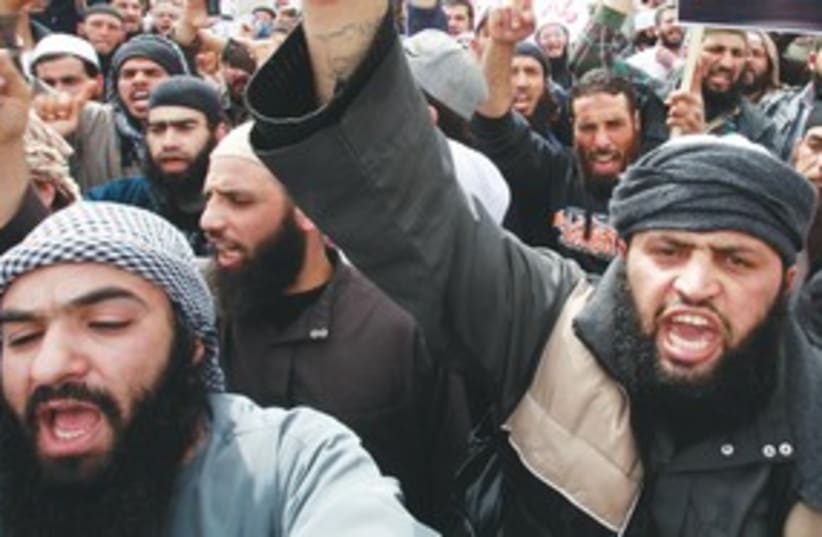
By BENJAMIN WEINTHAL, JPOST CORRESPONDENTIslamist rally in Amman, Jordan 311 (R)(photo credit: Reuters)
KOBLENZ, Germany – The third week of hearings to determine if Ahmad Wali Siddiqui, a German-Afghani, participated as a member of the terror groups al-Qaeda and the Islamic Movement of Uzbekistan unfolded on Monday and Tuesday. The proceedings shed light on planned attacks to decimate and undermine Europe’s economy in the fall of 2010 and strong ties between Iran and senior al- Qaida officials.Convicted German Islamist Rami Makanesi appeared on Monday at the trial, but refused to testify about his role in terror activities in Pakistan and Afghanistan, as well as slated bombing plans in Europe. A Frankfurt court convicted the broad shouldered and stocky Makanesi last year for his membership in al-Qaeda, and sentenced him to nearly five years in prison.According to a federal prosecutor at the trial, Makanesi “was the only source of information” about the campaign to destroy Europe’s economic infrastructure in 2010.Al-Qaida assigned Siddiqui and Makanesi to return to Europe with the aim of “destroying the financial and economic systems of Europe,” according to testimony at the hearing on Tuesday. The proceeding on Tuesday revealed a window into al-Qaida’s strategy to drain Germany’s economy of resources. Testifying on Tuesday, a federal prosecutor, who interrogated Makanesi, said the terror group sought to increase security measures to “damage the economy.”In 2010, the Germany Interior Ministry ordered high-security policies and actions to protect government buildings, including the Reichstag, to prevent bomb attacks believed to be connected with al-Qaida.The information regarding planned attacks in Germany and Europe was culled from the “investigatory phase” after Makanesi’s arrest in Pakistan in 2010. Makanesi and Siddiqui were part of the notorious Hamburg cell number two that departed Germany in 2009 to fight American and Pakistani forces.The first Hamburg cell staged the 9/11 attacks, resulting in the murders of roughly 3,000 people in the US.Makanesi invoked his right under German law to not testify, largely because his fresh testimony could expose the German-Syrian citizen to new criminal proceedings. He transported 20 to 30 anti-aircraft devices up a mountain in Pakistan to fire against advancing Pakistani military forces in 2009. After his capture in 2010, he issued exhaustive confessions to the German authorities about his role in Iran and activities in Pakistan and Afghanistan.According to testimony from the prominent terrorism and Islam expert, Dr. Guido Steinberg, who is a researcher with the Berlin-based Middle East and North Africa division of the German Institute for International Security Affairs, there are three layers to the Hamburg 9/11 al-Qaida cell.The first layer is the direct participants.The second group revolves around the core group containing the direct actors. And the third tier is the Islamists who circulate on the outskirts of the other groups.The six days of hearing have thus far revealed fresh evidence of the role of radical German Islamists in Iran. The popular website The Long War Journal has long documented the links between al-Qaida and Tehran. According to reports in the LWJ, Iran’s regime has tolerated widespread movement of high-level al-Qaida figures between Iran and Pakistan, and provided a refuge for members of the Sunni-based al-Qaida terror network. In a series of articles written in late 2011 and early 2012, the LWJ noted “Leaders of German al- Qaida living in Iran” and cited a US bounty for the capture of Yasin al Suri.As the key architect of financing for al- Qaida, al Suri, who is also known as Ezedin Abdel Aziz Khalil, met with members of the German Islamic group, including Makanesi and a fellow Jihadist from Hamburg, Namaan Meziche.In late December, the US State Department issued a $10 million dollar reward for al Suri’s capture or information resulting in his arrest. Writing in the IHS Jane’s military magazine, Steinberg noted that Makanesi met a top al-Qaida operative known as Yassin al-Suri in February 2010. Steinberg wrote that Suri asked Makanesi to “accompany him to Iran.” He added that Makanesi said that Suri “was responsible for funneling money and recruits via Iran and that he was known to cooperate with the Iranian government.”The revelations at the Koblenz trial have contributed to debunking the notion that Shi’ite-based Iran refuses to cooperate with Sunni terror groups.
if(catID != 151){
var cont = `Take Israel home with the new Jerusalem Post Store