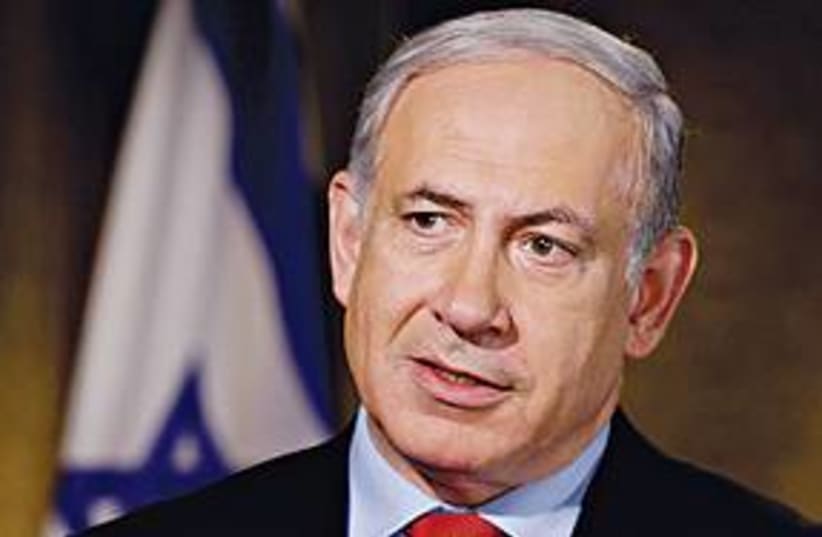
Netanyahu says an agreement with the Palestinians could take a year.
By HERB KEINONBibi worried 311(photo credit: AP)
While Prime Minister Binyamin Netanyahu said Thursday that he believed an agreement with the Palestinians could be reached within a year, he told Fox News Sunday that it would take considerably longer to implement that agreement.“I think there can be a solution [by 2012],” Netanyahu said in the interview Sunday.RELATED:PM to ask Mubarak for help with PAObama to PA: Start direct talksPA wants guarantees for direct talks“It may be implemented over time, because time is an important factor of getting the solution, both in terms of security arrangements and other things that would be difficult if they’re not allowed to take place over time.”According to government sources, Netanyahu believes that time will be an important component in judging the efficacy of certain security measures that will have to be put into place.For instance, Netanyahu has said that any agreement would have to include an Israeli security presence on the eastern border of a future Palestinian state, to ensure that weapons are not smuggled in. That arrangement, according to this way of thinking, could later be altered if certain procedures that were put into place proved themselves over a period of time.Netanyahu, in a speech Thursday to the Council on Foreign Relations in New York, elaborated on this theme.“I think the most important thing is to, first, try to define a clear vision of peace where people see the benefits of what it is they’re getting,” Netanyahu said.“The second thing, I think, is to introduce a very important dimension for the implementation of this peace agreement, and that is the dimension of time,” he said. “Time is a crucial element both for security and for other critical elements of a solution. It has – it’s a great facilitator of change. And if you build in a time factor to any type of solution that we have, I think it would help enormously. But the rest I’ll leave to the negotiations that I intend to have with [Palestinian Authority] President [Mahmoud] Abbas.”During the questions that followed that speech, Netanyahu said he believed an agreement could be reached within a year.Abbas, in the meantime, was not giving any indication that he would be quickly jumping into direct negotiations, despite clear signals from US President Barack Obama that the US wanted to see direct talks begin now.Abbas said in a speech late Saturday that he had no incentive to resume direct talks, and that direct negotiations now would be “pointless.”“We have presented our vision and thoughts and said that if progress is made, we will move to direct talks, but that if no progress is made, it [direct negotiations] will be futile,” Abbas said.“If they [the Israelis] say, ‘Come and let’s start negotiations from zero,’ that is futile and pointless,” Abbas added.Netanyahu has made it clear that, despite PA demands, he has no intention of restarting direct negotiations from the place where former prime minister Ehud Olmert and Abbas left off in late 2008.Netanyahu, briefing Sunday’s cabinet meeting on his recent trip to the US, reiterated what he said repeatedly while in the US – that he wanted to start the direct talks immediately.The prime minister said he had walked away from the meeting with Obama with the impression that on the US side there was also the “recognition that we must proceed to direct talks in order to advance the peace process.”“I gained the impression that the president is also attentive to the State of Israel’s special security needs,” he added. “On these issues, we are working in concert. We hope that the PAwill accede to the call to begin direct talks at soon as possible.”He also told the cabinet that the Israel-US alliance “is stable and strong.It has the support of the American administration and people. My visit to the US last week gave tangible expression to the strength and durability of this unbreakable bond.”Netanyahu said in the interview Sunday that the question of Jerusalem would be one of the issues discussed during the direct negotiations with the Palestinians.Ways of moving to direct talks are expected to be high on the agenda when Netanyahu goes to Cairo Tuesday for a meeting with Egyptian President Hosni Mubarak, their fifth meeting in a year.Obama, in his meeting with Netanyahu last week in Washington, made clear that he would like to see Israel transfer more of the West Bank to Palestinian security control.Netanyahu, for his part, said during an ABC interview during his trip to the US that, regarding concrete steps that could be taken to encourage the Palestinians to enter direct talks, he would be willing to take measures such as “additional easing of movements” and joining the Palestinians in some “economic projects.”Defense Minister Ehud Barak said at the cabinet meeting that Netanyahu’s meetings in the US were “very important.”Barak said that only diplomatic momentum and direct negotiations dealing with all the core issues, while ensuring Israel’s security interests, could stop the diplomatic siege on Israel and efforts at delegitimization.Regarding Israel’s isolation, its ambassador to the UN said Sunday that the country’s current situation in the UN was reminiscent of the situation in 1975 when the world body passed the resolution equating Zionism with racism.“Our situation in recent months – in fact, from the time when I took up this position [in 2008] – is not getting better, and there are those who compare it to the days when Zionism was equated with racism in 1975, a resolution that was later overturned,” Gabriela Shalev said in an Army Radio interview.“The general feeling inside the UN is very anti-Israel,” she said.AP contributed to this report.
if(catID != 151){
var cont = `Take Israel home with the new Jerusalem Post Store