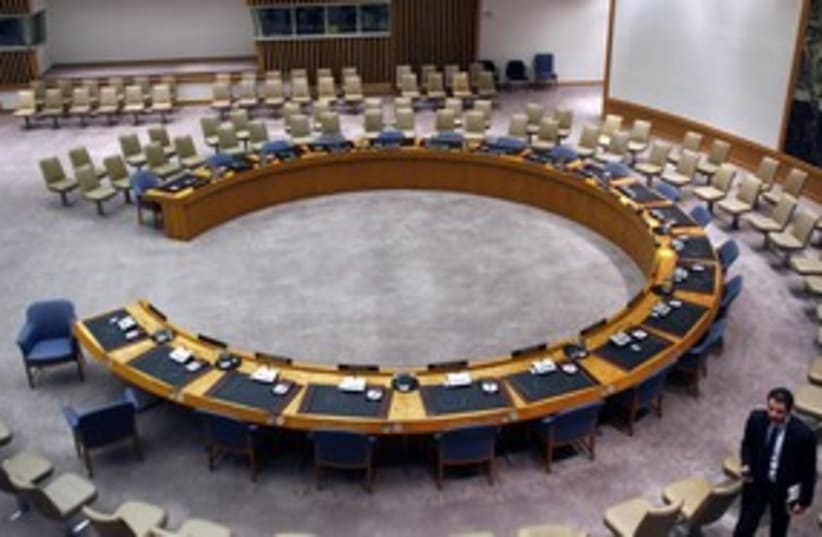
UNHRC condemns Israel on Golan, okays Iran rapporteur
A resolution calling for an immediate cessation of any “settlement” construction in the Golan is the first of six resolutions on Israel.
By JORDANA HORN, TOVAH LAZAROFFUnited Nations 311(photo credit: REUTERS)
The United Nations Human Rights Council in Geneva on Thursday denounced the Israeli presence in the Golan Heights and created the post of a special investigator into human rights issues in Iran.The resolution on the “Syrian Golan,” which calls for an immediate cessation of any “settlement” construction in the Golan, is the first of six resolutions on Israel. The UNHRC is expected to approve the remaining five resolutions when it wraps up its 16th session on Friday.RELATED:UN expert repeats 'ethnic cleansing' claim against Israel The UNHRC: Hard at work condemning Israel Clinton: UNHRC bias against Israel undermines its work Thursday’s vote on the Golan Heights was 29 in favor, with 16 abstentions. Only the US voted against the resolution; those abstaining included the United Kingdom, Hungary and France.The resolution calls on Israel to comply with Security Council Resolution 497 from 1981, which stated that Israel’s decision “to impose its laws, jurisdiction and administration on the occupied Syrian Golan is null and void and without international legal effect, and demanded that Israel rescind forthwith its decision.”The resolution deems the Knesset’s November 2010 decision to hold a referendum on the Golan a violation of international law, and considers it null and void.In addition, it insists that Israel “desist from its continuous building of settlements,” as well as from “changing the physical character, demographic composition, institutional structure and legal status of the occupied Syrian Golan, and emphasizes that the displaced persons of the population of the occupied Syrian Golan must be allowed to return to their homes and to recover their property.”The resolution further states that Israel should allow Syrians in the Golan free transit into Syria through Quneitra under Red Cross supervision, and should allow the Red Cross to “visit Syrian prisoners of conscience and detainees in Israeli prisons,” though it also calls for Israel to release all Syrian detainees in Israeli prisons.The HRC also voted on its one resolution on Iran, creating a special rapporteur on the situation of human rights there – the first in a decade.That resolution was adopted by a vote of 22 in favor and seven against, with 14 abstentions.Sweden and the US introduced the resolution.In the discussion, Swedish representative Jan Knutsson said it was the responsibility of the council to use all of its mechanisms to address the issue of human rights abuses in Iran.Eileen Chamberlain Donahoe of the US said America was extremely concerned about human rights in Iran, stating that floggings, torture and stoning continued to be carried out by the Iranian government.A Capitol Hill source told The Jerusalem Post that the resolution on Iran was a significant statement against the regime in Tehran.“It is one of the most visible manifestations of the Iranian regime’s increasing international isolation,” the source said.“Many countries who were not supportive of these resolutions or abstained switched votes. It was a huge win,” the source added, noting that countries that would have been expected to vote against such a resolution or abstain in the past, such as Brazil, South Korea and Senegal, had come out in support of the move.Senegal was particularly noteworthy, because it is a Muslim country, the source said.According to the source, the abstentions were also significant – particularly that of Malaysia, one of Israel’s fiercest critics, as well as Bahrain and Qatar.“It shows the degree to which Iran has further isolated itself, especially in such a politicized environment as the council,” the source said.
if(catID != 151){
var cont = `Take Israel home with the new Jerusalem Post Store