PM decries fact that next talks on May 23: "Iran now has 5 weeks during which it can continue to enrich uranium without limit."
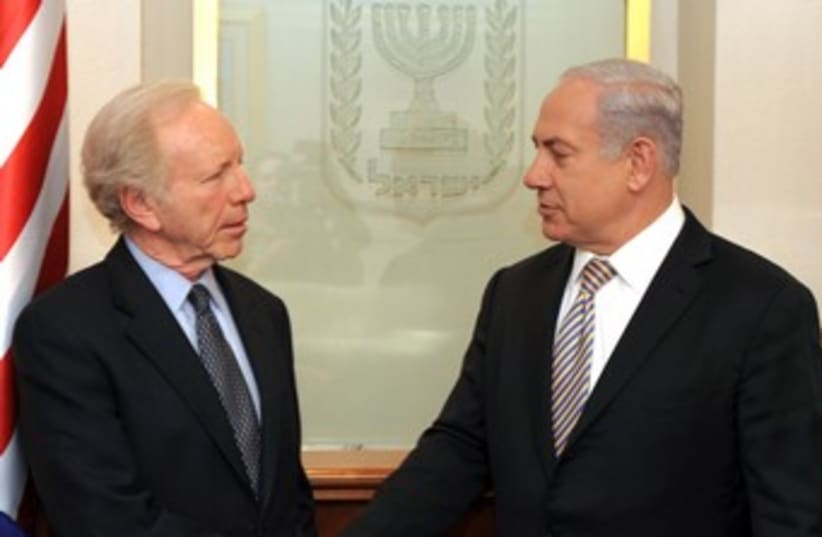
By HERB KEINONPM Netanyahu with US Senator Joe Lieberman 370(photo credit: Moshe Milner / GPO)
Prime Minister Binyamin Netanyahu threw cold water Sunday on the Istanbul talks dealing with Iran’s nuclear program, saying they provided Tehran with a five-week gift from the world to continue enriching uranium.Netanyahu’s comments on Saturday’s talks – the first formal reaction from Israel – were at marked odds with the otherwise upbeat assessments around the world of the discussions as a “constructive” development.“My initial impression is that Iran has been given a freebie,” Netanyahu said of the negotiations between Iran and a group known as the P5+1 – the US, Russia, China, France, Britain and Germany. At Saturday’s meeting the sides said they arranged to meet again in Baghdad on May 23.Iran, Netanyahu said before a meeting with visiting US Senator Joe Lieberman, now has “five weeks to continue enrichment without any limitation, any inhibition. I think Iran should take immediate steps to stop all enrichment, take out all enrichment material, and dismantle the [Fordow] nuclear facility in Qom.”Netanyahu said the world’s “greatest practitioner of terrorism” must not have the ability to develop atomic bombs.Netanyahu’s remarks contrasted starkly with US deputy national security adviser Ben Rhodes’s comments about the talks.“We believe... the talks in Istanbul have been a positive first step, that there was a constructive atmosphere, that the Iranians came to the table and engaged in a discussion about their nuclear program,” Rhodes told reporters in Colombia, where US President Barack Obama was attending a regional summit.The agreement to meet again in Baghdad next month was “an additional positive sign,” he said.Rhodes said the United States saw room to negotiate over how Iran could meet international obligations under its nuclear program.Daryl Kimball, executive director of the Washington-based Arms Control Association, slammed Netanyahu’s comments.“To suggest that the Istanbul talks have given Iran a ‘freebie’ by allowing Iran to continue uranium enrichment for another five weeks is illogical and counterproductive,” Kimball wrote in an email to The Jerusalem Post.“The reality is international and national sanctions will remain in place until Iran takes the steps necessary to provide confidence it is not pursuing nuclear weapons. It is naive for Netanyahu to believe that the P5+1 could have demanded that Iran halt all enrichment work and close Fordow and gotten anything but a brush-off from [Iranian chief negotiator Saeed] Jalili.”Kimball said that if Israel, the US or its P5+1 partners do not “seize the potential diplomatic opportunities, the international support necessary to maintain pressure on Iran will erode and Iran will no longer be seen as the roadblock to a peaceful resolution.”In a roundtable discussion that appeared last month on the Council of Foreign Relations website, Kimball said that air strikes on Iran’s nuclear facilities would “set back Iran’s program for no more than a couple of years, convince its leaders to pursue nuclear weapons openly, and lead to adverse economic and security consequences.”Reuters contributed to this report.
if(catID != 151){
var cont = `Take Israel home with the new Jerusalem Post Store