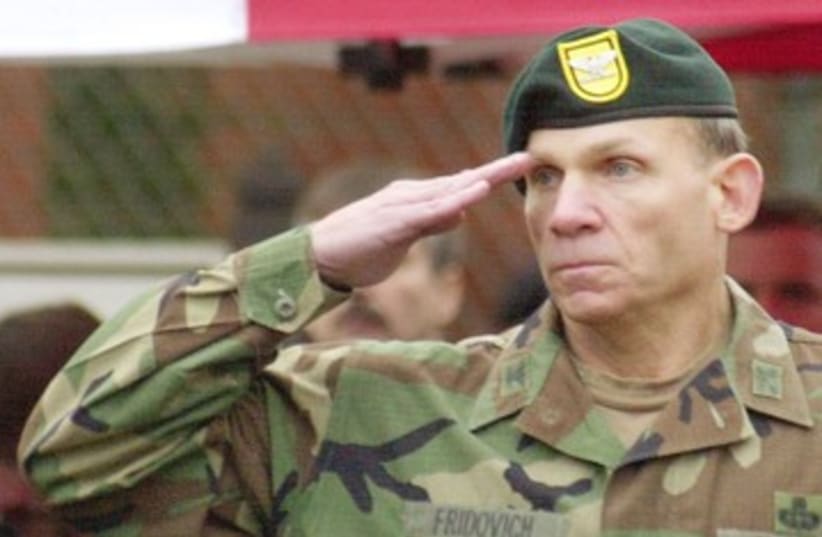
Fridovich to the 'Post': Emphasize imposing additional sanctions, int'l resolutions to increase Iran’s isolation.
By HILARY LEILA KRIEGER, JPOST CORRESPONDENTLt.-Gen. (res.) David Fridovich 390(photo credit: REUTERS/David Lewis)
WASHINGTON – A recently retired US general now working for a Jewish national security think tank cautioned Tuesday that military strikes against Iran could be counterproductive.“What’s really gained by doing an overt strike? And the answer is, it’s never good. The outcomes are just not good,” retired Lt.-Gen. David Fridovich, former deputy commander of Special Operations Command, told The Jerusalem Post. After retiring in December, Fridovich became the director for defense and strategies at the Jewish Institute for National Security Affairs, viewed by many as generally taking a hawkish line on foreign policy.When it comes to the potential results of an attack on Iran, Fridovich suggested that such a course would not achieve the desired result of ending Iran’s nuclear program.“While military [action] might give you some short-lived response, are you really going to stop them from gaining what they want?” he asked rhetorically.He also spoke of an external strike “galvanizing the people of Iran,” when international efforts should be focused on them turning against their leaders.“Why would you do that for them? That’s the first part of it being counterproductive,” he said.Fridovich’s skepticism echoed that of another former US military officer, recently retired Gen. James Cartwright, who served as vice chairman of the Joint Chiefs of Staff. The former Green Beret commander assessed that the US military is disinclined to enter another conflict that would necessitate sustained strikes and a long-term American presence to finish the job.“Does anybody really want to run Iran next? And the answer is no. And you have to think through that before you start phase one,” Fridovich said, referring to initial strikes.Instead, Fridovich emphasized imposing additional sanctions, international resolutions to increase Iran’s isolation and diplomatic approaches.“The road that we’re on [is] not doing a military strike, because the end state of that is not going to outweigh staying with the current program on sanctions and more resolutions and mandates squeezing the technology and everything else away from them,” he said of the Pentagon’s current thinking. “You just have to give these things time.”Fridovich, who worked with top Israeli and US commanders during his time in the military, described close cooperation between the two countries, especially when it came to technology and learning from one another’s experiences in the field. He said the current Israeli deployment of the Iron Dome missile defense system in Gaza presented another positive opportunity to learn from Israel’s operational experience.The new system could be “a game-changer” if it effectively repels enough missiles to force the enemy to resort to new methods of attack, he said.One aspect of Fridovich’s new role will be to strengthen connections between the two services. The Jewish Institute for National Security Affairs described his selection as the first time the American Jewish community has had a military officer of such a high rank serving as a professional staff member.
if(catID != 151){
var cont = `Take Israel home with the new Jerusalem Post Store