IAEA reveals Tehran quickly revived its nuclear program after Stuxnet attack; “Obama administration much more realistic about growing threat.”
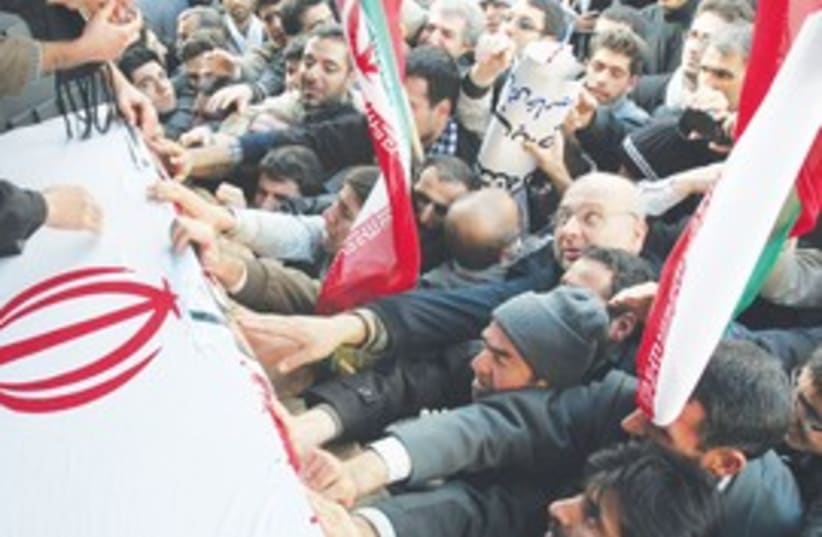
By HILARY LEILA KRIEGERPRO-GOVERNMENT IRANIANS 311(photo credit: AP)
WASHINGTON – As protesters take to the streets in Tehran and the Obama administration heightens its rhetoric against Iran, the US Congress is also looking to turn up the heat on the regime.A new bill introduced on Wednesday seeks to tighten the American sanctions regime by requiring publicly traded companies and their affiliates to report their Iranian links to the US Securities and Exchange Commission.RELATED:Editorial: Support a free IranTehran clamps down on pro-reform protests; 1 shot deadThe legislation comes as the intelligence community has reportedly prepared a new version of the National Intelligence Estimate on Iran that toughens the US assessment of the country’s nuclear activities from its estimate in 2007.So far, the new, classified version has been circulating among designated members of Congress, but not made public.At the same time, new International Atomic Energy Agency revelations on Wednesday suggested that Iran quickly revived its nuclear program after it suffered setback from a computer virus earlier this year.Click here for full Jpost coverage of the Iranian threatRepublican Sen. Mark Kirk, one of the co-sponsors of the new sanctions proposal, welcomed a revised version of the National Intelligence Estimate, calling its 2007 incarnation a “complete mistake.”Kirk noted that he hadn’t read the new version, first reported by Foreign Policy, and could therefore speak freely without worrying about violating classified restrictions.Obama administration 'more realistic about threat'Still, Kirk told reporters he hoped the Obama administration made the key findings public, since “it appears to be much more realistic about the growing threat.”Kirk said he was also hoping the administration would step up the enforcement of sanctions, which had only resulted in the sanctioning of one company since being implemented in the mid-1990s and strengthened last summer.“I have been very frustrated with the lack of enforcement,” he said. “My hope is that with this bipartisan legislation we can upgrade the enforcement.”Kirk was joined in sponsoring the legislation by Democratic Sen. Kirsten Gillibrand, Republican Rep. Dan Burton and Democratic Rep. Ted Deutch.Deutch said the new bill would increase enforcement because companies would be required to self-report their involvement with Iran rather than the administration needing to obtain information and then decide to open an investigation.“One of the reasons that this legislation is so important is because once the company identifies that they are doing business [with Iran], it will require the investigation to start and will pressure that company to make the decision to place national security interests first,” he said.Law forces companies to disclose Iran dealings“The hardest part has been trying to find out exactly what these companies are actually doing,” Mark Dubowitz of the Foundation for Defense of Democracies said in explaining the difficulties with the current sanctions regime. “The brilliance of this law is that it forces these companies themselves to disclose” their Iran dealings.Dubowitz’s organization has already identified two dozen US companies or international companies with US subsidiaries that would have to disclose such ties.Meanwhile, according to IAEA surveillance cameras operating at Iranian nuclear sites last year, Iranian workers were observed hauling away crates of broken equipment, or some 10 percent of the 9,000 centrifuges at the Natanz plant.Soon afterward, hundreds of new machines arrived at the plant to replace the ones that were lost.IAEA records show Iran struggling to cope with a massive equipment failure just at the time its main uranium enrichment plant was under attack by a computer worm known as Stuxnet, according to Europe-based diplomats familiar with the records.But the IAEA’s files also show a feverish – and apparently successful – effort by Iranian scientists to contain the damage and replace broken parts, even while constrained by international sanctions banning Iran from buying nuclear equipment.An IAEA report due for release this month is expected to show steady or even slightly elevated production rates at the Natanz enrichment plant over the past year.“They have been able to quickly replace broken machines,” said a Western diplomat with access to confidential IAEA reports. Despite the setbacks, “the Iranians appeared to be working hard to maintain a constant, stable output” of low-enriched uranium, said the official, who like other diplomats interviewed for this report, insisted on anonymity in discussing the results of the UN watchdog’s data-collecting.The IAEA’s findings, combined with new analysis of the Stuxnet worm by independent experts, offer a mixed portrait of the mysterious cyber-attack that briefly shut down parts of the Islamic Republic’s nuclear infrastructure last year. The new reports shed light on the design of the worm and how it spread through a string of Iranian companies before invading the control systems of Iran’s most sensitive nuclear installations.Attack curbs Tehran's nuclear ambitionBut they also put a spotlight on the effectiveness of the attack in curbing Tehran’s nuclear ambitions. A draft report by Washington-based nuclear experts concludes that the net impact was relatively minor.“While it has delayed the Iranian centrifuge program at the Natanz plant in 2010 and contributed to slowing its expansion, it did not stop it or even delay the continued buildup of low-enriched uranium,” the Institute for Science and International Security said in the draft, a copy of which was provided to The Washington Post.“If nothing else, it hit their confidence, and it will make them feel more vulnerable in the future,” said David Albright, ISIS’s president.Iran’s centrifuges are notoriously unreliable, but over a period of a few months last year the flow of broken machines leaving the plant spiked far beyond normal levels. Two European diplomats with access to the agency’s files put the number at between 900 and 1,000.IAEA inspectors who examined the machines could not ascertain why the centrifuges had failed. Iranian officials told the agency they were replacing machines that had been idled for several months and needed refurbishing. Whatever the reason, the plant’s managers worked frantically to replace each piece of equipment they removed, the two European diplomats confirmed. “They were determined that the IAEA’s reports would not show any drop in production,” one of the diplomats said.While US officials declined to comment on the massive equipment failure at Natanz, the speed of Iran’s apparent recovery from its technical setbacks did not go unnoticed.“They have overcome some of the obstacles, in some cases through sheer application of resources,” said US Ambassador Glyn Davies, Washington’s representative to the IAEA in Vienna. “There’s clearly a very substantial political commitment.”Albright and other nuclear experts discounted media reports suggesting that the worm posed a serious safety threat to Iran’s Bushehr nuclear power plant. But the ISIS and Symantec reports noted that parts of the malware’s operating code appeared to be unfinished, and Stuxnet has been updated with new instructions at least once since its release.IAEA inspectors were unable to determine whether Iran’s efforts to erase the worm from its equipment had succeeded, raising the possibility that subsequent attacks could occur.The Washington Post contributed to this report.
Related Tagsstuxnet
if(catID != 151){
var cont = `Take Israel home with the new Jerusalem Post Store