Netanyahu tells French magazine Israeli strike on Tehran could remove a potential threat and ease tensions in the Middle East.
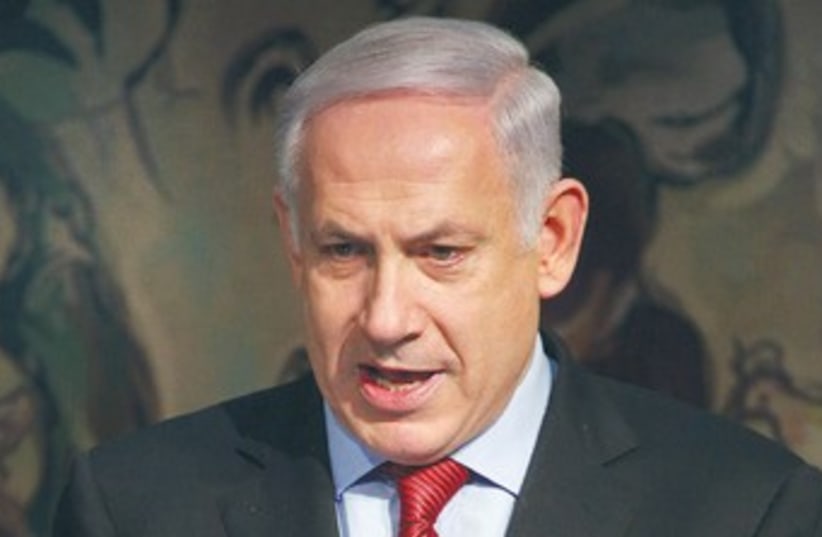
By HERB KEINONNetanyahu making a speech 370(photo credit: Marc Israel Sellem/The Jerusalem Post)
A military strike on Iran and neutralizing its nuclear threat would benefit the Arab states in the Middle East and ease tension throughout the region, Prime Minister Binyamin Netanyahu said in an interview published Tuesday in the French Magazine Paris Match.“Five minutes after [an attack], contrary to what the skeptics say, I think a feeling of relief would spread across the region,” said Netanyahu, who has been calling for the US and the international community to draw a clear “red line” beyond which Iran would not be allowed to pass in pursuit of nuclear capability.“Iran is not popular in the Arab world, far from it, and some governments in the region, as well as their citizens, have understood that a nuclear-armed Iran would be dangerous for them, not just for Israel,” he said.The interview appeared on the eve of Netanyahu’s scheduled visit to France on Wednesday where, in addition to meeting France’s leaders in Paris, he will also be traveling to Toulouse to participate in a memorial service at the Jewish school where a terrorist in March murdered a rabbi and three school children.This will be Netanyahu’s fourth visit to France, and his 33rd trip abroad since taking office in 2009. The only countries he has visited more times than France during his current term in office are the US (9 visits) and Egypt (6 trips).During his two-day visit to France, Netanyahu is scheduled to meet French President François Hollande, Prime Minister Jean- Marc Ayrault and Foreign Minister Laurent Fabius.Click here for full Jpost coverage of the Iranian threatNetanyahu will travel to Toulouse with Hollande.Asked in the Paris Match interview whether he was concerned that the terrorist responsible for the murders in Toulouse explained his act by saying that “the Jews have our brothers and sisters in Palestine,” the prime minister responded that “nothing can justify the massacre of children. This is pure barbarism.”“Any attempt to explain, justify or excuse such behavior is absurd,” Netanyahu said. “All civilized people must unite in the battle against terrorism and start by unanimously condemning it. I am going to Toulouse to demonstrate my solidarity with the victims of terror, Jewish and non-Jewish, and call for action against terrorism and those countries that support it.”This will be Netanyahu’s first serious meeting with Hollande, whom he met once only briefly in 2003.The two have, however, held a number of telephone calls since Hollande defeated Nicolas Sarkozy in French elections earlier this year. Netanyahu said he will be looking to discuss “concrete steps to intensify the sanctions against Iran,” as well as the “convulsions in the region” and terrorism.“I think we must do more together to fight terrorism,” he said. “One mustn’t reduce this to a matter of religion. This is a fight between moderates that want modernity and others, radicals, who by force would like to force values on us and take us back to past times that were more unhappy.”Netanyahu underlined in the interview what is already becoming a theme in his re-election campaign, that although he is perceived as a “hawk,” Israel has not gone to war once during the seven years over two terms that he has served in office.“Your enemies keep away when they know that you won’t hesitate one minute to defend yourself,” he told the magazine. “That is how I have been able to preserve the peace so far. I hope that I will one day have the opportunity to seal the peace.”Reuters contributed to this report.
if(catID != 151){
var cont = `Take Israel home with the new Jerusalem Post Store