Police: Investigation guided by facts and professionalism.
By DAN IZENBERG, YAAKOV LAPPINlieberman solemn 311 AP(photo credit: AP)
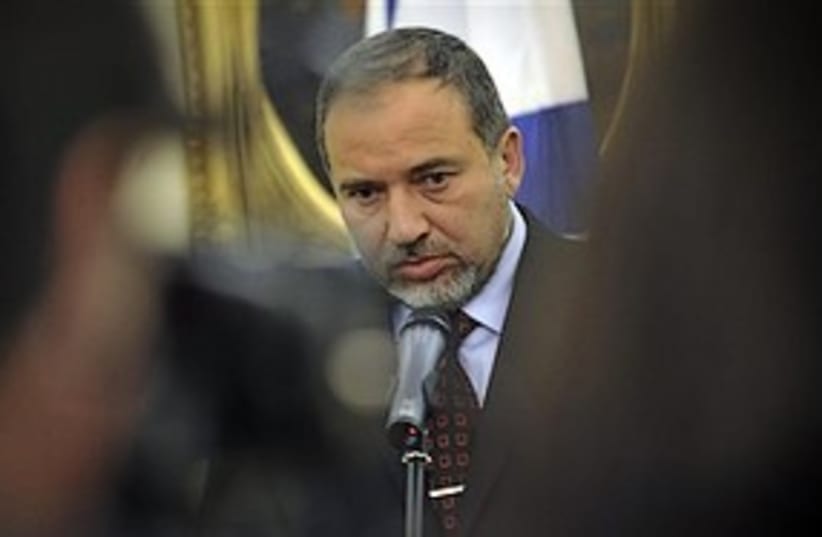
Foreign Minister Avigdor Lieberman arrived at the Supreme Court on Thursday, to demand an investigation of alleged police leaks dating back to 2008 from his investigation on corruption allegations, but appeared even more incensed over Tuesday’s police announcement that he had been questioned earlier in the day regarding a new allegation.His attorney, Yaron Kostelitz, charged that details appearing in the media regarding the new investigation had also been leaked by the police, and demanded an investigation to uncover the culprit.Lieberman told reporters at the Supreme Court, “Since I left the interrogation room and was warned that I must not mention any detail about the investigation and am forbidden from discussing it with anyone, so that is what I am doing. You can imagine how shocked I was when soon after I left the room, all the distorted details were released by the [Israel Police’s] Inspector-General’s Office.”According to the statement released by police, Israel’s former ambassador to Belarus, Ze’ev Ben-Aryeh, allegedly showed Lieberman classified information regarding his investigation by police on allegations that he had accepted bribes and failed to report income to the tax authorities.The documents had been sent to Ben-Aryeh by the Foreign Ministry to hand over to the Belarus government, whose help Israel required in tracing money transfers from a local bank.According to the police statement, “the ambassador, who was supposed to pass the request on discretely and directly to the authorities in Belarus, kept one copy for himself. When Lieberman arrived in Belarus on a visit (during October 2008), [Ben-Aryeh] copied classified information from the request, [and] handed it over to Lieberman illegally when they met. The investigation also deals with Lieberman’s involvement in the advancement and job appointments of Ben-Aryeh in the Foreign Ministry in recent months.”On Wednesday, the police defended the announcement they had issued. The investigation against the foreign minister “is not personal. It is guided by facts and professionalism,” a police source told The Jerusalem Post.The source denied accusations by Lieberman that the police had leaked details of the latest allegation.“There were no leaks to the media,” he said. “When the investigation reached a certain point, a statement was released. The public is entitled to know about all national public figures who are questioned. The investigation has been carried out in a thorough and proper way, and with a great deal of discretion.”Lieberman disagreed, charging that “everything that was released to the media, was released in a distorted manner. Any connection between the announcement and the facts is purely coincidental.“When details of an investigation are leaked before an indictment is served, this is obstruction of justice par excellence. It was also released in a distorted and tendentious manner to create pressure on the state prosecution and public opinion. This wasn’t just an obstruction of justice. It was the mother of all obstructions of justice, the mother and father of all obstructions of justice.”On Tuesday, after police released the announcement, Kostelitz wrote to Attorney-General Yehuda Weinstein demanding that he investigate the latest police leaks regarding the new investigation.“The repeated leaks from the police investigation of our client constitute grave crimes of obstructing justice, disclosure in breach of duty, fraud and breach of faith and abuse of office,” he wrote.Kostelitz made similar allegations in a petition that he filed on Lieberman’s behalf on Wednesday, asking the High Court of Justice to order the Justice Ministry’s Police Investigations Department (PID) to re-open its investigation into who leaked details of the investigation of the original corruption allegations against Lieberman.Kostelitz first petitioned the High Court in 2008 following a series of news reports about the investigation that he said were based on leaks from the police.In quick succession, Channel 2 reporter Amnon Abramowitz, Haaretz reporters Uri Blau and Gidi Weitz and the editor of the Internet news site News First Class, Yoav Yitzhak, reported on the investigation.After each leak, Lieberman’s lawyers demanded that then-attorney-general Menahem Mazuz order an investigation. When he refused, they petitioned the High Court to order Mazuz to do so. While the case was still being heard, the state announced that the PID had begun to investigate the leaks.The PID managed to narrow down the number of policemen who knew aboutthe investigation to 13. However, when they asked permission from theJerusalem Magistrate’s Court to wiretap the suspects, Judge HagitKalmanovith refused. The PID then closed the investigation.When Lieberman protested, Mazuz backed the PID decision.In his new petition, Lieberman asked the High Court to order Mazuz’s successor, Weinstein, to resume the investigation.
if(catID != 151){
var cont = `Take Israel home with the new Jerusalem Post Store