Border Police set to bolster IDF presence in West Bank
Exclusive: There may be increased tension over progress in the peace talks, officer says; decision follows spate of anti-Palestinian attacks.
By YAAKOV KATZBorder police training 311(photo credit: Ariel Jerozolimski)
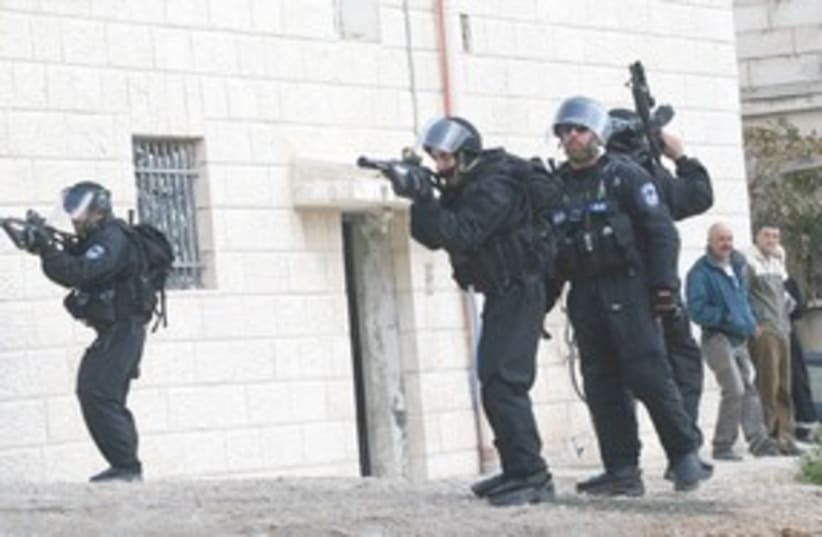
Border Police over the transfer of several hundred policemen to the West Bank from the Jordanian border, The Jerusalem Post has learned.The discussions come ahead of a possible escalation in violence in the West Bank under a moratorium or with the evacuation of settlements.RELATED:Rights groups decry olive harvest settler vandalismPalestinians blame 'hilltop youth' for school arsonThe talks are being held between Border Police chief Cmdr. Yisrael Yitzhak and the IDF Operations Directorate.“There is a need to beef up forces in the West Bank due to a possible increase in tensions there over progress in the peace talks,” a defense official said.During the talks, the IDF said that two to three companies of border policemen who were specially trained in riot control and crowd dispersal techniques would suffice, but the Border Police recommended the establishment of a larger brigade - or division-level force that would be deployed at designated “hot spots” in Judea and Samaria.In June, the Border Police held a massive drill in the West Bank aimed at preparing security forces for an escalation in Israeli and Palestinian violence.The brigade-level exercise involved hundreds of border policemen who drilled scenarios involving civil disturbances and crowd control. One of the scenarios included a large Jewish demonstration during which Palestinians carry out a terrorist attack.While the IDF Central Command has noted a lull in terrorism in recent years, there has been an increase in civil disturbances in the West Bank, particularly surrounding the recent olive harvest, described by the defense establishment as possibly the most violent in Israeli history.Since the beginning of October, the United Nations has recorded a weekly average of eight harvest incidents resulting in injuries and severe damage to property, including the uprooting and burning of thousands of trees.A new Border Police force in the West Bank would join a task force of border policemen that was established in April to enforce law and order in the Nablus area.The decision followed a spate of anti-Palestinian attacks, including one by settlers from Yitzhar against soldiers near the settlement on Independence Day.
if(catID != 151){
var cont = `Take Israel home with the new Jerusalem Post Store