The Jerusalem Post
Jpost search icon google-icon iphone
  Set as Homepage
Wed, Jun 19, 2013   11 Tammuz, 5773
newspapers magazines
 
    • Breaking News
    • Diplomacy & Politics
    • Defense
    • National
    • Mideast
    • Syria
    • Iran
    • World
    • Business
    • Sports
    • Health & Science
    • Environment
  • Video
  • Opinion
    • Columnists
    • Editorials
    • Op-Eds
    • Letters
  • Jewish World
  • Lifestyle
    • Arts & Culture
    • Food & Wine
    • Travel
  • Features
    • Insights & Features
    • Week in review
    • On the Web
    • Shalva Superheroes
    • Obama in Israel
  • Blogs
    • In the news
    • Judaism
    • From the Middle East
    • Lifestyle
    • Aliya
    • Science and Technology
  • JPost Apps
    • iPhone app
    • iPad app
    • Android app
    • Twitter
    • Facebook
    • RSS feeds
    • JPost Toolbar
    • JPost Newsletter
    • JPost Alert
  • Premium Zone
    • The Jerusalem Report
    • Magazine
    • Metro
    • In Jerusalem
    • ePaper
    • Expert Opinion
    • Q&A
    • Dash
    • Christian Edition
    • Ivrit
  • French
    • Politique & Social
    • Affaires Palestiniennes
    • Diplomatie & Monde
    • Art & Culture
    • Israel
  • Green Israel
JPost Learn Hebrew  
Advertise with us  
Nefesh Guided Aliyah  
Eldan  
AFMDA  
YTA  
Isram Group  
JPost Twitter  
JPost Facebook  
Classifieds  


Breaking News
 
 
  • JPost.com
  • Israel
 

Jordan River to run dry by next year

By EHUD ZION WALDOKS
05/03/2010 11:59
Tweet

400 million cu.m. needed to rehabilitate river.

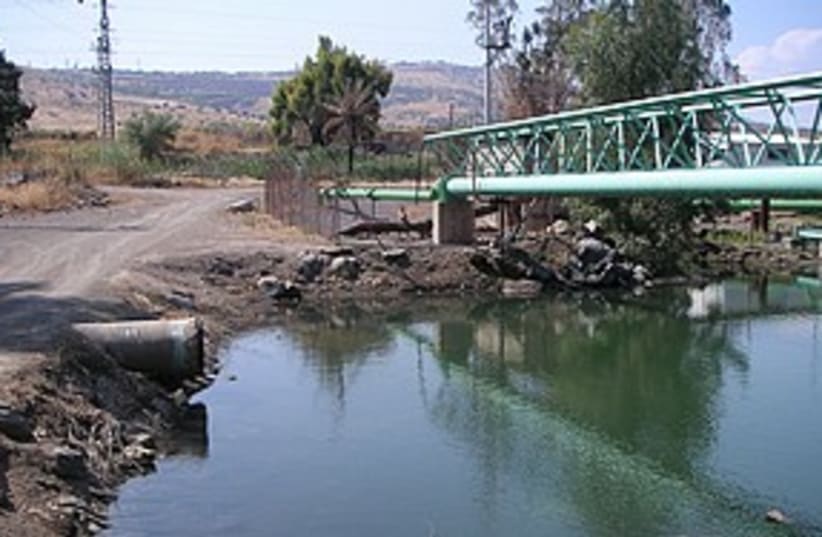
The Alumot Dam over the Jordan River.
The Alumot Dam over the Jordan River. Photo: Friends of the Earth/Middle East
Unless urgent action is taken, large sections of the Lower Jordan River, which runs from Lake Kinneret to the Dead Sea, will dry out next year, according to a study released on Sunday by EcoPeace/Friends of the Earth Middle East (FoEME).

The NGO ran tests over a year to determine how much water would be needed to rehabilitate the river and damage had been caused by the lack of water in it. Israel, Jordan and Syria divert 98 percent of the flow for their respective country’s use.

In the 19th and early 20th century, 1.3 billion cubic meters of water cascaded each year down rapids and rolled over waterfalls on the way down to the lowest point on Earth – the Dead Sea.

In 2009, just 20 m.cu.m. to 30 m.cu.m of water pooled and sluggishly flowed through the river’s channels – all of it sewage. Sewage runs from Israel, the Palestinian Authority and Jordan into the river. However, two new sewage treatment plants, one in the Beit She’an area and the other in the Jordan Valley Regional Council area, are set to begin operating over the next year and a half.

While FoEME praised the construction of the two plants, it warned that unless fresh water replaced the amounts of sewage water that would be removed, the once mighty Lower Jordan River would become a cracked and dry riverbed through much of its 100-km. length.

FoEME’s studies looked at how much water would be needed to totally rehabilitate the river, and an accompanying economic analysis recommended ways to free up the necessary amount.

The lack of fresh water has also destroyed much of the ecosystem both within and next to the river, the study found. Fifty percent of macro-invertebrates have disappeared because the river no longer flows swiftly and is highly saline. Examples of macro-invertebrates include flatworms, crayfish, snails, clams and insects.

Otters have disappeared from the Jordan and the willow trees that once lined its shores have all disappeared, FoEME Israel Director Gidon Bromberg said during a media tour of the river on Sunday.

FoEME determined that 400 m.cu.m. of water each year would be needed to rehabilitate the river, gradually rising to 600 m.cu.m.

In addition, the river would have to flood once a year to rehabilitate the shores. The river has not flooded since the winter of 1991-92, Bromberg said.

So where would that much water come from?

According to FoEME’s economic study, Israel would contribute 220 m.cu.m., Syria 100 m.cu.m. and Jordan 90 m.cu.m.. Each country has dammed the river or its tributaries and diverted it for use. Seventy-five percent of the water would have to be fresh water and the rest highly treated sewage water to preserve the saline balance.

An accompanying study pointed to potential water conservation methods cheaper than the $0.57 it takes to desalinate a cubic meter of sea water. As much as 517 m.cu.m. in Israel, 359 m.cu.m. in Jordan and 108.5 m.cu.m. in the PA could be conserved, the study’s authors contended.

Looking at both the supply and demand side, the three authors – one Israeli, one Palestinian and one Jordanian – suggested measures for Israel to take, like fixing leaky pipes, covering reservoirs to prevent evaporation, raising awareness, changing plants in gardens and using grey water (wastewater generated from domestic activities such as laundry, dishwashing and bathing).

For Jordan and the PA, wastewater reclamation was the key to conserving fresh water. Jordan should also reduce water conveyance loss, reform gardening and raise awareness.

Letting loose 400 m.cu.m. to 600 m.cu.m. of water each year would also go a long way toward saving the Dead Sea, FoEME noted.

The Israel Water Authority was not available for comment by press time.

However, under current policies, returning 220 m.cu.m. to the Jordan River would be highly unlikely. Right now, 10 m.cu.m. is allocated as water for nature for all of Israel’s streams. To put 220 m.cu.m. into the Jordan would mean using 20 times that. Moreover, any extra water that is generated by improving infrastructure and conservation would more likely be dumped back into Lake Kinneret to save it from irreparable ecological damage as it nears the black line, rather than run down the Jordan River into the Dead Sea.

However, the Environmental Protection Ministry apparently submitted a plan to rehabilitate the river in February, according to FoEME’s report. A copy of that plan could not be located by press time.
  • Send
  • Large
  • Small
  • Print
  • Share
JPost Community
Tweet
water jordan kinneret dead sea foeme green
Tweets by @Jerusalem_Post
Share this article
Tweet
Share
Send
Your comment must be approved by a moderator before being published on JPost.com. Disqus users can post comments automatically.

Comments must adhere to our Talkback policy. If you believe that a comment has breached the Talkback policy, please press the flag icon to bring it to the attention of our moderation team.
JPost Services
conferenceConference
newsletterNewsletter
iphoneMobile Apps
kotelcamKotel Cam
kolboJPost Alert
premiumPremium
JPost TV News  
Mobile Apps  
Bank Hapoalim  
Meir Panim  
Israel Law Center  
Inbal Hotel Jerusale  
Meier on Rothschild  
Weizmann Institute o  
JPost Premium Zone  
JPost kotel Camera  
         
 
Israel Focus
JPost TV News
Watch Now!  
Israel Law Center
The ultimate Mission to Israel, October 21 – 28, 2013 Register now!  
Nefesh B'Nefesh Guided Aliyah
Already living in Israel? Enjoy the Benefits of Aliyah!  
One year International MBA
in English, Bar-Ilan University, Israel – Open House July 9, 2013, 17:30  
Give "Freedom" this Passover
to needy Israeli families. Donate now  
YTA – A Yeshiva in Israel…
in English. Come Join Us  
War Threatens
Protect the People of Northern Israel  
Bank Hapoalim
Israeli's number one bank  
Jerusalem Post Lite
Lite Edition of the Jerusalem Post for English improvement  
Learn Hebrew with us
Get 10 minutes free personal coaching in Hebrew through phone or Skype  
JPost newspapers
Sign up for the JPost newspapers and receive one month free subscription  
Kosher English Magazine
English language weekly magazine - especially for religious people  
JReport Kindle Edition
Now you can get the Jerusalem Report directly to your Kindle  
JPost Premium Edition
The very best articles are available only in our Premium edition  
Lifestyle Magazine
 
 
Real Estate
Meier on Rothschild
Tel Aviv's Most Prestigious Address  
Don't Look For a House!
In Israel, our website will do it for you!  
 
Travel
Tourism Magazine
June 2013  
The Inbal Jerusalem Hotel
Hot summer deal, order now!  
Eldan Rent a Car
20% off all Car Rental Reservations in Israel  
Hertz Car Rental
Special Online Discounts!  
The King David Jerusalem Hotel
One of the world's truly iconic hotels, and a Jerusalem landmark  


Sites Of Interest:

Jerusalem Hotels
KKL-JNF
Poalim Online
BreitBart.com
Our Friends
Jerusalem Attractions
Jerusalem Tours
itraveljerusalem.com

JPost sites:

Learn Hebrew
The Jerusalem Report
Our Magazines
JPost Edition Francaise
Green Israel
Christian World
Jerusalem Post Lite

Services:

JPost Mobile Apps
JPost Premium
JPost Newsletter
JPost Toolbar
JPost News Ticker
JPost RSS feeds
JPost Archives
JPost Alert
JPost Kotel Cam

JPost Conferences:

NYC Conference
Diplomatic Conference

Information:

About Us
Feedback
Staff E-mails
Copyright
Sitemap
News Partners
Advertise with Us
Statistics
Ad Specs
Terms Of Service
Jpost.com, the online edition of the Jerusalem Post Newspaper - the most read and best-selling English-language newspaper in Israel. For analysis and opinion from Israel, the Jewish World and the Middle East. Jpost.com offers expert and in-depth reporting from Israel, the Jewish World and the Middle East, including diplomacy and defense, the Palestinian-Israeli conflict, the Arab Spring, the Mideast peace process, politics in Israel, life in Jerusalem, Israel's international affairs, Iran and its nuclear program, Syria and the Syrian civil war, Lebanon, the Palestinian Authority, the West Bank and Gaza Strip, Israel's world of business and finance, and Jewish life in Israel and the Diaspora.
 
About Us | Advertise with Us | Subscribe | Premium | Newsletter | RSS | Contact Us
 
All rights reserved © The Jerusalem Post 1995 - 2012