Public security minister expects "widespread disturbances"
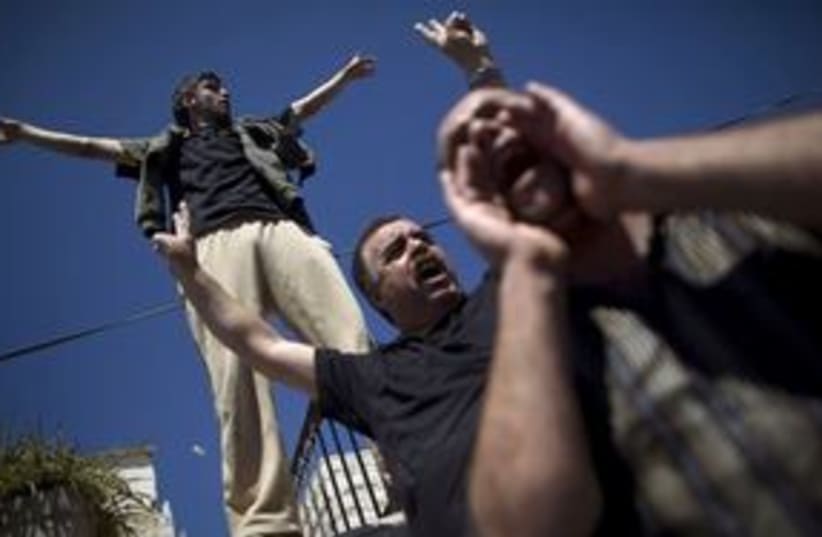
By ABE SELIG, YAAKOV LAPPINsilwan protest arabs 311(photo credit: AP)
The announcement this week of preliminary approval for an east Jerusalem redevelopment plan that involves 22 house demolitions in the city’s Silwan neighborhood has led police to begin preparing for “widespread disturbances” in and around the area, Public Security Minister Yitzhak Aharonovitch told the Knesset on Wednesday.Police expect the unrest to spread to “beyond the [Silwan] area,” Aharonovitch said.RELATED:Eviction threat to Silwan familyBarkat defends Silwan projectEast Jerusalem Arabs charged in Silwan attack“And this creates a need for special preparations.”The plan, which passed an initial hearing in the municipality’s Local Planning and Construction Committee on Monday, focuses on the El- Bustan, or Gan Hamelech (King’s Garden), section of the neighborhood, where 88 homes that were built without proper permits and are considered illegal by the city will be divided into two groups and either retroactively legalized, or demolished to make way for the restoration of parkland – for which the entire area was originally zoned.While officials at City Hall have maintained that the plan is aimed at improving the residents’ quality of life, and that a number of individual agreements have already been hammered out with Palestinian families living in El-Bustan, the announcement of demolitions has apparently ratcheted up already simmering tensions in the area. It has also outraged Palestinian Authority officials, who have denounced the plan and said it “threatens to harm US efforts to promote proximity talks.”Aharonovitch’s statements on Wednesday came in response to a question from MK Uri Ariel (National Union), who claimed that police only provided assistance to the Jerusalem Municipality when it came to demolishing illegal Jewish homes such as Beit Yehonatan, which was also located in Silwan.The public security minister said police were obligated to carry out court-ordered demolitions, and added that “the timing would be decided by operational considerations and diplomatic considerations.”Aharonovitch also said he had received instructions from Attorney-General Yehuda Weinstein to act in accordance with potential requests from the government to delay the demolition, but added, “As of now, there is no such request.”Nonetheless, the demolition of the homes is in no way immediate. There are two more committee hearings on the plan before it is granted full approval. Only then would the matter reach the police, where the government could make requests for the plan’s delay.But the redevelopment plan is not the only issue threatening to strain tensions inside the sprawling east Jerusalem neighborhood. During the same Knesset meeting on Wednesday, Ariel also touched on the separate issue of a historic Yemenite synagogue inside Silwan, where a court ruling has ordered the Arab residents currently living inside to vacate the premises.Jewish residents of Silwan – and in particular Beit Yehonatan, which is located close to the synagogue – have criticized what they have labeled police “inaction” in upholding the court order, and have in the past threatened to carry out the eviction on their own.On Wednesday, Ariel reiterated that ultimatum, saying that if no action were taken by police over the next two weeks, “we will independently evict the occupants on July 4 and return the property to its rightful owners.”While Aharonovitch had said that police helped with eviction orders according to their own set of priorities, and would even delay such orders if the issue demanded sensitivity, it remained unclear on Wednesday whether police did indeed plan on carrying out the eviction order in the near future.Meanwhile Wednesday, three east Jerusalem residents were charged with attempted murder at the Jerusalem District Court for their roles in a shooting attack that took place near Beit Yehonatan at the beginning of March.According to their indictments, two brothers, Taed Fataafta, 26, and Moussa Fataafta, 24, along with Issa Abassi, 25 – all from the nearby east Jerusalem neighborhood of Jebl Mukaber – had planned on killing two security guards who were guarding Jewish residents inside Beit Yehonatan. The men allegedly opened fire on the guards on the night of March 1.The prosecution requested that the men be detained until the end of the court proceedings against them, due to fears that they would be a security threat.According to the indictment, the men planned to shoot at a jeep used for escorting Jewish residents to and from Beit Yehonatan. The court documents further state that the men had armed themselves with loaded handguns, positioned themselves along the jeep’s route, and waited for it to arrive. Taed Fataafta and Abassi waited at the entrance of the local mosque, while Moussa Fataafta stayed with the vehicle and acted as a lookout.After an hour, the indictment continues, the jeep passed and the two men pulled out their guns and opened fire. Eleven shots were discharged from Abassi’s gun and hit the right side of the jeep, while Fataafta’s gun jammed and did not fire during the attack. One of the security guards in the jeep, which was not carrying any residents at the time, suffered leg wounds from shrapnel, and the jeep was damaged.In an additional charge, the Fataafta brothers were found guilty of hurling Molotov cocktails at Border Police vehicles in Silwan.Taed Fataafta was also charged with threatening a shop owner with a gun in the last year. According to the indictment, he arrived at the shop armed with a gun and fired two bullets in the air.Jerusalem Post staff contributed to this report.
if(catID != 151){
var cont = `Take Israel home with the new Jerusalem Post Store