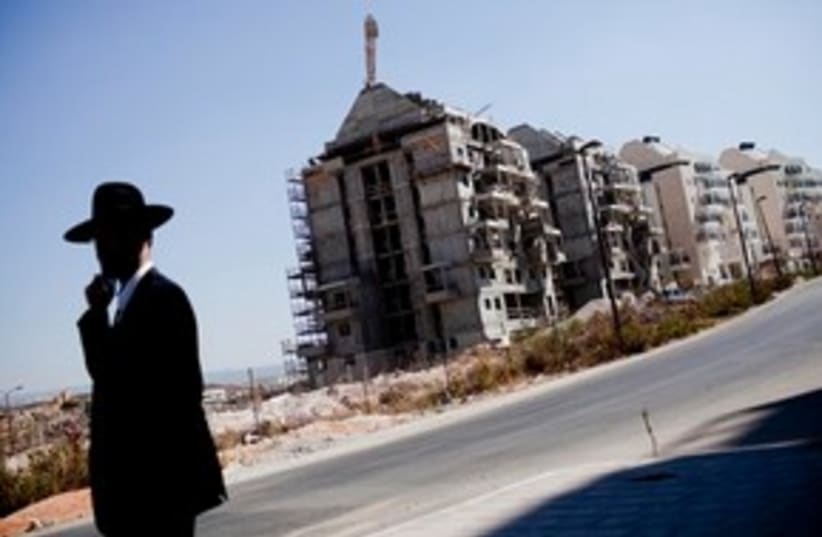
Settlers prepare for end of West Bank building freeze
Likud MK Danny Danon says activists plan to lay the cornerstone of a new neighborhood in the Revava settlement.
By TOVAH LAZAROFFSettlement Building 311(photo credit: Associated Press)
Although thousands of activists plan to rally on Sunday in the Revava settlement to mark the end of the West Bank construction freeze, which is due to expire at midnight, few settler leaders see any cause to rejoice now that bulldozers can lay foundations for new homes on Monday.“We are not going to celebrate,” Samaria Citizens’ Committee Chairman Benny Katzover said. “There is a feeling of relief that the freeze is over, but I am sure there will be other restrictions [on construction], so there is no reason for a party.”RELATED:Analysis: The settlements’ fateful hourEditor's Notes: The transformation of a Herut ideologueOpinion: The objectives behind settlements have mostly been achievedDanon: Settlers will start building the moment freeze ends“We look forward to resuming building,” said Dani Dayan, who chairs the Council of Jewish Communities of Judea, Samaria and the Gaza Strip.But for settlers, the true test that all their lobbying efforts in the last months have succeeded lies not in the expiration of the 10-month moratorium on new settlement construction, but rather in the future actions of the government.According to Dayan, the moratorium is only truly over if the government actively authorizes permits for new construction. Otherwise, he said, it is as if the freeze has continued.According to a Peace Now report published earlier this month, there are 2,066 housing units that can be built without any further authorizations and another 11,000 that need only a stamp from the local municipality.But settlers leaders have explained that many of those 11,000 units exist in settlements where there is little need for new construction, while some of the communities with acute housing shortages lack permits, particularly in the main settlement blocs that Israel expects to keep in any final-status agreement.“If there is no new construction in the pipeline, that means there is a freeze,” Dayan said.“We will not agree to a situation similar to that of east Jerusalem, where there is a de facto freeze,” said Dayan.He added that he expects the government to respect all the terms of the moratorium, including those that, based on his understanding, allow for new permits to be issued.“I know that people expect a dramatic statement from me. But I see the situation like a film where someone pressed the pause button and the video frame remained frozen for 10 months. Now that we press the play button, it does not make the action more dramatic,” Dayan said. He cautioned against expecting an earthquake on Monday.Samaria Regional Council head Gershon Mesika was equally low key. The moratorium was born “in sin,” and just because Prime Minister Binyamin Netanyahu had finally righted an injustice did not mean that the problem of new settlement construction had been solved, Mesika said.MK Danny Danon struck a much more optimistic note in his message to the media on Saturday night in which he detailed the Revava rally organized by World Likud, which he chairs.According to Danon, 100 buses filled with Likud activists will tour Samaria settlements on Sunday, in a show of solidarity.In addition, they will gather for corner- laying ceremonies, first in the Kiryat Netafim settlement and then in the Revava settlement, both of which are in Samaria, 30 km. and 35 km. east of Tel Aviv, respectively.In Revava, settlers and Likud activists plan to hold a rally on behalf of settlement construction.“We have decided that the best way to end the freeze is to begin building,” Danon said. “The message coming out of Samaria on Sunday will be aimed directly at the prime minister: Stay true to the way of the Likud, resist the pressures of President Barak Obama and continue building throughout the State of Israel.”Cement trucks, bulldozers and other earth moving equipment are already in place in Revava, Danon said.Also on Sunday morning, the Council of Jewish Communities of Judea, Samaria and the Gaza Strip plans to meet with the Knesset Lobby for the Land of Israel in the Kfar Eldad settlement in Gush Etzion.On Monday, Deputy Education Minister Meir Porush (United Torah Judaism) plans to participate in a corner- laying ceremony for a nursery school in the Jewish section of Hebron, where construction has been frozen irrespective of the moratorium.According to the Jewish community of Hebron, 44 MKs, including 14 from Kadima, have asked the prime minister to allow the nursery school to be built.Vice Premier Silvan Shalom (Likud) plans to speak in Hebron later in the day.Settlers and right-wing activists are not the only ones who plan to rally around the moratorium’s end.Peace Now, which has advocated on behalf of extending the moratorium, plans to set up a one-day protest tent in front of Netanyahu’s Jerusalem residence and to hold an emergency meeting there in the afternoon.It also plans to increase its monitoring activity by holding more aerial photographic flights over the West Bank settlements to improve its ability to collect data on construction.Peace Now executive director Yariv Oppenheimer said of the moratorium’s end, “We are pretty worried that this action might lead to the collapse of the peace talks.”
if(catID != 151){
var cont = `Take Israel home with the new Jerusalem Post Store