Flood of new leaked cables: Ron Dermer confirmed shaky ties at start of new administrations; additional cable calls Israel "deceptively calm."
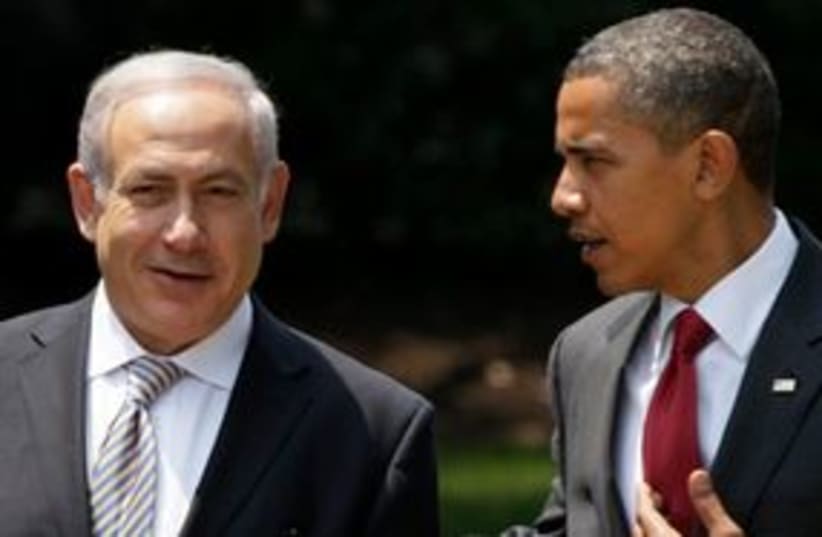
By JPOST.COM STAFFnetanyahu obama 311(photo credit: Associated Press)
Ron Dermer confirmed that the US-Israeli relationship had weathered a "rocky start" following the transition to new administrations in both countries during a December 14, 2009 meeting, the latest US government cable released by WikiLeaks revealed Sunday.During the meeting with with Senate staff members, Prime Minister Binyamin Netanyahu's senior adviser argued that the international environment had changed in favor of pursuing a pressure track with Iran.RELATED:'WikiLeaks employs Israeli-Swedish Holocaust-denier'Opinion: WikaLikes - US ME policy recalibration, Dec. 2010He also stressed that tougher sanctions combined with continued domestic pressure within Iran might bring about change in Teheran.The prime minister's advisor expressed frustration with the peace process, noting that the government had taken steps in the effort to convince Palestinian Authority President Mahmoud Abbas to return to the negotiating table to no avail.In another cable released by WikiLeaks Sunday it was written that "Israel is deceptively calm and prosperous." The cable created on November 12, 2009, was prepared for US Deputy Secretary of State James Steinberg's visit to the country.The cable went on to say that "the security situation inside Israel is the best since the outbreak of the Second Intifada, the economy has weathered the storms of the international economic crisis, and Netanyahu's governing coalition is stable, for the time being at least."'2010 will be a critical year in terms of Iran'According to different diplomatic cable leaked by WikiLeaks on Sunday, Israel predicted that that 2010 would be "a critical year" in terms of the Iranian nuclear threat.The document, which summarizes a meeting of the 40th joint political-military group from November 11, 2009, cited Israeli concerns that "if the Iranians continue to protect and harden their nuclear sites, it will be more difficult to target and damage them."The cable also revealed that Israel had raised concerns about dual citizenship with "respect to access to sensitive technology," and that the government had "recommended obtaining a waiver similar to the relationship from which Canada or Australia benefit."Defense Ministry Dir.-Gen. Pinhas Buchris and Maj.-Gen. (res.) Amos Gilad were both present at the meeting along with a number of other Israeli officials.US participants acknowledged Israeli concerns, noting that the issue was being worked at the highest levels of the US government to reach consensus on how to proceed.Click here for full Jpost coverage of the latest WikileaksThe same document discusses how Israel raised concern that the Government of Turkey was leaning toward Syria and Iran, and away from Israel.Israeli participants argued that Turkey has been supportive of Hamas in Gaza while pursuing a more "Islamic" direction with the goal of becoming a regional superpower.The document revealed that US and Israeli counterparts continued discussion on the creation of four new Qualitative Military Edge (QME) working groups.Both sides presented their primary points of contact for the four newly proposed working groups focusing on previous agreements, mitigation measures for the F-15 sale to Saudi Arabia.Iranian sanctions were also discussed and the cable revealed that the Israeli government officials expressed concern regarding Chinese and Russian cooperation with respect to enhanced Iranian sanctions.Diskin: Fatah 'on its last legs'; Yadlin: Gaza is 'number four' threatAnother releasedWikileaks cable from June 2007 revealed Shin Bet (Israeli Security Agency) head Yuval Diskin's assessments of the current situation in the Gaza Strip and West Bank.He painted a picture of "a desperate, disorganized, and demoralized Fatah in the Gaza Strip, versus a well-organized and ascendant Hamas."In separate cable released Monday, it was revealed that during a 2007 June 12 meeting with US Ambassador to Israel Richard H. Jones, then-head of Military Intelligence Maj.-Gen. Amos Yadlin said that Gaza was "number four" on his list of threats, preceded by Iran, Syria, and Hizbullah in that order.
if(catID != 151){
var cont = `Take Israel home with the new Jerusalem Post Store