There is a belief, recorded in the Mishna, that the world is judged through water.
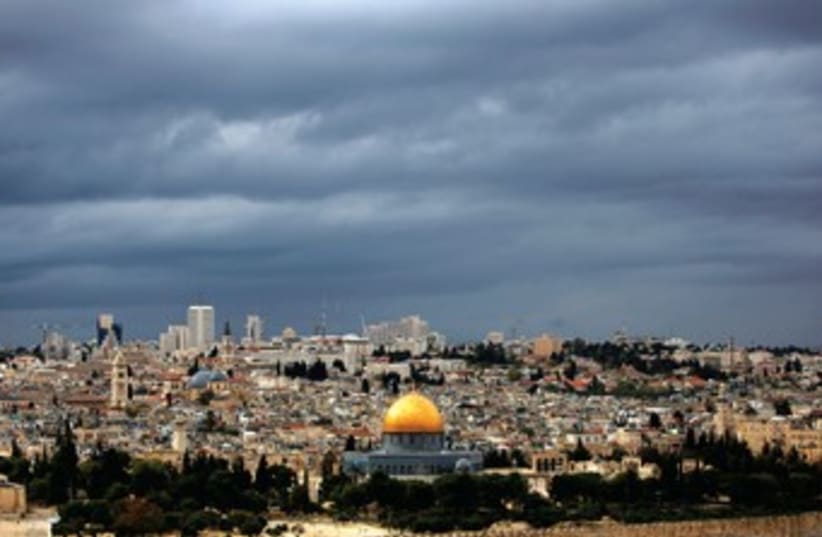
By DVORA WAYSMANDome of the Rock 370(photo credit: REUTERS)
Simhat Torah is the time to rejoice and to celebrate the completion of the reading of the Torah. Yet a little known, but important, aspect of the holiday is the fact that throughout the world on Simhat Torah, Jews pray for rain – in Israel on 22 Tishrei and a day later in the Diaspora. After all the joyous processions with the Torah scrolls, after the singing, dancing and merriment, when the scrolls are returned to the Ark, we recite: “Tefillat Geshem,” the Prayer for Rain.Why pray for rain, and why at this particular time? For Jews who live in the Southern Hemisphere (Australia, New Zealand, South Africa) it doesn’t even make sense, for in that part of the world summer is approaching, yet they are still required to make the petition. And is a winter of hard rain really necessary in Chicago?Click for more JPost High Holy Day featuresHistorically, when the Jewish nation was forced to leave its homeland and scatter in the Diaspora, the holidays related to Judaism were already firmly intertwined with the physical realities of the Land of Israel, with its landscape, nature and agricultural problems. Tishrei, the seventh month, is linked to the start of the winter rains. Even today, in an era of irrigation, crops in Israel will no doubt fail if a winter of drought is realized.We are commanded in Exodus 23:16: “You shall keep the festival of the ingathering at the end of the year, when you gather in from the fields the fruit of your labor.” The festival referred to is Succot, and Simhat Torah is the last day. By “the end of the year” is meant the end of the agricultural year, which in Israel is early, mid-October. In biblical times, crops still in the fields were hastily gathered for storage before the winter rains. The figs and raisins were brought in from the rooftops where they had been drying in the sun; olives were pressed for oil or marinated for eating and the date clusters were cut from the palm trees.The Prayer for Rain, recited by Ashkenazi Jews, was written by Eliezer Kallir. It pleads for abundant water because of the merit of our forefathers Abraham, Isaac and Jacob, Moses, Aaron and the Twelve Tribes… “for a blessing, and not for a curse; for life and not for death; for plenty and not for famine.”Prayers for rain are among the earliest liturgical texts, and withholding it is regarded in the Bible as a punishment from God (Deuteronomy 11:11-17; I Kings 17:1). God is acknowledged as the power causing rain, and in the prayer He is petitioned for fertility of the fields and preservation from famine.Simhat Torah only began to be celebrated as a separate festival from Succot some time between the sixth and 13th centuries. Rabbi Nahman of Breslov, a famed mystic and kabbalist, likened joy to a vessel with which to draw upon the wellsprings of the Torah’s vitality and freshness.There is a belief, recorded in the Mishna, that the world is judged through water. Today, with the Jewish people again settled in Israel, there is an even greater awareness of the unbroken unity of the Land of Israel and the nation of Israel.No matter in what part of the world Jews may live today, Judaism has only one tradition for all its people, which centers around the belief in one God who controls all the forces of nature, the fate of all crops and the destiny of all nations.It is fitting that when we celebrate at Simhat Torah, we pray for good winter rains that will ensure fertility for the Land of Israel.The writer is the author of 12 books. Her novel The Golden Pomegranate has been made into a movie, and will be released in Israel by Cinema City complexes on October 25.
if(catID != 151){
var cont = `Take Israel home with the new Jerusalem Post Store