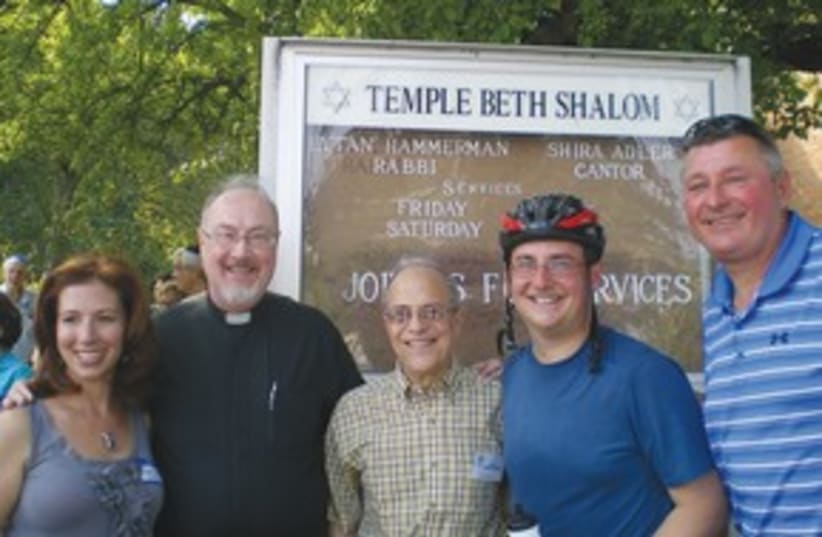
Rabbi Eytan Hammerman made a memorable entrance to his new position in Mahopac.
By DAVID GEFFENHammerman 311(photo credit: Courtesy)
Mahopac, in Putnam County New York, is 76 kilometers north of New York City with a population of 8,000. At Temple Beth Shalom, the local synagogue, founded in 1953, there are 132 family members comprising about 350 people. In June Rabbi Eytan Hammerman made a memorable entrance to his new position.“When I was here for my interview in the winter,” Hammerman emphasized recently, “I spotted a bike path running alongside Route 6 where Mahopac is located. I knew immediately that I had to move to my first rabbinical position by bike.”So on the last Sunday in June, he sent his wife Rebecca and their three kids off from the Westchester area by car. Hammerman, dressed for the day in latex blue, “off-loaded” his bike in White Plains. In that community he had been a student rabbi under the mentorship of Rabbi Gordon Tucker. There he linked up with two members, of course bikers, from Temple Beth Shalom and off they went on the 40 km. ride.The path of the rabbi’s biking adventure next to Route 6 resonates somewhat with the route which a few Jewish families, American patriots, took to escape the British in the Revolutionary War. In nearby Danbury, Connecticut, the noted New York Jewish silversmith Myer Myers used his equipment to cast bullets for the army.Hammerman recalls that “ as we got closer and closer, more people joined the route – bikers of all ages. It was fun but it related to how we should all appreciate and care for the world around us.”The ride occurred only a week before the Eden Village Camp, a new Jewish environmental camp, opened literally down the road with 150 young people.In fact, Hammerman’s temple loaned the camp a Torah for this first summer.The local newspaper, Mahopac News, described the arrival as being “wonderfully and uniquely American.”Present were Town Supervisor Kenneth Schnitt, Board of Education President Penny Swift, School Superintendent Thomas Manko, Mahopac Volunteer Fire Chief Ron Goodrow and Putnam County Sheriff Donald Smith.Brett Freeman, publisher of the paper, put it in these terms. “The presence of these individuals at the rabbi’s arrival ceremony, along with clergy from many of Mahopac churches, was an example of what makes America great... This follows in the footsteps of America’s first president, George Washington, who responded to a letter in 1790 from the Hebrew congregation in Newport, Rhode Island in this fashion assuring the ’children of the stock of Abraham’ that religious liberty was one of the hallmarks of the newly formed American government ‘which gives to bigotry no sanction, to persecution no assistance.’” The paper also felt that the presence of the town supervisor and the school superintendent “was a gesture of hope that the new rabbi would contribute to the education of Mahopac’s children.” Interestingly the paper also noted that “the presence of the sheriff was a testament that religion can have a positive impact on the moral order of our community.” The challenges for Hammerman are very wide ranging.Eytan Hammerman, 33, grew up in Toms River, New Jersey, where his father Richard Hammerman was a rabbi. The senior Hammerman served his congregation for more than three decades, in particular developing educational programs for all ages, sending youth to Camp Ramah and Israel and creating a strong ecumenical bond with his fellow clergy in the community.Richard and Sharon Hammerman have a deep love for Israel, have owned an apartment in Jerusalem for several decades where they brought their three children to visit and study on at least 30 trips.After Eytan completed his undergraduate studies at Columbia University, he worked for a foundation in Maryland which dealt with development of Jewish youth’s interest in philanthropy. After marrying, he took his new bride Rebecca to Madrid, Spain, for a year.As a team they helped to develop a Masorti congregation, and at one point Eytan taught the son of David Broza for his bar mitzva, held in Jerusalem.Now it was on to the Jewish Theological Seminary of America for five years of study, one of which was in Israel where their twins were born. Ordained in May, Hammerman now has the opportunity to use his religious, educational and organizational skills at Temple Beth Shalom. He stressed the following to me. “I want to program outside the walls of the synagogue. In the 21st century, the leadership of the Jewish community in general and synagogues in particular cannot sit under the roofs of our institutions and wonder why people won’t just come in the doors.”Hammerman wants to engage people in “their comfort zones.” That means in their homes whether it be via Shabbat programs or other types of study circles where people can raise the level of their yiddishkeit. He also wants to use community spaces – be it for Hanukka, Purim, Tu Bishvat – in the malls. “Then we can touch individuals who rarely if ever enter the synagogue.”Since there are a number of Hebraists in his family in Israel and in the US, Hammerman surprised everyone on his arrival with a linguistic footnote. “My uncle Ira in Israel posited that Mahopac might be derived from the Hebrew word ‘me-hu-pach’ or as translated ‘head-over-heels’ which is the way I already feel about my new hometown.”The writer is a Conservative rabbi and because of family friendship has watched the new rabbi develop for last 20 years.
if(catID != 151){
var cont = `Take Israel home with the new Jerusalem Post Store