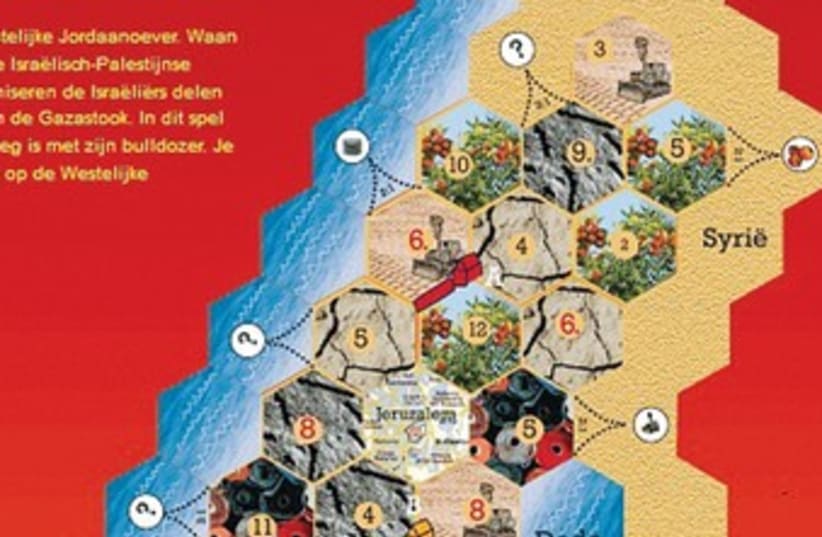
In downloadable game, players can use ‘Anne Frank card’ to colonize West Bank, 'Jewish stinginess' card to gain resources.
By CNAAN LIPHSHIZ, BENJAMIN WEINTHALSettlers of the West Bank 370(photo credit: Courtesy)
THE HAGUE\BERLIN – A Dutch public broadcasting network last month offered its viewers a board game featuring Israeli settlers who use “Jewish stinginess” and “the Anne Frank card” to colonize the West Bank.Organizations combating anti-Semitism have called on the Dutch government to persuade the network, VPRO, to halt the downloading of the board game.A VPRO representative said the game was not anti-Semitic, but rather a thought-provoking satire.The game, titled “The Settlers of the West Bank,” is based on the multiplayer hit “The Settlers of Catan,” first released in Germany in 1995. The Dutch variant appeared in 2010 on the VPRO website – a self-described liberal-Protestant network.In the game, the user is a settler trying to expand his community and mine diamonds and Dead Sea mud while producing textile and bulldozers. Players can use the “Jewish stinginess” card to force competitors to hand over resources. The instructions refer three times to the “nation’s typical mercantile spirit.”Terrorist attacks are described as a natural result of settlement expansion. “Saw wood, and you get wood chips: Not everyone’s happy with the Israeli settlements. Least of all the terrorist,” the instructions explain. “Terrorist attacks” cost players resources.The settler may also use the “Mahmoud Ahmadinejad card” to avoid losing resources to a terrorist and simultaneously draw resources from other players. The Anne Frank House is a “winning point” for the settler.The game first appeared on VPRO’s website for younger viewers and was prominently reposted last month. The network explained the reposting by saying: “It’s one of the items everyone loves to hate.”“Criticism of the settlement movement cannot appear in the form of anti-Semitic stereotypes,” said Joël Serphos, chairman of the Dutch youth organization CiJO – For Israel, for Peace. Serphos added that this “gave the wrong impression, that criticism on settlements is rooted in anti-Semitism.”Serphos, whose organization opposes settlement expansion, called on the Dutch Education, Culture and Science Ministry to compel the network to remove the game from its website and apologize for its publication.The Simon Wiesenthal Center strongly condemned VPRO for publishing the “disturbing” game.“It would be more likely as a product of neo-Nazis or Ahmadinejad,” Dr. Shimon Samuels, the center’s director for international relations, told The Jerusalem Post.References to Jewish stinginess, the exploitation of minerals and the “contemptuous misuse” of Ann Frank’s House as a “winning point” were “anti-Semitic tropes,” Samuels said.The Ministry of Education, Culture and Science provided 89 percent of VPRO’s budget of 51,973,000 euros in 2010.“This funding makes the Netherlands the largest financier of hate incitement among youth in Europe,” Samuels said.The Wiesenthal Center has written to Viviane Reding, the European Commission’s vice president for justice, fundamental rights and citizenship, urging her “to take all available measures to press The Hague to withdraw its funding from VPRO for as long as it serves as a vector for racism.”Queried by the Post, VPRO Communications Manager Marina Alings defined the game as “satire.” VPRO is of the opinion that “although the item ‘The Settlers of the West Bank’ could have done with some more delicate detailing, it is not fitting to earmark it as anti-Semitic,” she said.The VPRO Dorst youth section “ironically commented on the Israeli-Palestinian conflict with its satirical item,” Alings said.Alings added that VPRO did not seek permission from the designers of the original game before releasing the Dutch variant. “Since ‘The Settlers of the West Bank’ was made with such an unmistakable hint to the board game ‘The Settlers of Catan,’ the VPRO did not feel it was necessary,” Alings said.Freek Manche, spokesman for the Dutch Education Ministry, said “the minister of education, culture and science has no opinion about this specific game.” He added that the minister would not ask to remove the item from the website since it is not her responsibility.Manche said that VPRO told the ministry that the website that offers the game was developed by young editors of the weekly magazine VPRO Gids, which does not receive a government subsidy, but is financed through membership fees from VPRO’s approximately 300,000 subscribers.In the Netherlands, the original board game, “The Settlers of Catan,” is marketed by the 999 Games company.PR representative Saskia de Lint told the Post the firm “wants to stay out [of the issue] because we do not wish to take a stand.” She added: “We deeply regret the use of the game by [the young viewer platform of] VPRO.”De Lint would not say if the firm views the distribution of the Dutch game as copyright infringement, nor whether 999 Games would ask VPRO remove the controversial content.Calls and emails to the original game’s distributors in the US and Germany were not immediately returned. The company’s US representatives were at a retail convention in Las Vegas and were not immediately available for comment.
if(catID != 151){
var cont = `Take Israel home with the new Jerusalem Post Store