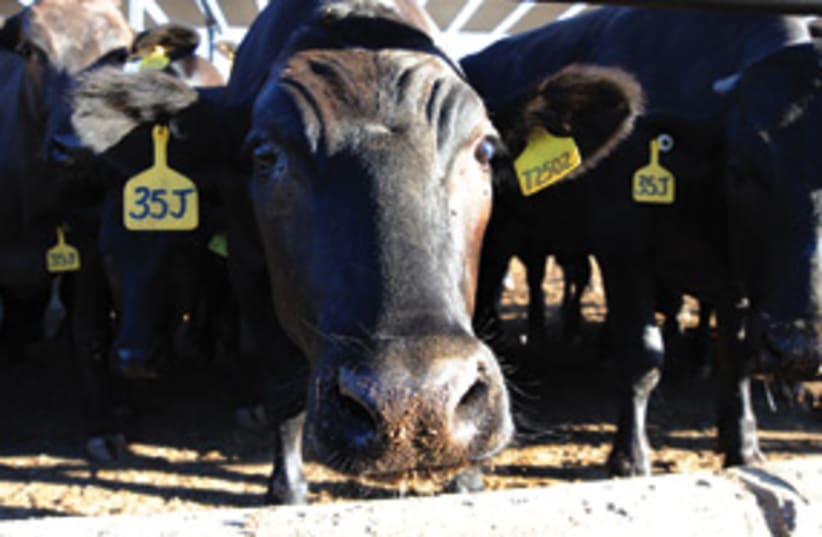
The Dutch parliament is set to debate a bill prohibiting the slaughter of animals in the Netherlands that have not been stunned.
By JONAH MANDELcows 311(photo credit: Courtesy)
Jewish communities in Europe are galvanizing their political clout and reaching out to whoever might help to prevent looming legislation that could seriously harm their right to conduct ritual slaughter of animals.The Dutch parliament is set to debate next week a bill prohibiting slaughtering animals in the Netherlands that have not been stunned, which would include Jewish shechita and the Muslim halal methods. The European Parliament is set to debate a number of new amendments to the EU’s draft Food Information Regulation next week, which will raise the possibility of labeling all meat slaughtered using the Jewish or Muslim methods. Such labeling, it is feared, would have devastating effects on the kosher meat industry.RELATED:EU ministers call to rescind rule for kosher meat labeling Shechita resumes in New Zealand New Zealand Jews fight for shechita Jewish law dictates that an animal about to be slaughtered “has to be fit and healthy and capable of independent life,” as Dr. Stuart Rosen wrote in a 2004 article defending shechita – defined there as “a perfectly clean incision through the structures at the front of the neck” – that appeared in the British Veterinary Association’s The Veterinary Record. Stunning – which can be done mechanically by dealing a blow to the animal’s head with a captive bolt pistol; with a large electrical discharge to the head; or through narcosis induced by making the creatures breathe carbon dioxide- enriched air – directly damages the animal’s nervous system.As such, it would become “unfit for Shechita because of an existing injury or abnormality,” Rosen explained.While killing animals to consume their meat is permitted in Europe, the EU’s directive “European Convention for the Protection of Animals for Slaughter” generally requires stunning before slaughter. Still, it lets member states allow exemptions for religious slaughter in light of Article 9 of the European Convention on Human Rights, which provides for the right to freedom of thought, conscience and religion.The only member of the EU to ban shechita to date is Sweden; Switzerland, Norway and Iceland, which are not part of the EU, have banned it as well, as per data provided by the Rabbinical Centre of Europe.The potential shechita crisis was one of the central topics on the itinerary of the European Jewish Congress’s General Assembly, held Sunday in Budapest. Last week, EJC President Moshe Kantor expressed his concern over the Dutch bill in a letter to The Netherlands’ Prime Minister Mark Rutte. The Dutch bill, put forth by a proanimal rights party and supported by politician Geert Wilders, who is not considered hostile to the local Jewish community, would also affect the widely unregulated halal practice in the country.“While the proposed law suggests that two million animals are slaughtered according to religious tradition every year in Holland, our records indicate that Jewish slaughter rarely exceeds a couple of thousand animals annually. So this law would only infringe on and single out the rights of a very small minority and have little effect on the vast majority of religious slaughter in The Netherlands,” Kantor wrote.The EJC also appealed to every Dutch parliamentarian and ambassador in Europe.Kantor met Sunday with Hungarian Prime Minister Viktor Orban, who is also the current president of the Council of the European Union.“Orban said he’d appeal to the president of the EU Parliament, Jerzy Buzek, to do what he could to prevent harming the Jewish community of Europe by prohibiting shechita,” Kantor told The Jerusalem Post, noting that while the volume of Jewish slaughter in the Netherlands was small, such a law could create a dangerous precedent.Kantor also stressed the importance of joint action on the topic.“The joint efforts of the Jewish communities from around Europe are crucial here,” Kantor said. “There are not many Jews in Europe, and our strength comes from synchronized action.”Joël Mergui, president of the Consistoire Central – the union of Jewish communities in France – who has been concentrating European efforts to protect shechita, explained in his address to the GA on the topic the financial ramifications of labeling meat taken from the bodies of animals that were not stunned.“Most of the meat from animals slaughtered according to Jewish law – some 75 percent – does not end up being kosher, either because of the part of the livestock it is, or because health blemishes were discovered in the animal post-slaughtering, which disqualifies it,” he said.That kind of meat ends up in the general market, and labeling would encourage its boycott, which would lead to a dramatic rise in the prices of kosher meat, he explained.Mergui also said that Jewish slaughtering causes the animal’s relatively swift loss of consciousness due to the lack of oxygen to the brain, while various methods of stunning have their faults and do not always succeed on the first attempt.Pro-stunning advocates contend that beginning the killing process this way is far more humane than simply cutting the animal’s throat with a very sharp blade.Sources involved in countering the Dutch bill believe that anti-Semitism is not at the root of it; however, Shimon Cohen of Shechita UK outrightly compared the notion of marking kosher meat, as per the proposal facing the European Parliament, to the Nazi methods of setting Jews apart.“Mr. Stevenson is picking on Jews and Muslims by saying that only their slaughter methods should be labeled. He is blatantly discriminating against our communities,” said Cohen, referring to Scottish Conservative MEP Struan Stevenson, who is behind the recent proposal.“It is the 21st-century equivalent of the yellow star, but on our food. We have our own labels for kosher meat, but we do not want the law to discriminate against us by singling us out in this way,” continued Cohen, whose organization advocates Jewish ritual slaughter.“Mr. Stevenson is a known opponent of shechita, and he is doing all he can to sow doubts in the minds of consumers about our slaughter methods, which are in fact both legal and humane – far more humane than the electrocution, clubbing, shooting and gassing that takes place in secular slaughter,” he contended.The question of shechita’s humaneness in comparison to other methods of killing animals seems as yet unresolved.Dr. Temple Grandin, a professor of Animal Science at Colorado State University who is considered one of the world’s leading experts on handling and welfare of livestock in slaughter plants, defended appropriately conducted shechita in an article published in the journal Meat & Poultry last year.“I have observed that cattle held in an upright restraint device had almost no reaction to correctly done Kosher slaughter that was performed with a special long knife,” she wrote.“The cut with the special knife appeared to not cause pain.”In some kosher slaughterhouses, however, the animals, still conscious, are hoisted with shackles before being killed, which greatly increases their anxiety and suffering. Chief Ashkenazi Rabbi Yona Metzger informed kosher slaughterhouses in South America last year that he would no longer permit the import of meat produced in such an inhumane manner to Israel. An alternate method, involving large brackets that hold the animal from both sides and then flip it over, is being gradually introduced instead of the shackles.“From my observations, it appears that when good practices are used, the steer or lamb will stay still and not react to the cut,” she wrote. “For religious slaughter it is important to use a knife that is long enough to fully span the neck; keep the tip of the knife outside the neck during the cut; use a very sharp knife; and hold the wound open during the cut.”Addressing findings of a team of New Zealand researchers that showed how slaughter without stunning causes pain, Grandin stated that the knives used in that study to kill the animals were neither as long nor as sharp as Jewish slaughter practice dictates. Additionally Grandin noted that “in properly done kosher slaughter, the wound is held open during the cut,” an action that apparently diminishes the animal’s pain, while “the methods section of the [New Zealand] paper did not contain sufficient detail to determine if the wound was held open during the cut.”New Zealand has also recently outlawed shechita in its limits.To Margui, himself a medical professional, there is no doubt as to the humaneness of the ancient Jewish ritual slaughter practices. He has asked various Israeli ministers, as well as Metzger, to help the Jewish European efforts by finding a major Israeli university to conduct a comparative study of the Jewish and European animal-killing methods.“It is now time that Israel helps the Diaspora, too,” he told the Post.Margui’s efforts to counter the European legislation include urging the various Jewish communities into action in every country, in line with the Jewish principal of mutual responsibility and the belief that the passing of one law prohibiting or hindering shechita could create a broader phenomenon.He also is coordinating with the other group that stands to be affected by such legislation: the local Muslim community.“We are working closely with the Muslim community of France on this, and I am in contact with my Muslim counterpart, who sees the issue eye to eye with me,” he said.
if(catID != 151){
var cont = `Take Israel home with the new Jerusalem Post Store