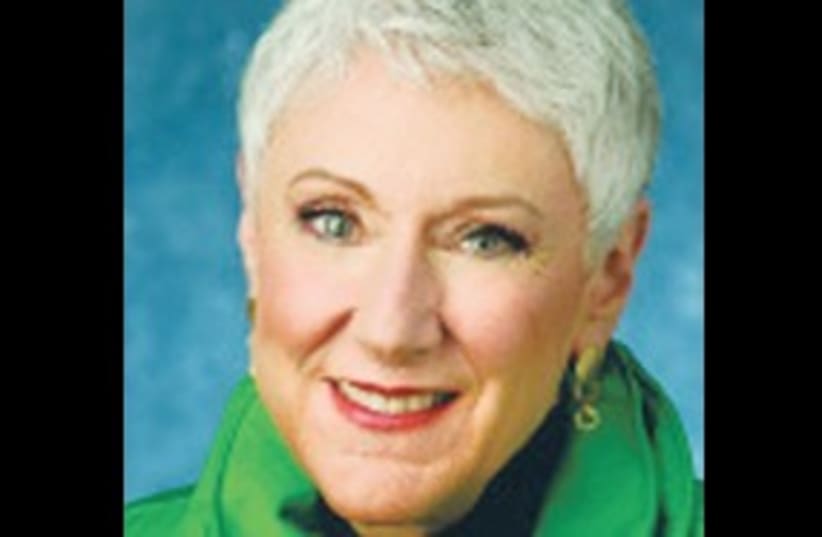
New Hadassah head: Next generation is ‘our top priority’
Marcie Natan: Women’s group hit hard by Madoff, but has balanced its books.
By GIL STERN STERN SHEFLER, JERUSALEM POST CORRESPONDENTMarcie Natan 311(photo credit: Hadassah)
NEW YORK – Marcie Natan has no illusions about the aging membership of Hadassah, the Women’s Zionist Organization of America, and what it spells for the future of the group that will celebrate its centenary next year.In a recent interview at its headquarters in New York City, Hadassah’s new national president said getting younger women involved in its activities has been one of her top priorities since she assumed her position in July.“I’m very much hoping that we can find a way to bring the next generation of women and really connect them with Hadassah,” she said.“It’s been a challenge that we’ve been facing for many years. The changing role of women, the fact that they have careers and are starting their families later and have limited discretionary time makes it harder and harder for us to really involve them.”To that effect, Hadassah has launched a centennial campaign that has brought in 32,000 new life-time members. But that’s the easy part, according to Natan.“We need to get them connected to Israel, and that’s a big piece for me because the future lies in being able to train and involved the next generation of leadership,” she said.The new national president of Hadassah slowly rose through the ranks.Born to a Jewish family who immigrated from “one of these areas that was either Russia or Poland depending on which day of the week it was,” one of her fondest childhood memories is of sitting around the radio and listening to the 1947 vote on the partition of Palestine at the United Nations.“I grew up with this aura of Israel and the realization of how important it is,” she said.It might come as a surprise, but the current president of Hadassah said she joined the group almost by accident.“I went to a study group in Baltimore where I was living at the time, and when it was over I enjoyed the dialogue and liked the other women in the group,” she recalled. “They took me aside and said we’d love to have you continue to come, but we’d like you to know that this meeting has been held under the auspices of Hadassah, the Zionist Women’s Organization of America, and if you want to continue to come you have to pay $10 a year – shows you how many years ago it was. So I became a member. I joined a study group that happened to be Hadassah.”When she moved to Lancaster, Pennsylvania, with her husband in 1977 she became the head of the now defunct East Pennsylvania district. Later, she served in New York as national secretary for three years and national treasurer for four years before deciding to run for national president last year.Hadassah was one of the Jewish organizations hit hardest by Bernie Madoff’s stock scam. But Natan, the group’s former treasurer, reiterated the statement made last year that it has balanced its books.“We are financially sound,” she said. “We paid $45 million in clawback. We made major financial adjustments over the years but it is now behind us and now we’re hoping the economy will stay stable.”Total fund-raising for 2010 was $78m., of which $16m. was dedicated toward the construction of The Sarah Wetsman Davidson Hospital Tower at Hadassah University Medical Center in Jerusalem’s Ein Kerem, she said. The first patient is expected to move into the tower in March and a dedication will be held in 2012 with about 3,000 people in attendance.Much has changed since Hadassah was founded by Henrietta Szold in 1912. Back then Palestine was a poor area of the Ottoman Empire, “the sick man of Europe” as it was dubbed.
The territory had little infrastructure and few doctors, and the monies sent by American Jews were a lifeline for its fledgling Jewish settlement. Nowadays Israel is a “Start-Up Nation,” an economic miracle that is the envy of many. Its increasing affluence has raised the question of whether Jewish-Americans still need to send money to their no longer poor cousins.Natan said she realized Israel was no longer a Third-World country and that her group had changed its giving strategy to reflect that.“We’re not giving our money to Israeli colleges so they can open the doors, we’re giving the money so that Israelis who otherwise wouldn’t have the opportunity to go to school, whose families couldn’t afford it, could go,” she said. “We’re not giving you money to eat, we’re giving you money to train chefs that are world class. We’re not giving you money to open a hotel, but we’re giving money to open a hotel managers course so that any tourist around the world can go into an Israeli hotel and say, ‘Wow,’ this is the best services I’ve ever experienced.”
if(catID != 151){
var cont = `Take Israel home with the new Jerusalem Post Store