Festival will be held for fifth year in a row and is expected to draw tens of thousands of people, Jews and non-Jews.
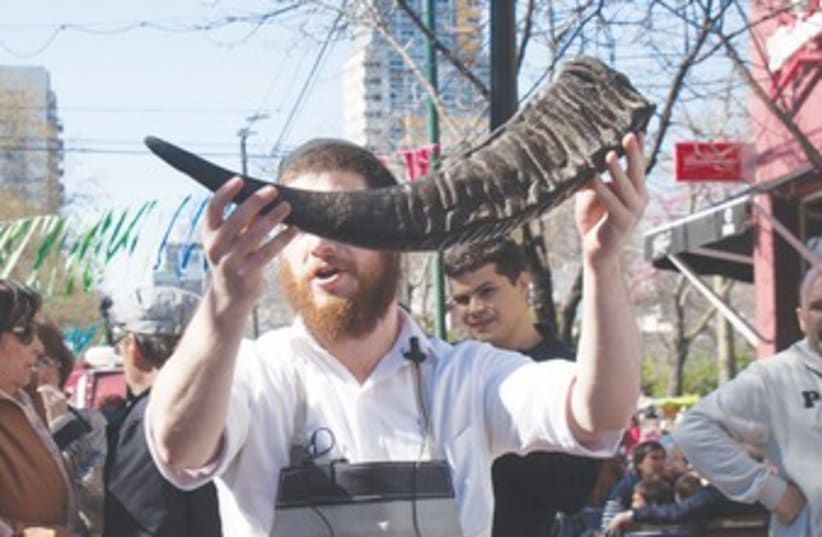
By GIL STERN STERN SHEFLERMan holds shofar at Buenos Aires Rosh Hashana festival 370(photo credit: JDC)
Jewish communities around the world on Thursday were preparing for the Jewish new year that starts on Sunday evening, each with its unique traditions and festivals.In Buenos Aires, for instance, organizers of an annual fiesta called Rosh Hashana Urbano were putting the final touches on their event.“Rosh Hashana Urbano is an activity, a strategic program the American Jewish Joint Distribution Committee developed, that reaches out to mostly non-affiliated Jews with holiday activities in an open place,” said Diego Freedman, the man organizing the mix of concerts, stand-up performances and lectures. “We consider it to be part of the Jewish community center without walls.”The festival will be held in the neighborhood of Palermo for the fifth year in a row and is expected to draw tens of thousands of people, Jews and non-Jews alike. Its roster includes bands such as BarbaCoaJ, an act that blends Sephardi and Ashkenazi sounds with reggaeton and rock similar to the style popularized by Jewish-American singer Matisyahu; Jewish essayist and thinker Santiago Kovaldoff, who will return a second time after delivering a successful lecture last year; and Sergio Langer, a cartoonist whose work has been featured in publications like La Nacion and Pagina/ 12.Click for more JPost High Holy Day featuresOne favorite from years past that will not take place this Rosh Hashana is the gefilte fish contest. Freedman said locals were asked in 2011 to submit entries of the homemade carp dish traditionally consumed over the holiday to a panel of judges.“They went over the different dishes that people brought from home and selected a winner,” he said. “It was very amusing.”Despite its success, organizers decided to drop the fish ball contest from the itinerary this year, though Freedman said it might return in the future.Ahead of Rosh Hashana there is some room for optimism in the area. Jewish institutions in Buenos Aires have been heavily fortified since the 1992 and 1994 bombings of the Israeli Embassy and the Jewish community center that left 114 dead, but festival organizers said that from their experience there has been an improvement in the local security situation.“When it started five years ago people from Bitachon,” a local Jewish security outfit, “called us and told us we will need special security but we have full cooperation with police and we don’t provide any Jewish security,” Greenberg said.“We’re like any other public act and the last six years we had no problems, which is a good signal.”
if(catID != 151){
var cont = `Take Israel home with the new Jerusalem Post Store