Binah is taking a stand against what it deems a renewed legitimization of Italy’s fascist past and anti-Semitism.
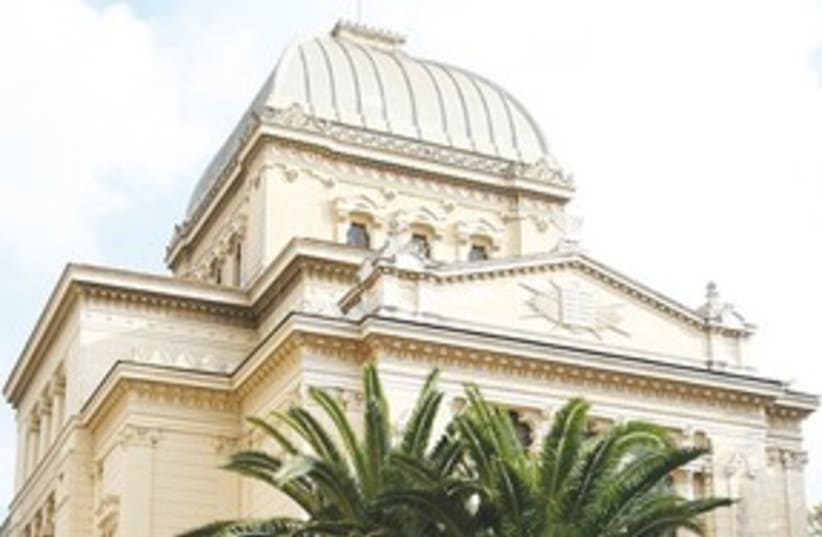
By LISA PALMIERI-BILLIG JPOST CORRESPONDETEMPIO MAGGIORE: Rome’s Great Synagogue 311(photo credit: Arthur Wolak)
ROME – A new Jewish women’s group in Italy is taking a stand against what it sees as a growing legitimization of fascism and anti-Semitism in the country.The group, Binah, protested the latest event appearing to signal renewed legitimization of Italy’s fascist past, when a mausoleum and park honoring a fascist commander was inaugurated in Rome in August.The monument raised in the town of Affile to Rodolfo Graziani, once defense minister of the Italian Socialist Republic of Salo, cost 127,000 euros from regional and local budgets.At the opening ceremony a priest performed a mass and gave a sermon in Graziani’s memory, followed by a buffet and an evening of entertainment.The National Partisans Association (ANPI) lodged an official protest and made known its intention to sue the town mayor for an “apology for fascism [and related crimes].”An open letter to Italian Jewish leaders was written by the councillors of Binah, the new all-women’s party elected to the National Board of the Union of Italian Jewish Communities (UCEI) by 40 percent of Jewish voters in recent elections.Binah’s letter invites the UCEI “to interrupt a deafening silence” and take urgent measures against this “shame on Italian soil” with special reference to responsibility for “the new generations.”Graziani, whose signature is on the 1938 Racial Laws – against Jews – was nicknamed the “butcher of Fezzan” and the “butcher of Ethiopia” for his brutal executions of Libyans, his responsibility for about 50,000 deaths in Africa, the use of poison gas and chemicals and his ruthless massacres of Italian partisans.Binah calls for Jewish leadership to take action against a series of recent incidents of historic revisionism and anti- Semitism, and supports a request to the UCEI by Carla Di Veroli, councillor for Culture, Youth, Equal Opportunity and Memory of the 11th Rome Municipal District.Di Veroli has requested that the parliament be pressured for ratification of the “Additional Protocol” to the 2001 Budapest “Convention on Internet Crimes” related to “racist and xenophobic Internet crimes” adopted by the Council of Europe in 2003. This protocol permits signature states to black out internet activity regarding the denial of any genocide.“The US plays a fundamental role in this,” says Di Veroli, “since 70 percent of the world’s Internet servers of countries that ratified only the Budapest Convention [and not the additional protocol] are housed there.”On September 30, Italy lost a national hero, Shlomo Venezia, 88, a Holocaust survivor who since the 1980s had been speaking and writing tirelessly about his nightmarish experiences, having been forced to serve in an Auschwitz Sonderkommando.In a poignant speech to Venezia’s memory, Riccardo Pacifici, president of the Rome Jewish Community, once again appealed for the enactment of a law against Holocaust denial – a proposal espoused by Binah.While Italian Jewish champions of free speech have long opposed this, the proposal is finding more consensus following the appearance of shocking comments and insults to Venezia on Stormfront, the neo-Nazi Holocaust-denier Internet site which offers such comments as “one less liar in the world”; “sooner or later all these fake survivors will die off”; “Pinocchio is dead...long live Pinocchio! Not to worry – his stories, his ugly book, his recorded tapes will keep him alive...”However, municipal and national government officials and inter-religious associations repeatedly organize commemorations of Holocaust-related events. The Catholic community of St. Egidio will once again lead a silent march to remember this year’s anniversary of the Nazi round-up of Roman Jews on October 16, 1943.Italian President Giorgio Napolitano is scheduled to speak at Rome’s Great Synagogue on October 10 in memory of victims of the Palestinian terrorist attack of October 9, 1982 which cost the life of a baby, Stefano Tache.Holocaust memories and Righteous Gentiles were recalled last week – and will be again later this month – in commemorations of Raoul Wallenberg and Giorgio Perlasca.The latter was an Italian businessman who impersonated a Spanish diplomat in Budapest to save the lives of 5,000 Hungarian Jews, supplying them with Sephardi identity papers.The Rome Holocaust Foundation and the mayor of Rome organize regular trips to Auschwitz-Birkenau for high school students. January 27, the anniversary of Auschwitz’s liberation by the Russian army is a nationwide event.However, despite all this activity, there is a growing tendency to rewrite history by giving in to demands of “letting bygones be bygones” and offering equal honor to the memory of fascists as to their victims’ for the sake of national pacification.Some time ago, Roman Mayor Gianni Alemanno – justifiably praised for his remarkable campaign for the liberation of Gilad Schalit and for sponsoring educational trips to Auschwitz – sponsored a meeting of veterans of the hardline fascist “Decima Mas” association at a municipality conference room.Partisan associations, political groups, and the women of Binah are attempting to stem this tide.
if(catID != 151){
var cont = `Take Israel home with the new Jerusalem Post Store