But before we get upset or ecstatic that Israel has found religion, we should take a deep breath.
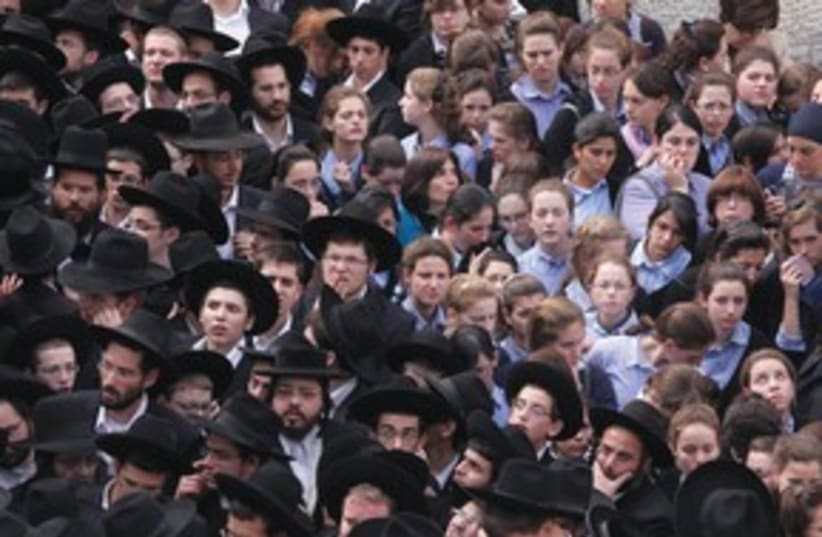
By REUVEN HAMMERrelligous, orthodox, haredi boys, girls_311(photo credit: Marc israel sellem )
‘Jewish Israelis becoming more religious, poll finds,’ proclaimed a recent headline in The Jerusalem Post (January 27). Haaretz was even more impressed, using a large bold, two-line front-page headline reporting on a survey that found a “record number of Israeli Jews believe in God.”But before we get either upset or ecstatic that Israel has found religion, we should take a deep breath, read the survey carefully and then realize that there is nothing here to get excited about, one way or the other.Remembering that such a survey must have some margin of error, a change in those who believe in God from 76 percent in 1990 to 80% in 2009 hardly seems radical – especially when one takes into consideration the increased numbers of both the national religious and the haredi (ultra-Orthodox) populations. How many more of them were questioned this time than before? Furthermore, take the question itself, “Do you believe in God?” – to which 80% replied that they “believe wholeheartedly” or “believe but sometimes doubt.” How many were in the “wholehearted” category, and how many in the “sometimes doubt” one? It makes a difference.Additionally, what does “believe in God” really mean? It is such an amorphous concept that the answer to it can mean much or little.INDEED, THERE is more hidden than revealed in the figures that were presented in this article. Eighty-five percent said that “celebrating the Jewish holidays as prescribed by religious tradition” was “important” or “very important.” But did they say they celebrated them that way themselves, and, if so, what exactly do they observe? Which holidays and in what way? Before we get too excited about an Israeli return to religion, let’s not forget that the majority of respondents also said they wanted shopping centers and public transportation, as well as movies, restaurants, etc., to be open on Shabbat. A majority support civil marriage as well.I think that this is a case of much ado about nothing. To prove that there has been a resurgence of religious belief or religious practice here – both of which I would love to see – one would have to find out how many people have actually changed their ways of believing or acting over the years. What this survey shows, if it shows anything, is simply that the Orthodox and haredi populations have grown over the past two decades, and that we already knew. What the rest of the population thinks or does, and how that has changed, remains a great unknown.THE IMPORTANT stories about religion and religious observance in Israel are the growth in the haredi population, which will have profound effects politically, financially and socially; the “haredization” of much of Orthodoxy; and the radicalization of the haredi community.We no longer have a Mizrahi-type Chief Rabbinate, but a haredi one. The demands that many Orthodox soldiers, goaded by their rabbis, have made for the separation of men and women in the army, as well as not hearing women sing, demonstrates a change in behavior, a radical shift to the Right even among many so-called moderates.The haredim themselves, or at least some of them, have also gone far beyond their previous demands regarding women and have become physically and verbally violent in their conduct.Personally I believe that we need more religion in Israel, not less.But the religion we need is one that will turn away from extremism and emphasize the humanism that is to be found in the Jewish tradition, rather than the darker hues of superstition and obscurantism.We need rabbis who will not automatically take the stricter position when a more lenient one is available. Religion can be a force for good and for moderation, or it can be a force for divisiveness. What is needed now is more brave religious leaders who will speak up when Judaism is being distorted and will lead it in the correct direction.Such a development would truly warrant bold headlines.The writer, former president of the International Rabbinical Assembly, is a two-time winner of the National Book Award. His latest book is The Torah Revolution (Jewish Lights).
if(catID != 151){
var cont = `Take Israel home with the new Jerusalem Post Store