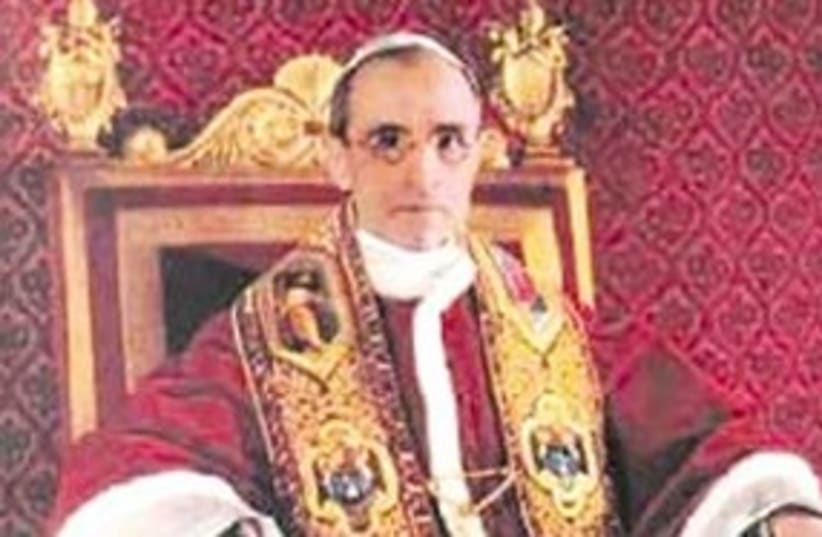
Israel’s ambassador to the Holy See regards Pius’s views toward
newly established state of Israel as a product of his times.
By LISA PALMIERI-BILLIG, JERUSALEM POST CORRESPONDPope Pius XII 311 courtesy(photo credit: Courtesy)
ROME – The creation of the State of Israel in 1948 was viewed by the Vatican “with mixed feelings,” and Pope Pius XII greeted the news by calling for a “crusade of prayer” for “the sacred land” (“terra sacra”), says Mordechay Lewy, Israel’s ambassador to the Holy See.Lewy made the remarks in a speech in Munich, a transcript of which was published in the Frankfurter Allgemeine Zeitung on Friday.Lewy presents Pius XII (recently moved one step closer toward sainthood by Benedict XVI) as a self-doubting Hamlet, working behind the scenes, who is insecure in his choice of public silence over Nazi persecutions. Lewy recalls several incidents where Pius failed to act against anti-Semitism.In private conversations, Pope Pius XII/Cardinal Eugenio Pacelli expressed a fear of worsening the situation by speaking out. However, it’s not clear whether this was a realistic or morally justifiable assessment, Lewy says.Then-cardinal Pacelli’s only objection to Italy’s anti-Semitic laws in 1938 was regarding mixed marriage provisions. He became pope on March 2, 1939, and continued to remain silent after the war in 1946, when approached by Jacques Maritain (at the time France’s ambassador to the Holy See) to publicly condemn anti-Semitism.While the controversy over Pius’s diplomacy, and the question of whether the Church institutions that opened their doors to thousands of Jewish refugees acted on official orders from the pope remains shrouded in secrecy, Lewy shifts his focus to “no less important issues”– namely, the mentality of Pacelli, seen as a product of his times.Pius’s attitude reflected the Vatican’s stolid opposition to the founding of a Jewish state, Lewy concludes. According to Lewy the motivations were political, mixed with anti-Judaic theological prejudices common among Catholic society in the pre-war and pre-Vatican Council II era.“On the day of Israel’s foundation,” says Lewy, “the Osservatore Romano [the official Vatican daily] described the situation as ‘another milestone on the Palestinian Via Cruxis.’ The reference to Christ’s passion was not accidental.”“The founding of the State of Israel was seen in the Vatican as a Communist-Atheist threat,” says Lewy. “On June 12, 1948, an editorial in the Osservatore Romano stated, ‘The birth of Israel gives Moscow a base in the Near East from which the microbes can multiply and spread.’“However, opposing demonizing comparisons were also used. The bulletin of the [Catholic] Congregation de Propaganda Fide, at that time, even went so far as to defame Zionism as ‘the new Nazism,’” Lewy said.Aversion to the Israeli state lasted for decades. As late as 1957, recalls Lewy, Pius’s foreign minister, Domenico Tardini, wrote to the French ambassador, “I always felt that there was no overriding reason to found this state. It was a mistake of the Western countries. Its existence is an immanent factor for the danger of war in the Near East. Since Israel exists, of course there is no possibility for destroying it, but we are paying the price for this mistake day by day.”This negative attitude, says Lewy, was rooted in a prevailing theology that considered Jews “a deicide people who lost God’s grace and with it their right to the Holy Land. The goal of the Zionist movement was in open contrast to traditional Catholic doctrine.”A taboo on calling Israel by name lasted for decades, and had some humorous aspects. In 1955, the Israel Philharmonic Orchestra performed at the Vatican and L’Osservatore Romano reported a performance “by Jewish musicians from 14 countries.”Pope Paul VI’s 1964 visit to Israel was a visit to “the Holy Land,” and he did not meet with Israeli leaders.The current era of bilateral relations with Israel was ushered in during the 1980s by Pope John Paul II, the first pope to speak openly of “the right of the people of the State of Israel to live in peace and security,” initiating the process that led to diplomatic recognition of Israel in 1994.Regarding the controversy over Pius XII’s “silence” during the Shoah, which was accompanied, however, by the opening of church institutions to Jewish and political refugees, Lewy echoes the repeated calls by Jewish leaders to suspend historical evaluation until scholars have access to the secret archives of the wartime years of Pius’s papacy.While Vatican officials foresee the opening of these archives withinfive years, they note that all the pre-1939 documents referring toPacelli’s nunciate in Germany and his years as Pius XI’s secretary ofstate are already available.Lewy confirms the documents’ historical importance, recalling, forexample, Pacelli’s research in Munich on “the relationship betweenCommunists and Jews in the 1919-21 Revolution. The stereotype of afusion between Bolsheviks and Jews could be particularly devastating,”intimating a possible influence on Pacelli’s attitudes.To optimize historical research on the vast amount of material alreadyavailable, Lewy suggests a work strategy involving cross-consultationsbetween Vatican and European archives.
if(catID != 151){
var cont = `Take Israel home with the new Jerusalem Post Store