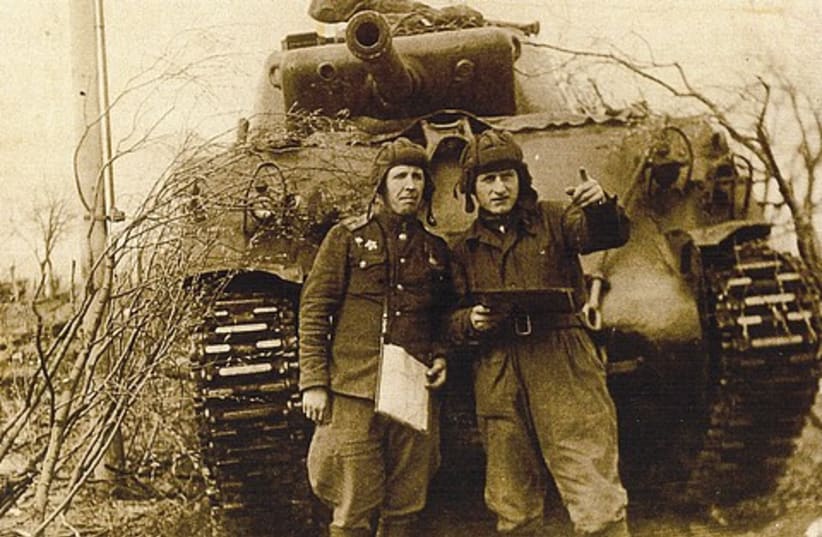
Most Israelis are ignorant of the fact that 1.5 million Jews fought Hitler and Nazism during World War II.
By JOANNA PARASZCZUKRed Army jews(photo credit: Association for the Museum of the Jewish Soldier i)
Red Army veteran Shalom Scopas defies his 85 years as he dashes about the mini-museum of World War II memorabilia he has created in the basement of his Holon home. His bright blue eyes sparking with pride, he points out rows of medals, sepia snapshots of himself as a dashing young man in his smart Soviet uniform, and letters of gratitude from Russian President Dmitry Medvedev and former president Vladimir Putin.Scopas is one of half a million Soviet Jews who joined the Red Army to fight against the Nazis. Forty percent of these Jewish recruits died in battle, the highest percentage of all the USSR’s ethnic groups.Soviet Jews were not the only ones to join the fight against the Nazis. One and a half million Jews from all over the world fought in World War II, including 150,000 women. A quarter million of these Jewish fighters fell in battle.“Yet most Israelis, especially young people, don’t know that so many Jews stood up and fought Hitler and Nazism,” says Scopas. “It’s very sad.”Scopas was born in 1925 in Panevezys, one of the largest centers of Jewish life in Lithuania. The Baltic state was occupied by the Soviet Union in 1940 and a year later by the Nazis.As the German forces approached Panevezys in June 1941, panic gripped the town. Scopas’s mother told him to flee to Russia with his older brother, Hillel.The 16-year-old managed to hitch a ride out of Panevezys on a Red Army truck, but Hillel didn’t make it.It was the last time Scopas was to see his family. Four days later, the Nazis entered Panevezys. Lithuanian Nazi collaborators murdered Rochel Leah and sons Hillel, Shimon and Avraham on August 28, 1941.By 1943, Panevezys’s Jewish community had been obliterated. Scopas reached Russia and in 1942 joined the Red Army.“I was Jewish. I wanted to fight the Nazis,” he says, switching from Hebrew to Russian as his memories take him back in time. Scopas was assigned to the razvedchiki, specially trained troops who went behind enemy lines to capture what the Russians dubbed yazyki (“tongues”) – German soldiers who were pumped for information about enemy plans.“We were sent out on undercover missions,” Scopas relates. “One day we went to bring back ‘tongues’ from a German military hospital in the forest. We captured several Germans. One of the captive officers lit a cigarette.I said in Yiddish: ‘Put it out, the smoke will give away our position. He refused... I killed him on the spot.“I had to. I still have nightmares. It was terrible. War is awful, a terrible thing.”On January 12, 1945, Scopas went behind enemy lines for what would be his last retrieval mission.“When we went out, I carried a medal, ‘For Courage’, in my breast pocket. We attacked a line of Nazis in the forest. In the fighting, we lost three comrades. Then the enemy lobbed a grenade at me from close range. I woke up days later in hospital covered in wounds. The doctor said if it hadn’t been for that medal over my heart, I’d have been a goner for sure.“A piece of the medal was missing where shrapnel hit it! It saved my life.”The Red Army’s Jewish soldiers knew nothing about the death camps until the end of the war. “When we found out, it was terrible. We were in shock. Horrified. We wept and wept,” Scopas remembers.Scopas made aliya in 1959, fleeing rampant anti- Semitism in the USSR. Despite his many decorations and the honor he has received in Russia and Israel for his wartime bravery, the traumas of war have not left him.“I am disabled. I still feel trauma, sometimes depression,” he admits. “War is cruel and terrible.”Brig.-Gen. (ret.) Zvi Kan-Tor, who over the past decade has pushed forward plans for a dedicated museum to commemorate Jewish fighters like Scopas, describes the extent of the global Jewish contribution to the war as “enormous.” Jews fought in the ranks of the Allied Forces, in underground movements, as partisans and in the ghettos themselves, in every single battle in Europe, North Africa and the Far East, on land, air and sea.“THE BIGGEST army that fought against the Nazis was the Jews. No other nation on earth provided so many soldiers,” explains Kan-Tor. Yet the fact that so many Jewish soldiers enlisted to fight against Nazism, or fought as partisans has thus far been overlooked in Israeli and Jewish history.“In Israel people are not aware of the extent of Jewish heroism in World War II,” stresses Kan-Tor. “It’s a historical injustice.”To shed light on this neglected chapter of Jewish history, Kan-Tor and a team of other World War II experts and veterans have revealed plans for a museum dedicated to the subject, The Museum of the Jewish Soldier in World War II.Why is this museum being created only now, 62 years after the State of Israel was founded? “There is a deficit in our education,” believes Kan-Tor.“In the first years of the State of Israel, the country faced tremendous difficulties. The trauma of World War II, then the War of Independence, financial troubles, international pressures. Huge waves of aliya brought Jews from all over the world. At the same time, Israel needed to build a new nation, a new country.”To do this, Israel needed Israeli heroes, says Kan-Tor.“We grew up on our own heroes, from the Lehi, the Hagana and the Irgun Zva’i Leumi. It’s painful to say it, but those from poor, old broken Europe were not heroes then,” he continues sadly. “At that time, even Shoah survivors were not heroes.” This sounds unthinkable to contemporary Israeli ears.But the young Jewish state was determined to build a strong national identity that would enable it to rise from the ashes of World War II – and fight its own wars.As the years passed, Israeli Jews were forced to come to terms with the enormity of the Shoah.“In 1961 came a watershed: the trial of Adolf Eichmann. Everyone heard what happened in that trial, and suddenly, people started to talk,” says Kan-Tor. “We realized, we understood that Shoah survivors had so much to tell us.”In 1953, Yad Vashem, the Holocaust Martyrs’ and Heroes’ Remembrance Authority, was established by government decree. In the 1960s, a permanent museum to honor and remember the six million who perished was created in Jerusalem.With the 1980s came another turning point: the fall of the Iron Curtain opened up Eastern Europe to outside visitors.“Now we could visit Poland,” says Kan-Tor. “We saw the camps. We knew those who we thought victims were really heroes.”THE DISINTEGRATION of the USSR in 1989 opened the gates for hundreds of thousands of Jews from former Soviet countries to make aliya. Now Israelis saw another side to the events of World War II.“We saw Russian olim wearing medals,” remembers Kan-Tor. “They brought with them new customs like Veterans’ Days. We heard Russians talking about the Great Patriotic War. Here were Jews who fought against the Nazis.”The Jewish soldiers had a unique role in the war, says Dr. Tamar Ketko, a World War II expert and curator of the new museum. “They had a double identity. They were recruited as Soviet, American or British soldiers but they also fought as Jews.”As more became known about the extent of the Jewish contribution in World War II, ideas started to germinate about commemorating the Jewish fighters. Like all ideas, it started out small – a single room at the Armored Corps Memorial in Latrun.To properly commemorate the incredible history of Jewish heroism in World War II, a 2,000-square-meter site has been earmarked for a dedicated museum at the Armored Corps Memorial.Led by Kan-Tor, the museum project is supported by Dr. Tamar Ketko, architects Zalman Enav and Haim Dotan, and museum designers from the Orpan Group.Separate wings are planned for each of the armies in which Jews fought, plus the partisans and ghetto fighters.Through maps, movies, photos, displays of uniforms and medals, and most importantly via the personal stories of individual fighters, Kan-Tor hopes visitors will be able to glimpse the amazing courage of the one and a half million Jews who helped defeat Nazism.Kan-Tor says the Museum of the Jewish Soldier in World War II has received government backing.Ariel Sharon’s government initially agreed to the museum in 2002. More recently, the cause has been championed by Avigdor Lieberman, chairman of Israel Beiteinu and now foreign minister, who insisted on funding for the museum being a condition of the coalition agreement he signed with former prime minister Ehud Olmert in 2006.However, while the government has agreed to provide up to $16 million in matched funds, it has still to issue a building permit to construct the museum at Latrun, Kan-Tor says. The delay is because the land earmarked for the museum is on the border of Judea and Samaria, disputed West Bank territory. The building permit is being coordinated via the Ministry of Defense Coordinator of Government Activities in the Territories (COGAT) and the Israeli Civil Administration, the governing body operating in Judea and Samaria.“The Armored Corps Memorial is currently in the process of regulating the contracts required to build the museum in conjunction with the Israeli Civil Administration,” said a COGAT spokesperson in a statement in response to a query by Metro.“Upon completion of the contractual agreement, the conditions for issuing building permits will be negotiated in accordance with the criteria established by the Israeli Civil Administration’s planning office.”REGARDLESS OF this delay, the museum has received widespread support from Jewish World War II veterans in Israel. Among those championing it is Dr. Yitzhak Arad, the former director-general of Yad Vashem and an internationally renowned World War II historian.A teenager during the war, Arad joined the fight against the Nazis as a partisan in the forests of Lithuania.Born Yitzhak Rudnicki on November 11, 1926, in Swieciany, Lithuania, Arad moved to Warsaw as a child with his family. The Rudnickis were ardent Zionists.When World War II broke out in 1939, Arad was just 13.“I celebrated my bar mitzva under German occupation,” he remembers. “In December 1939, my 15-yearold sister Rachel and I returned to Swieciany. Our parents did not make it. They were both killed.”Swieciany’s 3,000 Jews comprised just over half the town’s population. During 1940, Lithuania’s Jewish population swelled to 250,000 as refugees fled Nazioccupied Poland. But the Baltic country was not the safe haven many hoped to find. In June 1941, Nazi forces occupied Lithuania and the mass murder of Jews began.“At the end of September 1941, the Nazis rounded up Jews and forced them into a remote military barracks,” relates Arad.The night before, continues Arad, he and a small group of Jewish teens – including his sister Rachel – escaped to Belarus. That decision saved their lives. On October 9, 1941, a total of 3,726 Jews – 1,169 men, 1,840 women, and 717 children – were murdered in the Poligon barracks near Swieciany. With shocking coldness, these numbers are precisely recorded in an official Nazi document.“If I hadn’t escaped, that list would have read 1,170 men,” adds Arad.Refuge in Belarus was short-lived; when the Nazis started killing Jews there too, Arad returned to Swieciany and lived in the ghetto.“I and around 10 others were rounded up and taken out of the ghetto,” says Arad. “I thought we were going to be shot because we didn’t have [ghetto] registration papers, but they took us to a weapons store. They made us clean the weapons.“When the German officer showing us round went outside to smoke, I shoved a rifle down my sweater. I’d had an idea of creating a partisan group and freeing the Jews. I had to work all day with that gun – I didn’t know if I would be searched and caught. But when they took us back to the ghetto that night, I managed to get through without being detected.”The boys’ daring theft of weapons from under the noses of the Nazis continued.“We stole many weapons,” says Arad with pride. “In 1943, we escaped from the ghetto to the forest. We were 22 boys and three or four girls.” Arad’s teenage sister Rachel also became a partisan fighter.Partisan life in the forest was harsh. “The partisans could not have survived without the help of the local people,” Arad acknowledges. “To live, we had to take food from local villages. It was very tough. This was a war of life and death, of our survival or theirs. We eventually met up with some Soviet partisans. They weren’t Jewish, but we joined with them.”Arad, nicknamed “Tolka” by his fellow partisans, carried out daring resistance activities from their forest hideout.“The Germans were building a railway to reach Leningrad. We put explosives on the line to blow it up. We worked in winter when it was terribly cold. I myself blew up 16 Nazi echelons,” describes Arad.“In the summer of 1944, we met up with troops from the Red Army and I fought with them until the end of the war.”When the war ended, Arad decided there was only one place for him to go.“All my life I wanted to go to Israel,” he says. “At the end of the war, I escaped and went to Poland. From there, via the Bricha [illegal Jewish immigrant movement] I reached Bratislava, then Austria and Italy. I arrived in Israel on the small boat Hanna Szenes on Christmas night, 1945. I immediately joined the Palmah against the British and fought in the War of Independence.”Arad’s career in the IDF was stratospheric. He reached the rank of brigadier-general, and was appointed chief education officer. In 1972, he retired from the army, but his working life and contribution to the Jewish people were far from over.“I became director-general of Yad Vashem in 1972 because I felt an obligation to dedicate the second half of my life to those murdered in the Shoah,” he says.Since his retirement from Yad Vashem, Arad has concentrated on his academic career and published widely on the Shoah and World War II. His 2009 book The Holocaust in the Soviet Union, won the National Jewish Book Award. His latest tome, Under the Shadow of the Red Banner, is a history of the half-million Soviet Jews who fought in the Red Army.Arad stresses the importance of the Museum of the Jewish Soldier in commemorating and teaching about the Jewish people’s role in defeating Nazism.“When we talk about the Shoah, there has been an emphasis on the six million victims,” he explains. “I feel it is very important to teach children that the Jewish people also have a share in the victory against Nazism.”Although it has yet to receive a government permit to build at Latrun, the association has launched a campaign to raise funds for the museum.According to Alan Gold, who is leading fund-raising efforts on behalf of the association, the campaign’s goal is the $16 million required to construct the museum.A fund-raising and PR expert originally from the UK, Gold is concentrating initial fund-raising and awareness- raising efforts in English-speaking countries and among Israel’s Anglo community.“I believe people will want to donate to a museum commemorating the 1.5 million Jews who fought against Nazism,” says Gold.“Also, we are appealing for people to give testimonies about family members and friends who fought in the war.”The museum is not for Israel alone, adds Gold. “It’s about the unity of the Jewish people,” he believes.At home in Holon, Shalom Scopas has created a memorial for his beloved mother Rochel Leah and three brothers murdered in the Shoah. On this warm October morning, sunlight floods through the window, illuminating a photograph of this beautiful Jewish woman and devoted mother.“I live with them here. Every day,” says Scopas quietly.“And now I’m giving my story [to the museum] so that generations to come will know the Jewish people stood up and fought the Nazis.”To find out more about how you can help with fund-raising for the Museum of the Jewish Soldier in World War II, contact Alan Gold at (08) 922-4764 or at veteran@jwmww2.com If you, a relative or friend fought against Nazism in World War II, please visit www.jwmww2.org and enter the details on the museum’s database.
if(catID != 151){
var cont = `Take Israel home with the new Jerusalem Post Store