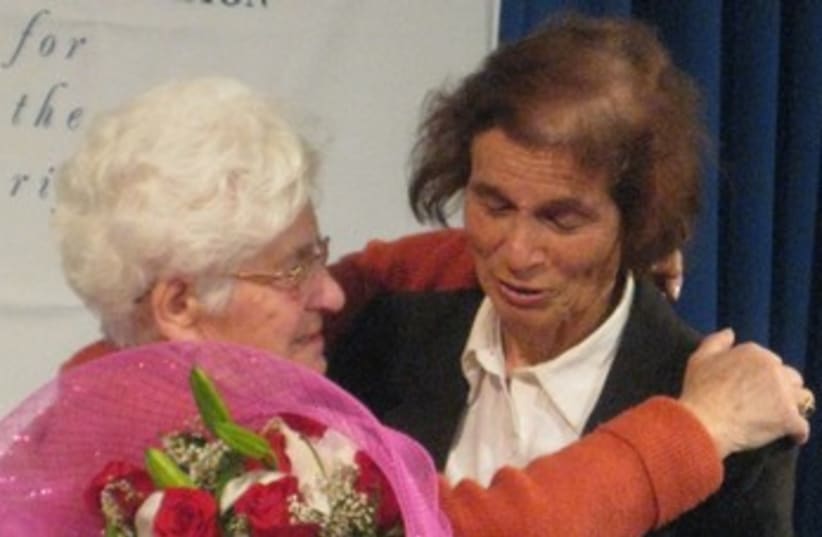
Jewish Foundation for the Righteous reunites a Holocaust survivor with her Polish rescuer.
By DANIELLE ZIRIGolan reunites with rescuer 370(photo credit: Courtesy of Jewish Foundation for the Righteous)
The last time Shoshana Golan had seen Wladyslawa Dudziak, it was 1945, in the Polish village of Kajetanowka. Nazi Germany was occupying the country and Jews were being arrested and sent to concentration camps.Golan, whose name back then was Rozia Beiman, was the daughter of Joseph and Sara Beiman, owners of a flour mill in Lublin, a city in eastern Poland.As life under German control was dangerous for Jews, Sara and Joseph Beiman decided in 1942 to travel south to Krakow where they knew they could obtain false identity documents for themselves in order to pass as Christians.Since it was too unsafe to travel with their daughter Rozia, Sara and Joseph asked their employee, Karolina Dworczy, to look after her for the few days it would take them to travel to Krakow.The Beimans were only successful in obtaining false identity documents for Sara, so Rozia stayed with Dworczy for a second time while her parents made another trip to try and get Joseph the same forged papers.But on this second journey, Joseph Beiman was arrested by the Germans and taken into custody.Worried, Sara Beiman returned to Lublin to collect as much money as she could in order to bribe the Germans to release her husband, but when she approached the soldiers, her pleas were unsuccessful. Sara and Joseph Beiman were never heard from again. Till this day, it is believed that they were murdered in the Majdanek concentration camp, where over 79,000 people were killed.Seeing that Sara was not returning, Dworczy realized that Rozia, whom she had been hosting for a couple of weeks, was now an orphan. She was left with a little Jewish girl, who represented a great danger to the family: if the Germans, who had established a post across from her home, were to discover Rozia, Dworczy and her family would be killed.Dworczy’s sister, Tekla Dudziak, offered to take in the four-year-old Jewess.Dudziak was a widow with four daughters: Wanda, Janina, Maria and Wladyslawa. The family was Christian, poor and lived on a small farm in the village of Kajetanowka.Wladyslawa Dudziak was the closest in age to Rozia so she took care of her and their relationship grew into that of sisters.Rozia remained with the Dudziaks until Poland was liberated and she could leave for Israel. Upon her arrival, Rozia, which means “rose” in Polish, changed her name to the Hebrew equivalent, and Shoshana Golan was born.This past week, the Jewish Foundation for the Righteous (JFR), which provides financial assistance to non-Jews who risked their lives to rescue Jews during the Holocaust, hosted Golan in New York City and reunited her with her host-sister, Wladyslawa.“It was very emotional to see her again,” Golan told The Jerusalem Post on the phone from her hotel room at New York’s Waldorf Astoria.“It was like we never left each other. I feel I am family to her and she is to me.”Golan and Dudziak were invited by the foundation for its annual dinner at the Waldorf Astoria, which is traditionally scheduled for the week of Thanksgiving. This year’s gala took place on Tuesday.“Even though I was very young at the time, I knew I was Jewish and I was aware that they were taking a risk for me and I appreciated it,” Golan said.“Even though we were very poor, I remember they used to get me Christmas presents, just like everyone else in the family. I felt wanted. I felt loved.”During the dinner on Tuesday, a film about Poland was screened in which Golan saw some familiar childhood places. She explained that it was a moving experience to watch it and be reminded of her life there.“Those memories are very vivid in my mind. I can still hear the sound of the swing I used to play with. I hear the friction of the cord against the metal in my head,” she said.“I remember going through war with only one pair of shoes, and most of the time, I had my feet wrapped in cloth so I could walk in the street and not hurt myself.”Golan brought her husband and son to New York with her, as she wanted to share the memories with them.“In the many years we have worked with survivors and their rescuers, I remain awestruck by the heroism of the thousands of Christian rescuers who risked their lives to save Jews. By holding true to their values, these individuals saved Jews from certain death,” said JFR executive vice president Stanlee Stahl.“We owe a great debt of gratitude to these men and women, and through our work, hope to improve their lives and preserve their stories,” she added.The JFR was created in 1986 to provide financial assistance to non-Jews who rescued and hid Jews during the Holocaust. Today, the foundation supports more than 750 rescuers in 22 countries around the world.Most of the “righteous gentiles,” as they are called, are elderly and in need of financial aid.“In the 70s, Rabbi Harold Schulweis, who founded the JFR, met a German rescuer and he realized that the Jewish people had a double memory – a memory of indescribable evil and a memory of blessed righteousness,” Stahl told the Post in an interview conducted last June.“It was incumbent upon us, all of Israel, we the Jewish people, to remember both; to remember those who were lost, the six million, and to remember those precious few who risked their lives and often the lives of their families to save Jews, many of whom were total strangers.”To reach rescuers, the JFR works with Yad Vashem, which recognizes gentiles from all faiths who helped Jews during the war.“As my board chairman, Rabbi Harold Schulweis’s cousin, says, Yad Vashem gives medals and diplomas, but the Jewish Foundation for the Righteous gives money for the rest of their lives,” Stahl explained.When she became vice president of the foundation 20 years ago, Stahl had a few motivations to get involved.“First off, my name is Stanlee. It’s not a girl’s name. My name is Stanlee because my mother’s brother was killed in the US Army in the battle of Rome in 1944 and he’s buried at the US military cemetery. I was a history major in college – World War II and the Shoah have always been a passion,” she explained.“This is who I am. I’m the social action lady at shul. I sleep with the homeless; I used to run the New Jersey feeding program and set up the first kosher food transfer program of its kind in America,” Stahl continued.“But I don’t know if I would do what these men and women did. It’s one thing to risk your life, but in eastern Europe, the penalty for helping a Jew was death, and if you were living in a little Yemensville, they took the animals out of the barn and they put the Christian family and the Jewish family in the barn and burned them alive. If you were in a bigger town, you were hung on a meat hook in front of your home with the sign ‘I helped a Yid.’”Shoshana Golan and her family were set to return to Israel over the weekend. In the meantime, she is enjoying New York City.“We’ve been walking around, and we also went to see “Mama Mia,” the musical. We love looking at the tall buildings,” she said.“I enjoy Central Park very much. We see a lot of horse carriages, and it reminds me of Poland; we had them there everywhere as well.”Steve Linde contributed to this report.
if(catID != 151){
var cont = `Take Israel home with the new Jerusalem Post Store