Rethinking Jewish Life: While the Jewish people certainly didn’t invent democracy, we should have.
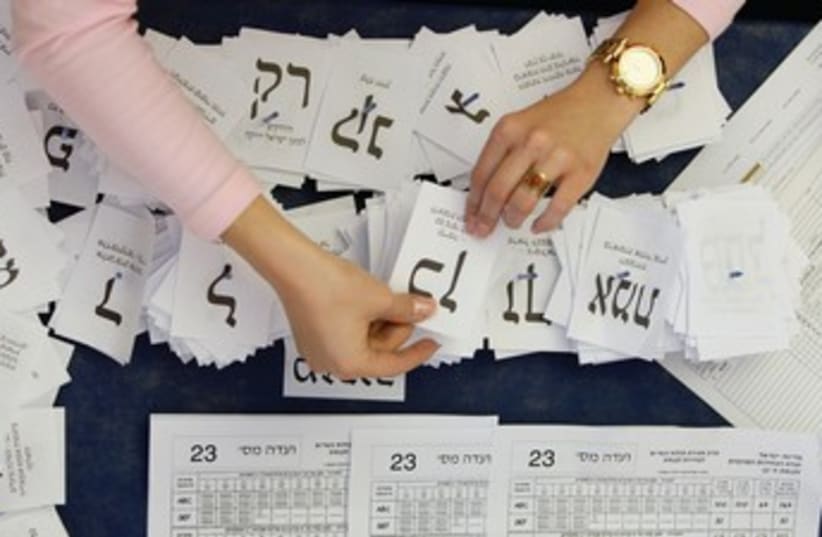
By RACHEL SABATH BEIT-HALACHMIIsraeli Ballot (R370)(photo credit: REUTERS)
While the Jewish people certainly didn’t invent democracy, we should have.Democracy’s ethics of equality and freedom of religion have allowed us not only to survive as an otherwise often subjected minority, but to flourish dramatically and fully participate in society. Far beyond these clear gifts of the post-enlightenment world, democracy enabled the Jewish people to respond to God’s original call to the first Jew (Genesis 12) to be a nation and a blessing. As a people, the creation of democratic societies and our intimate involvement in them allows us to be a powerful and direct cause of positive change in the world. Simply put, without the protection and possibilities that democracy has given us, we could not fulfill our destiny as Jews.Aspects of the first seeds of democracy were embraced by ancient Jewish sages who – both in Babylonia and especially in the Land of Israel – were sensitive to the costs and benefits of various forms of government, especially for minority cultures. It was not only survival instincts that guided them.The sages also knew they must harness the power of the best ideas they encountered in order to fulfill a core mission: to create the ideal ethical society that Judaism demands we build. Rabbinic literature certainly includes some of the best elements of what much later would be part of the culture of democratic societies: democratic-style discussions, pluralistic legal interpretation and often a deep understanding of the needs and rights of the individual to help shape his community and find fulfillment.Whenever we had the chance, we not only embraced the possibilities of democratic governments, but – more than most minorities – we immersed ourselves in them, challenged them and ultimately made them better and stronger. We made democracies better because we insisted that all minority rights be protected, not just our own; because we generously contributed intellectual, civic and financial resources; and we made them stronger primarily because of our intensive committed involvement on every level. We embraced democracy like a modern messiah.But at what cost? Democracy has also had a deeply complicated spiritual impact on the Jewish people.By the late 19th century, American Jewish leaders expressed concern that our life raft might also be the context for our spiritual and communal death. If the Jew is completely embraced and – literally – married into American society, and in living the American dream has the freedom to be and do anything and everything, who needs Judaism, much less the hassles of Jewish communal life? These questions continue to challenge some North American Jews while for others they have positively shifted the discourse toward reimagining the possibilities for Judaism in America.Even though the 65-year reality of a Jewish democratic state expands our capacity to combine the best of Judaism and the best of democracy, thus enabling us to fulfill our destiny as a sovereign people, the knowledge still lurks in every Jewish mind and heart that democracy’s demons revealed themselves even in the “best” of Western cultures. If a democratic society can also attempt to annihilate us, then, as Eugene B. Borowitz teaches, the 20th century taught us a bitter lesson about the “false messiah” of democracy and human progress.With both disillusionment and hope, we enter the voting booth once again. (That I can vote – freely choose the party and candidate that my Judaism and my conscience guide me to choose and without risking my life, is not something I should ever take for granted.) What might change in the next government? Will the status quo continue or might these elections help us build the society we were called to create? Or, as the great modern Jewish thinker Mordecai M. Kaplan (1881-1983) taught, might democracy still be the source of our salvation? In his teachings, writings and institutional leadership, Kaplan helped American Jews rethink Jewish life, prayer and purpose in radical ways. According to Kaplanian theology, “God is the power that makes for salvation” and, alternately, the power that makes for freedom and the power that makes for righteousness; thus God can also be found in the positive power of democracy because it is a vehicle for our total individual and collective realization.Kaplan believed that while Judaism is about the full realization of a people, it is no less about the fulfillment and perfection of the individual. In celebrating the centrality of the individual, democracy is a phenomenally Jewish value because it also recognizes the individual’s need to participate in and be fulfilled in his or her greater social context. Without this context, the individual cannot achieve the moral perfection which Judaism seeks and which leads to salvation.Mel Scult, Kaplan’s biographer, writes in his forthcoming book, The Radical American Judaismof Mordecai M. Kaplan, that Kaplan saw in democracy similar goals to those of Jewish life: a whole culture built upon the encouragement of certain values and certain kinds of behavior essential to an ethical life. If we engage fully in both, we will achieve not only a collective worthy of redemption but our own personal fulfillment and salvation as well.So, in these pre-election days, we should anxiously and joyously stand as though we are simultaneously in both the Hebrew months of Elul and Nisan.Elul, the month preceding the Days of Awe, because we ought not to cast our vote with out a severe heshbon nefesh (soulful self-critique) of where our previous votes and political activity (or inactivity) has lead us in the years that have passed. If we fail to participate, we fail to be engaged in our own salvation.But it is also Nisan, the month in which Passover, the Holiday of our Freedom, falls: a time of joy and hope because we are engaging in the greatest of all freedom rituals; the ritual that enacts the collective and individual salvation that the Exodus from Egypt sought ultimately to achieve.We can only be fully human if we are fully free; and only in exercising our freedom to influence our democratic culture can we find the possibility of redemption for our society and for ourselves.Rabbi Rachel Sabath Beit-Halachmi, PhD, is a senior fellow at the Shalom Hartman Institute and teaches at the Hebrew Union College-Jewish Institute of Religion in Jerusalem. Her column appears monthly.
if(catID != 151){
var cont = `Take Israel home with the new Jerusalem Post Store