The Eda Haredit continues to battle against accepting money from evangelicals.
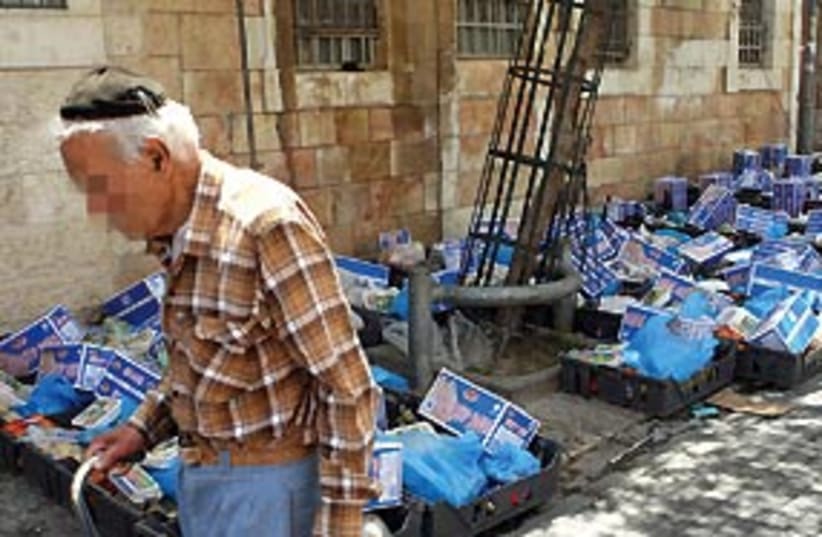
By PEGGY CIDORIFCJ food parcels jerusalem 311(photo credit: Ariel Jerozolimski)
Rabbi Moshe Shternbuch has become a respected figure in the haredi world both in Israel and abroad. A few years ago, the local Eda Haredit decided that the Talmudic genius was just their man: radical, highly esteemed and totally engaged in the most extreme struggles waged by that community. Shternbuch didn’t disappoint his followers, and his name and signature soon appeared on some of the more extreme posters in the haredi neighborhoods.One of his fiercest campaigns was that launched against Rabbi Yechiel Eckstein, the founder of the International Fellowship of Christians and Jews, which collects donations from evangelicals to help needy Jews in Israel. The Eda Haredit doesn’t accept outside funding anyway, but that didn’t prevent Shternbuch from declaring that accepting even a shekel from that foundation was no less than “raising a hand against God and His holy Torah.” The radical haredi sect considers evangelicals to be missionaries and fears that accepting money from the foundation may lead to conversion.The things he said about Eckstein sounded extreme even to the most kosher haredi ears, but Shternbuch and his followers (most of the Eda Haredit) didn’t stop. As a result, Eckstein and his foundation became persona non grata not only at city hall under the former mayor but in Jerusalem in general, consequently depriving nonprofit organizations of sorely needed funds. Last Wednesday the boycott ended when Eckstein presented Mayor Nir Barkat with a NIS 13.5 million check to fight poverty in the city.But such a defeat was not nearly enough to convince Shternbuch to capitulate. The crusade against Christians – donors or simple visitors – had to go on. A routine meeting of the Tourism Committee, headed by Deputy Mayor Hilik Bar held three weeks ago announcing the municipality’s decision to encourage and even invest in enlarging the program of evangelical tourist groups in the city, reignited the conflict. Once the committee approved the decision, it was published on the municipality’s Web site and was brought to a final vote at the next city council meeting. Under Barkat’s administration, all discussion should be completed within the committee meeting, but that didn’t deter a few haredi members of the coalition from asking, against all protocol, that the decision be struck from the council’s agenda.Bar, who admits he was astonished by the request, didn’t cave in. “We’ve been working hard to achieve this important enhancement to the city’s economy. Think of it, they are ready to raise tens of thousands from their fellow Christians to visit, to stay overnight and hold some of their conventions here. This is a huge opportunity for the city, its residents and their well-being, and we should say no? And besides, how exactly would we prevent it? By announcing that evangelical Christians are not welcome in Jerusalem? Seriously, it would be like New York’s municipality forbidding Jews to visit the Rebbe’s house in Crown Heights or the Polish government forbidding Jews to visit the remains of the Jewish communities there or the camps,” he said.Bar, who has promoted a decision to support and even provide incentives for large conventions of evangelicals who would bring at least 3,000 participants for a minimum of four nights in the city’s hotels, says there is no way the municipality will reverse the decision, and he gently but firmly expressed his opposition to the haredi members’ attempt to stop the initiative.As for the haredim, at least according to one source within the community who requested anonymity, “Nobody takes Shternbuch too seriously. He has become the Eda Haredit’s problem, and many haredim outside this radical group can barely conceal their satisfaction regarding the untenable situation their ‘genius’ has brought upon them. After all, we all suffer from his extremism. And in any case, I don’t expect any particular problem. What are they going to do – stop the Christians at the city’s gate?”For Bar the issue is already behind him, and he didn’t soundparticularly concerned that it might come up in the future. Still,according to the haredi source, four city council members of thecoalition – Eli Simhayof of Shas, Yossi Daitch and Avraham Halperin ofUnited Torah Judaism, and Yair Gabbai from Habayit Hayehudi – aresiding with the Eda Haredit. The first organized evangelical visit isscheduled for Shavuot.
if(catID != 151){
var cont = `Take Israel home with the new Jerusalem Post Store