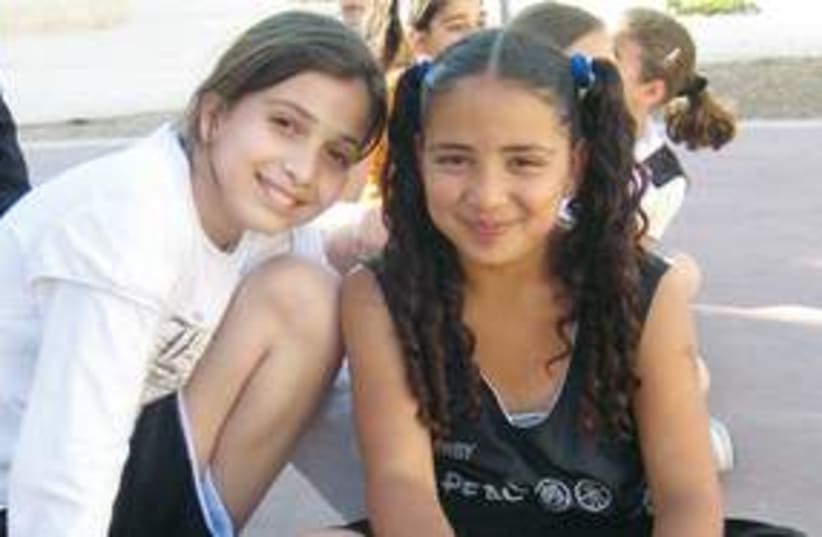
In a precedent-setting accomplishment, PeacePlayers Middle East is entering four Jewish-Arab teams in the Israel National Basketball League.
By ABIGAIL KLEIN LEICHMAN/ISRAEL21CPeace players girls basketball 311(photo credit: PeacePlayers)
If Halid and David had not joined the PeacePlayers basketball program in 2005, they probably wouldn’t have met – at least, not under good circumstances.David, a Jewish teen, immigrated alone to Israel from Ethiopia at age 12. Halid comes from a poor Arab village where people are mistrustful of Jews. But they got to know each other when their teams came together for activities, and later they both joined an integrated league team. Now completing a coaching certification program together, the boys volunteer with younger players and in social action projects in their communities.“They help each other,” says Karen Doubilet, managing director of PeacePlayers International – Middle East (PPI-ME). “Halid is an amazing role model for his community. And David, who was at first shy and suffered from low self-esteem, is a young leader now.”This year, PPI-ME will enter four integrated teams in the Israel National Basketball League – two in Jaffa and two in Jerusalem. The Jerusalem teams will be the first to feature players from both east and west Jerusalem. “We are so proud of this precedent-setting accomplishment,” Doubilet reports.PeacePlayers International was founded in 2001 by Sean Tuohey and his brother Brendan on the premise that “children who play together can learn to live together.” The global nonprofit organization uses basketball to unite children and develop leaders in conflict and post-conflict regions. PPI runs programs in Northern Ireland, Cyprus, South Africa and New Orleans, where its initiative was recently handed over to a local partner.In Israel, the locally led charity aims to unite and educate Jewish and Arab youth and their communities through basketball. Its curriculum, developed in partnership with the Arbinger Institute, a US-based consulting firm, combines on-court experiential learning with open dialogue.More than 300 children were registered in PPI-ME programs last year. “In our new year we should have about 750 kids,” says Doubilet. The children come primarily from Jerusalem, Beit Shemesh and environs (in the Jerusalem district) and Jaffa. “We work with schools, community centers and sports clubs to recruit children, and in smaller villages we use word of mouth.”The program targets ethnically and religiously diverse populations, including Ethiopian, Russian and American immigrants, and works toward gender equality through sports in both Jewish and Arab communities. A single-identity, capacitybuilding program in the West Bank provides another outlet for underprivileged children and an additional training opportunity for Arab coaches.“PPI is a long-term program for ages 10 to 15, so you see them developing as teammates and friends,” says Doubilet, a Toronto native with a background in conflict resolution and experience with the Peres Center for Peace. “At the start it’s awkward and there’s a language barrier, and some kids have never met the ‘other side’ before. As they become better players and a more integrated team, they become better friends, and many friend each other on Facebook.”Later on, she continues, the kids are eager to meet with the ‘other side’ and tour communities they’ve never ventured into previously. “At one point, you see that a ‘color blindness’ has developed. There is quite a difference from beginning to end.”When the organization runs a fun day to introduce the free program, usually more children want to register than there are places to accommodate them.“Our local staff members are key,” relates Doubilet. “We utilize American post-collegiate scholar/athletes who serve as ‘neutralizers’ and work with local coaches and program managers to build excitement. The initial draw isn’t about meeting with the other side but about fun and basketball.”She admits that parents sometimes need a bit of persuasion to give their permission, “but I’ve never seen it really getting in the way. Parents are less reluctant to have their kids participate locally than if they go on one of our retreats or trips. In those circumstances, they have to be reassured that there are always people from their community there in addition to me, whether a local coach or siblings. I also invite them to speak with other parents whose kids have participated before.”Doubilet explains that basketball, Israel’s most popular sport after soccer, is a particularly intimate sport because just five players from each team are on the court during a game. Therefore, players understand that communication among them is essential.Children are required to participate at least twice a week and may go as often as five times per week. Some kids are involved in more than one PPI initiative. There are twinned basketball clubs for Arab and Jewish children ages six to 15, which offer joint peace education and life skills activities and also afford them the opportunity to compete on integrated teams of the Jerusalem Peace League and the Jerusalem Girls Basketball League.Another project is a leadership development program for outstanding 16-year-old participants. There is also professional development and conflict management training for future basketball coaches, intergroup facilitators, educators. and leaders such as Halid and David.The costs of the programs are borne by donors, including USAID, Adidas, Laureus Sport for Good Foundation, family foundations and a grant from the US State Department. www.israel21c.org
if(catID != 151){
var cont = `Take Israel home with the new Jerusalem Post Store