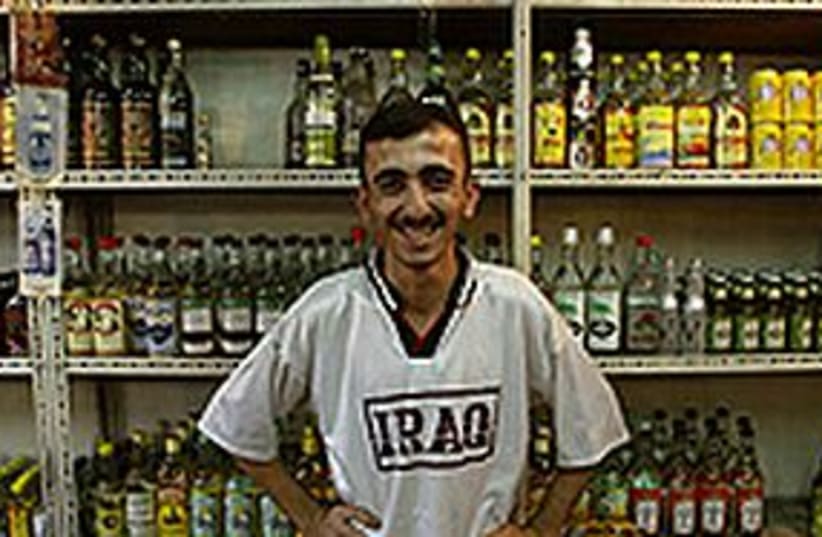
Booze bails out of Baghdad in face of resurgent Islam
Old rules banning alcohol resurface as Christian purveyors of liquor flee the city; literary elite protest government regulations.
By DAVID E. MILLER, MICHAEL GRUBB / THE MEDIA Liraq alcohol 311(photo credit: The Media Line)
Baghdad’s literary elite took to the streets on Friday to protest a government order shutting one of the city’s few places where people can drink liquor freely, striking a blow to the alcohol-inspired conviviality poets and artists so value. But drinkers face a much more fundamental threat to their freedom to imbibe, as the city’s Christians free.The government ordered the social club located near the Iraqi Writers Union closed by enforcing a Saddam-era ban prohibiting the serving of alcohol in hotels and restaurants. The ban had fallen into abeyance as the U.S. troop surge put Muslim extremists on the defensive. Now, with the U.S. presence much smaller, Islamists are back in the saddle.Their ascendancy has not only led to a crackdown on drinking but has frightened Baghdad’s Christians, who aren’t subject to the Islamic ban on alcohol and thus are the city’s main purveyors of liquor. Since Baghdad’s Syrian Catholic Cathedral was attacked at a cost of 53 lives in October, Christians have been leaving the city for Kurdish-controlled areas in the northern Iraq."We’re worried about more decisions against personal freedoms," Ali Hussein, political editor of the Al-Mada newspaper, who organized the protest, told The Media Line. "This decision doesn't only harm Christians, but all Iraqi citizens. We are hoping to collect one million protest signatures to send the government."In Islam, alcohol —or any intoxicant—is generally forbidden, but in Iraq the status of liquor has veered from permitted to punished over the years. During the 1990s, the nominal secularist dictator, Saddam Hussein, restricted sales of alcohol while shutting down nightclubs and casinos, to win support of conservatives.In 2005, two years after the U.S. and its allies toppled the Saddam regime, Iraq’s Interior Ministry rescinded the ban. But a year later Islamic militants began targeting liquor stores and trucks transporting booze. As security improved in 2008 and militants lost sway, the liquor trade revived. only to meet a renewed Islam-inspired prohibition campaign this year.Protestors last week gathered outside the Iraqi Writers Union building in al-Wattanabi in the city center, carrying signs that read "Freedom first" and "Baghdad won’t be Kandahar," a reference to the stronghold of Taliban fundamentalists in Afghanistan. Demonstrators accused the government of implementing repressive policies that restrict individual rights. For the protestors, the demonstration was about more than just alcohol. In a statement sent to the Iraqi leaders, protesters urged the government to defend pluralism in Iraq. Hussein added that people on the street expressed sympathy with his organization's protest. "We hope you boldly stand up and defend democratic values side by side with the forces that seek a democratic, pluralistic and multi-cultural Iraq," the statement read. "This is a battle against the forces of darkness and extremism that wish to turn the provinces under their control into new Kandahars."Christians and Yazidi-Kurds, the latter members of a religion with ancient Indo-Iranian roots, are the only religious groups legally allowed to sell alcohol in Iraq. But as their numbers dwindle in the wake of anti-Christian violence, secular Iraqis – Muslim and non-Muslim alike -- fear that a full-blown prohibition will soon be in place as social clubs close down and liquor store owners flee.William Wardeh, an Iraqi Christian and president of the Hammurabi Human Rights Organization, contends that the alcohol ban was part of an organized campaign against Iraq's Christians. Prior to the attack in October, six churches were attacked in July 2009 and a wave of killings that targeted the Christian community occurred in February 2010."There are close-minded people who are trying to bring Iraq back to dark days in the past," Wardeh told The Media Line. "They attack everything that portrays Iraq in a cultural or progressive light." Citing religious leaders, the U.S. State Department report “International Religious Freedom” published in November estimated that Iraq’s Christian population in 2003 ranged somewhere 800,000 to 1.4 million but has fallen to day to between 400,000 to 600,000.The Christian community lays claim to a heritage in Iraq that dates back thousands of years, and many religious and community leaders have expressed fear that the community could soon disappear entirely. Christian leaders estimate that as much as half the country's Christian population lives in Baghdad, and 30% to 40% lives in the north, with the largest Christian communities located in and around Mosul, Erbil, Dohuk, and Kirkuk.“There is a fear that they will lose the Christians, just like they lost the Jewish community,” Middle East analyst Ali Al-Saffar told The Media Line.According to the UN High Commissioner for Refugees, although Christians represent only 3% of Iraq’s population, they make up half of the refugees leaving the country.
if(catID != 151){
var cont = `Take Israel home with the new Jerusalem Post Store