Egypt MPs demand mufti resign over Jerusalem visit
Parliament votes to ask Gomaa to apologize to the Arab and Islamic people and submit his resignation.
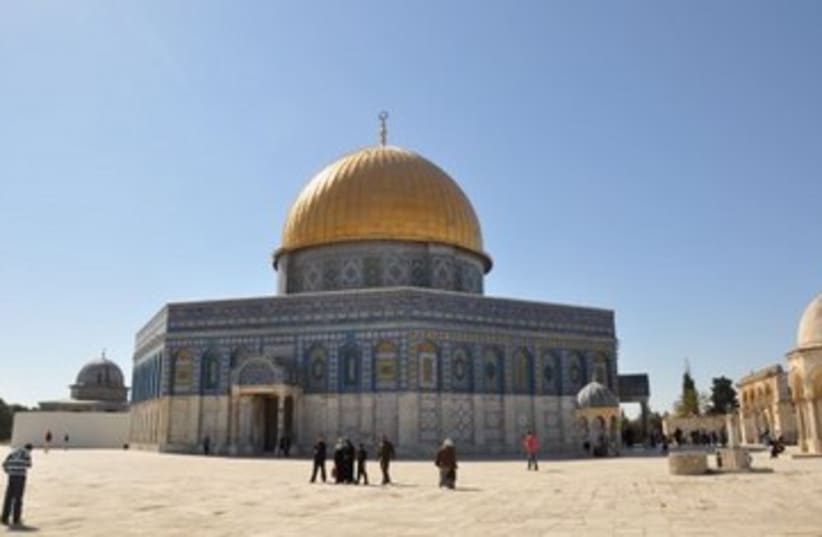
By OREN KESSLERDome of the Rock on the Temple Mount 390(photo credit: Ilan Evyatar)
Egypt’s top Islamic cleric continued Sunday to draw fire over his visit last week to Jerusalem, eliciting condemnation from Cairo’s Islamist-dominated parliament and a possible ejection from the country’s writers union.“The brutal enemy controls [Jerusalem’s] entries, exits, mosques and churches,” the parliamentary committee responsible for religious affairs said in a statement, recommending the vote that called on Grand Mufti Ali Gomaa to step down. “Going into [Jerusalem] enforces occupation and bestows upon it legitimacy, as it also represents a sign of normalization with the Zionist entity that is popularly rejected.”Parliament voted to ask Gomaa to apologize to the Arab and Islamic people and submit his resignation. The gesture has symbolic significance, but parliament cannot force him from office – a senior adviser to Gomaa said the cleric had not been formally notified of parliament’s vote and doubted he would step down because the visit was “not a crime.”Earlier, Gomaa defended his trip on his Twitter account. “Jerusalem is in the heart of every Muslim,” he said. “Visiting Jerusalem increases one’s feelings of rejection of occupation and injustice and helps strengthen the [Palestinian] cause.”On Saturday, an official in Egypt’s Writers’ Union told Cairo’s Al-Ahram newspaper that it was discussing terminating Gomaa’s membership. Salah Alrawy, a member of the union’s board, told the paper the cleric had “broken the national consensus” on an all-encompassing boycott of Israel, including in particular visits to the holy city.Alrawy said the union would meet Monday to issue a final decision on the matter.This weekend, Yussuf al- Qaradawi, the Muslim Brotherhood’s Qatar-based chief ideologue, issued a fatwa determining Gomaa’s visit to be haram, or forbidden by Islam’s written or oral traditions.“I did not expect such an eminent person like Sheikh Gomaa to go against this consensus and visit Jerusalem and offer prayers in al-Aksa Mosque,” said Qaradawi, a popular regular contributor to the Al Jazeera satellite network who also serves as president of the International Union for Muslim Scholars.“There is a mutual agreement among Muslims and Christians that visiting Al- Quds shall remain prohibited as long as Israel continues to occupy it by force,” he said, according to the website OnIslam.net.“We must feel as though we are banned from Al-Quds and fight for it until it is ours,” Qaradawi told the AFP news agency. “Those who visit legitimize an entity which plunders Palestinian lands, and are forced to cooperate with the enemy’s embassy to receive a visa.”For decades Egypt’s Muslim and Christian religious establishments have forbidden followers from visiting Jerusalem’s Islamic holy sites as long as the eastern part of the city is under Israeli control.But in February of this year, Palestinian Authority President Mahmoud Abbas called on Arabs and Muslims worldwide to visit Jerusalem in a show of solidarity with Palestinians. “Visiting a prisoner is an act of support and does not mean normalization with the warden,” he said at the time.Over the last month, two members of the Jordanian royal family have heeded Abbas’s call, and one of them accompanied Gomaa on his visit to the city Wednesday.Coptic Pope Shenouda III had forbidden his flock from visiting Jerusalem, but following his death a month ago several hundred Coptic pilgrims seized the opportunity to fly to the holy city for Easter.Gomaa justified his trip by arguing that it was “unofficial,” and that he had entered the city via Jordan and the West Bank rather than through Israel proper. He said he viewed the trip as a “gift from God” but reiterated that he remains adamantly opposed to normalization with the Jewish state.Hamas has also condemned Gomaa’s visit. “We reaffirm that this visit meant a recognition of the occupation, meant the normalization of relations with the enemy, gave [Israel] ethical testimony, and meant supporting Israeli policies that go against the right of our people in the West Bank and the Gaza strip to pray [at al-Aksa],” wrote Mousa Abu Marzook, deputy chairman of Hamas’s political bureau, on the group’s Facebook page.Writing in the London-based newspaper Al-Hayat, Lebanese columnist Elias Harfoush condemned Gomaa’s visit but warned against blowing it out of proportion. Gomaa’s visit, while lamentable, did not represent a betrayal of Egypt on the scale of president Anwar Sadat’s historic 1979 visit to Israel, he wrote.“Sadat’s visit was to the Knesset, the heart of the State of Israel, and represented an indisputable recognition of it,” Harfoush wrote. “The Grand Mufti of Egypt, on the other hand, went as a pilgrim to a place over whose religious standing in the hearts of millions of Muslims there is no disagreement. Furthermore, his visit was arranged with the Jordanian side... and welcomed by the Palestinian Authority, and the man certified that he did not meet a single Israeli.”Reuters contributed to this report.
if(catID != 151){
var cont = `Take Israel home with the new Jerusalem Post Store