Amid escalating violence in Syria, Iranian deputy FM heads to Russia to discuss crisis with counterpart Mikhail Bogdanov.
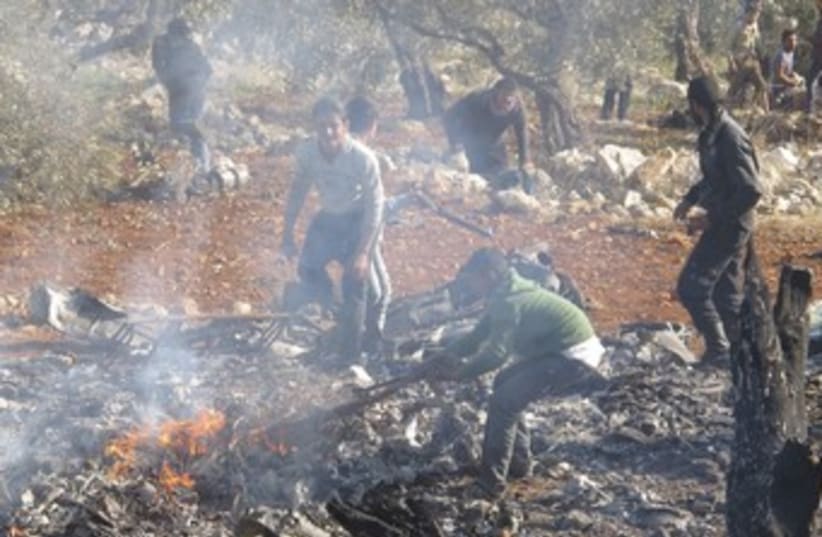
By JOANNA PARASZCZUKBurning wreckage of Syrian warplane 370(photo credit: REUTERS/Abdalghne Karoof)
As pressure grows on Syrian president Bashar Assad to step down, Iran’s Deputy Foreign Minister for Arab and African Countries, Hossein Amir-Abdollahian, headed to Moscow on Monday to discuss the crisis with his Russian counterpart Mikhail Bogdanov.Amir-Abdollahian’s visit to Russia comes on another day of intense fighting across Syria.Assad’s staunchest allies, Moscow and Tehran, have backed his regime since the fighting began over 21 months ago.Although there are signs that Syria’s rebels are gaining ground, Tehran has not wavered in its support for Assad. On Sunday, Iran set out a six-point plan to resolve the Syrian crisis, while its Foreign Minister Ali Akbar Salehi said Tehran would “never allow a Western plot to forcibly topple Assad to be implemented.”However, in recent days Moscow has given signs that it no longer believes Assad will survive. Bogdanov, who is also the Kremlin’s special envoy for Middle East affairs, sparked global speculation last week when he was quoted as saying the Syrian government was “losing control of more and more territory” and that the “victory of the Syrian opposition cannot be ruled out.”Russia’s Foreign Ministry rushed to play down Bogdanov’s statement, saying that Moscow had “never changed its position” on Syria, but not before the US said his comments showed that the Russian government was “finally waking up to the reality” that Assad’s days were numbered.Click for full JPost coverageMoscow, which has arms contracts with Assad worth billions of dollars, has been Syria’s main weapons supplier since the days of the USSR. However, if Assad falls, Russia stands to lose more than just its arms sales.If Assad is ousted, Russia could lose its naval base at Tartus, its only military port outside the territory of the former Soviet Union. While Tartus has no command and control facility, meaning Russia cannot conduct military operations out of the port, it is politically significant because it acts as a regional foothold for Moscow. Russia also fears that if Assad falls, he could be replaced by radical Islamists who would threaten Russia’s national security.Iran has an even greater stake in Syria, for if Assad falls and his Alawite regime is replaced by a Sunni-dominated coalition, Tehran’s strategic reach in the region will wither.Intelligence officials believe Tehran has used its Qods Force, the elite extraterritorial unit of the Iranian Revolutionary Guards Corps, to provide significant assistance to Assad – including weapons, military training, electronic surveillance equipment and intelligence.While Iran continues to stress, at least outwardly, that Assad will not be ousted, there are also signs that Tehran is planning for a potential loss in Syria by cultivating other axes of influence, including in Iraq.Iran has shown signs that it is exerting more influence over Iraq, whose airspace it has used to ship military equipment to Syria. Iraqi and US intelligence officials also believe that Iran and its Lebanese proxy Hezbollah give financial and military support to the Shi’ite terror group Asaib Ahl al-Haq, which is responsible for over 6,000 attacks against US troops.Lebanese daily Al-Mustaqbal quoted unnamed political sources on Monday as saying that during a visit to Baghdad, Ahmadinejad may present a plan to partition Syria into two by deploying international forces.
if(catID != 151){
var cont = `Take Israel home with the new Jerusalem Post Store