Government must take steps to ensure long-term stability of domestic supply, experts say.
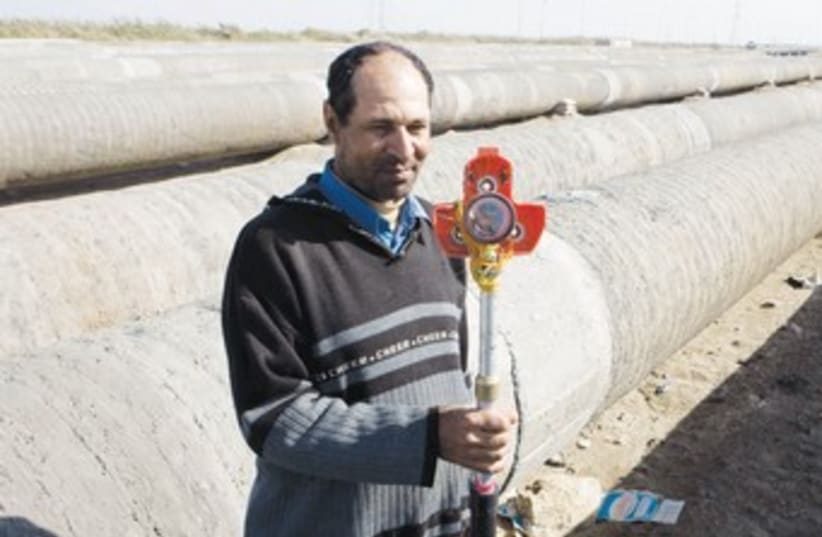
By SHARON UDASINEMPLOYEE works on the Egyptian gas pipeline 370(photo credit: Nasser Nuri/Reuters)
The Egyptian decision to officially cut off natural gas supplies to Israel is far from unexpected and will presumably have very little effect on the Israeli energy market, experts agreed on Monday.“I think this formalizes a situation which has already existed for a year,” Prof. Eytan Sheshinski, of the Hebrew University’s economics department, told The Jerusalem Post on Monday. “Israel is already adjusted to doing without the Egyptian gas.”Saboteurs have blown up the Sinai gas pipeline that brings natural gas from Egypt to both Israel and Jordan – as well as Lebanon and Syria via Jordan – 14 times since February 2011. This has caused the supplies to be inconsistent throughout the recent past, flowing on and off and delivering only very small quantities of the product during the time, Sheshinski explained.“The supplies have been so erratic that it’s not going to make so much of a difference,” agreed Prof. Brenda Shaffer, an expert on energy policy and management in the School of Political Science at the University of Haifa.“It was pretty inevitable,” Shaffer added, calling the official cut more significant “on a symbolic level.”While the Egyptian decision “does not make much of a difference in reality,” it does bring to light some already existent problems in Israel – namely, the narrow window that exists between the depletion of the existing Yam Tethys gas supply and the flow of the Tamar reservoir, Sheshinski explained.The estimated availability date of April 2013 for oil from the Tamar gas field off the coast of Israel is quite reasonable, but does not help the fact that there may be some electricity shortages this coming summer, he added.“Overall, looking forward to a year from now, if Tamar will start flowing then we will be on a steady course for electricity generation and other uses,” Sheshinski said.By not having an Egyptian supply, however, Israelis are losing out on an economic level, as the market will suffer from a natural gas monopoly without a second competitor, he argued. In order to ensure that domestic purchasing and availability of gas remains fair, the government must place constraints on local prices as well as the export quantities, according to Sheshinski.“The supervision of the monopoly becomes a very important issue – in other words the supervision of the pricing, so that the interest of the public will be guarded,” he said.Sheshinski had chaired the 2010 Sheshinski Committee, which had recommended that the government raise the state’s share of oil and gas revenues from 33 percent to 52- 62%, depending on the individual case. The committee recommendations became law in March 2011.“[Gas providers] would like to have a free hand to export as much as they can. But on the other hand the country wants some strategic insurance for adequate supplies,” Sheshinski said. “While the situation has not changed dramatically it is really important to consider these constraints.”While Shaffer agreed that it is the government’s responsibility to set necessary constraints to ensure a regular gas supply to its population, she said she did not believe that having an Egyptian supply would affect an Israeli gas monopoly.“Most gas markets in the world are not competitive markets,” Shaffer said. “The chance to have a really competitive market in Israel when there’s one consumer and one provider dressed up in different outfits is almost impossible.”In Europe, for example, almost no countries have competitive natural gas markets, and usually have long-term contracts with one or two suppliers – Norwegian Gas, Russian Gas and/or Algerian Gas, according to Shaffer.“Gas is a utility, not a commodity and it’s the government’s job to make sure that people have access to regular gas and electricity supplies at a reasonable price. The market doesn’t create the conditions for security of supply,” Shaffer said. “It’s easy to blame the Egyptians here but what about the Israeli government? They let the private market do these deals and they were obviously unsustainable.”The government, she argued, must now take care of the country’s gas security, create long-term investments and infrastructure, including redundancy, backup and storage. Even with no competition, at this point the gas providers cannot charge whatever price they want domestically, particularly because there is currently no export infrastructure in place and they have no one else to sell to besides the Israeli consumer, according to Shaffer.“The consumers and producers in Israel are linked in a marriage,” she said.Regardless of whether Israelis benefit from receiving Egyptian gas, Sheshinski felt that Egyptians forego a financial opportunity by not selling gas to Israel.“It’s in the economic interest of Egypt to continue to continue exporting gas to Israel,” he said. “What they claim is the initial deal was unfavorable to Egypt because corruption was involved.”As of now, it is difficult to tell if this is a commercial or political dispute, and one way to determine this will be to watch whether supplies continue to Jordan and whether any renegotiations with Israel over prices occur, according Sheshinski.“If we see that they are not interested in any renegotiations about the deal, that will at least be some indication that there are broader issues involved,” he said, Ultimately, however, it is impossible to predict whether Egyptian officials will decide to renegotiate the terms and start up the Israeli supply once again, but this most certainly would not occur before next year’s presidential elections, Sheshinski explained.“The only thing that I got the distinct impression was that in Egypt all the political parties and politicians came out against the gas deal,” he added. “It’s about name – it’s something that has a negative image in the Egyptian streets.”In Shaffer’s opinion, on the other hand, Egyptians have absolutely no benefit from exporting gas to Israel. Today, Egypt produces about 65 billion cubic meters (BCM) of gas per year, 45 of which are consumed domestically and 20 of which have gone to Jordanian, Israeli and LNG (liquefied natural gas) facility exports, according to Shaffer.Of that 20 BCM, about 70% of the gas should ideally go to the LNG facility, as LNG facilities are quite expensive to construct and therefore merit maximal use, despite the fact that pipeline sales usually reap higher prices.This, she explained, should be a lesson for Israel as it considers constructing an LNG export facility of its own.“Once you have the facility in place it’s very difficult to keep the numbers down – producers will always want to use the highest capacity possible,” Shaffer said.With the idea that Egypt should be using 70% of its 20 BCM gas for export in LNG, it is only left with about 6 BCM for pipeline export.“[Egypt] can’t meet its commitments to Israel,” Shaffer said.In order to do so, the country would have to tap what should be domestic supplies, exporting natural gas at the expense of its own public – a path that governments generally do not take but that contributed to the Egyptian summer blackouts in 2010, under Mubarak, according to Shaffer.“I’m not saying that those blackouts caused the fall, but certainly when you have six weeks of blackouts it raises the public anger,” she said, calling the blackouts a sign of failed governance. “This current regime is so unstable in Egypt that I don’t think it could allow itself the blackouts, certainly not if the gas was exported to Israel.”
if(catID != 151){
var cont = `Take Israel home with the new Jerusalem Post Store