Cairo stops building underground wall; Israel urges Cairo to continue tough position on smuggling and to prevent the flow of arms to Gaza.
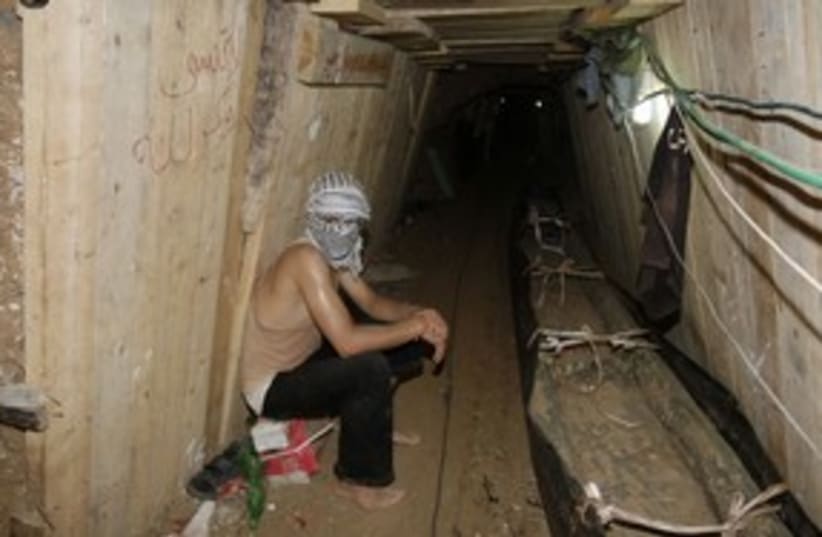
By YAAKOV KATZGaza smuggling tunnel 311 (R)(photo credit: REUTERS)
Egypt has suspended construction of an underground steel wall along the Egypt-Gaza border that it had been building over the past year in an effort to stop smuggling weaponry through tunnels into the Gaza Strip, defense officials have told The Jerusalem Post.According to the officials, Egypt suspended construction of the underground barrier following the revolution in the country in February which toppled Hosni Mubarak’s regime.RELATED:The region: The future of Egyptian politics, religionIAF kills Islamic Jihad militant, strikes tunnelHamas digging ‘terror tunnels’ along border with IsraelEgypt began building the underground barrier in late 2009 to a depth of about 20 meters and along 10 kilometers of the border, where most of the hundreds of smuggling tunnels which serve as Hamas’s main conduit for weapons are located. While smugglers succeeded in breaching the wall in some parts, Israeli officials said that it had been partly effective in places where it was built by making it more difficult for smugglers to dig tunnels across the border.Israel has not lodged an official complaint with the new Egyptian government led by Defense Minister Muhammad Tantawi, but has urged Cairo to continue the previous government’s tough position on smuggling and to work to take action to prevent the flow of arms to the Gaza Strip.News of the freeze on construction comes as concern increases in Israel over an apparent strengthening of ties between Hamas and the new Egyptian government. During a recent visit to Cairo, Mahmoud al-Zahr, the so-called Hamas foreign minister, met not just with Egyptian politicians but also with military and intelligence officials.“There is a new relationship between Hamas and Cairo today,” one senior official said. “This is likely connected to the upcoming elections and the understanding in Egypt that the Muslim Brotherhood is a strong player and as a result it is important to maintain contacts with Hamas.”Israel’s concerns are split into two categories.Firstly, it is worried that Cairo’s new relationship with Hamas will come at the expense of its relationship with Israel. The second concern has to do with security and the possibility that Egypt will turn a blind eye to the movement of weaponry, cash and people across the border.During 2010, for example, more than 160,000 people passed through the Rafah Crossing into Egypt and Gaza.That number is expected to grow dramatically over the coming year.
if(catID != 151){
var cont = `Take Israel home with the new Jerusalem Post Store