Netanyahu: Israel can only rely on itself; security officials: at least six of those killed in attack wore explosive vests.
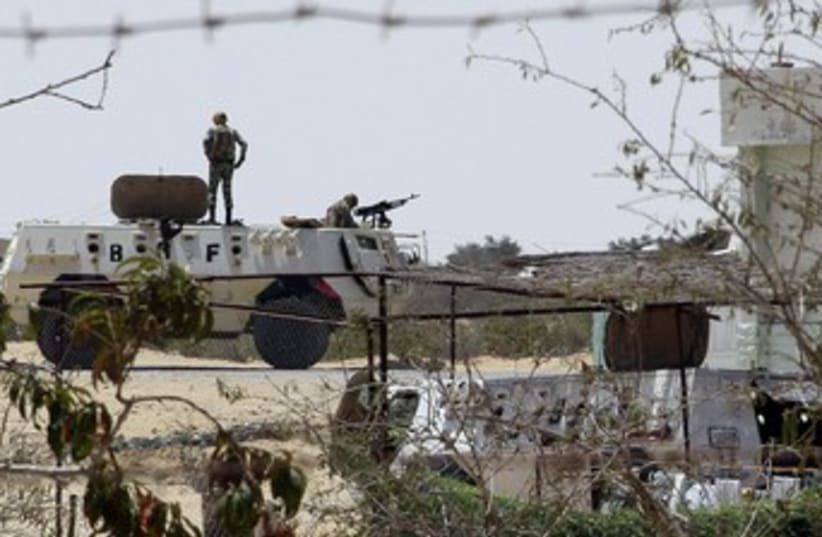
By YAAKOV KATZ, HERB KEINONEgyptian soldiers stand guard at a checkpoint in Rafah city (photo credit: REUTERS)
Israel will consider any Egyptian request to deploy additional military forces in the Sinai in an effort to retake control of the peninsula and weed out a global jihad terrorist infrastructure, defense officials said on Monday.An Egyptian request was expected to come in the aftermath of a sophisticated cross-border attack Sunday night that was thwarted by the IDF after terrorists stole an armored vehicle and infiltrated into Israel. The IDF revealed on Monday that eight terrorists had been killed and at least six of them were wearing explosive belts.The IDF said the attackers were part of a global jihad terrorist infrastructure operating inside the Sinai that was made up mostly of local Bedouin.During the attack, some 35 armed men stormed an Egyptian military base, killing 16 policemen and soldiers. On Monday, Egypt branded the attackers “infidels” and vowed to launch a crackdown throughout the Sinai.Until now, Israel has permitted the Egyptians to deploy about seven battalions in the Sinai, although under the peace treaty the peninsula is meant to remain demilitarized.The conclusion Jerusalem hopes the Egyptians will draw is that they will act more forcefully to stamp out the global jihadi terrorism that is growing there, threatening both Israel and Egypt.“Perhaps this will be a necessary wake-up call for the Egyptians to take matters in their hands in a more serious way,” Defense Minister Ehud Barak told the Knesset Foreign Affairs and Defense Committee on Monday.Prime Minister Binyamin Netanyahu, who toured the border with Barak, said the lesson Israel took away from the thwarted terrorist attack was that it “can and must rely only on itself” for security.Netanyahu said that while it was clear that both Israel and Egypt had an interest in a “quiet border,” only the IDF and security services could fulfill the role of providing security for Israel’s citizens.Netanyahu, near the stolen and burned-out Egyptian armored jeep, praised the soldiers and officers at the scene for their preparedness.“I also want to express my sadness at the killing of the Egyptian soldiers,” he said.Later in the day the Foreign Ministry issued a formal statement conveying the country’s condolences to Egypt and the Egyptian people.“This barbaric attack has caused the death of Egyptians, and was meant to slay Israelis as well,” the statement read.“Moreover, it aimed at shattering the peace agreement between Israel and Egypt. Peace between the two countries has been, and still is, an interest common to both peoples; Israel will continue to act in a spirit of cooperation with Egypt in order to preserve this vital interest and ensure security and stability in the region.”Despite the attack and the common interest both countries have in a quiet border, diplomatic officials were skeptical that it would open the door to warmer ties with the newly elected Egyptian government.While the relationship between the two countries’ security establishments remains intact and there is contact at the intermediate level in the foreign ministries, there is no high-level diplomatic contact as there was during Hosni Mubarak’s rule.Foreign Minister Avigdor Liberman, meanwhile, said the Egyptians knew very well the significance of Sunday’s attack and what they needed to do, and did not need Israel’s advice.Liberman, on a tour of the northern border with other members of his Israel Beitenu party, said it was clear in Cairo that the attacks in Sinai were bad for Egypt’s national security, economy and tourist industry.“I hope the Egyptians will draw the conclusions,” he said.Asked whether Israel sent any messages to the new government in Egypt since the attack, Liberman said that Jerusalem was in daily contact with Egypt.“I don't think Egypt needs any advice from us; they alone understand the significance of these types of actions,” he said.“I only hope that they draw the conclusions and we see results as fast as possible for the good of the whole region.”
if(catID != 151){
var cont = `Take Israel home with the new Jerusalem Post Store