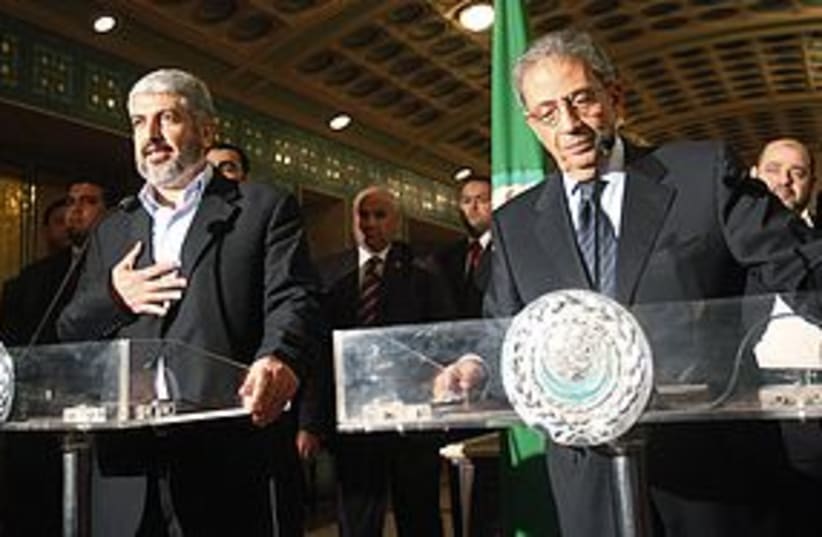
Fatah-Hamas agreement ends 4-year rift; Arab MKs travel to Cairo for ceremony; Israeli expert: Deal only a marriage of convenience.
By OREN KESSLERmashaal moussa 311(photo credit: REUTERS)
The leaders of Fatah and Hamas signed a reconciliation agreement in Cairo on Wednesday, ending their schism that began four years ago.“We announce to Palestinians that we turn forever the black page of division,” Palestinian Authority President Mahmoud Abbas, who is also chairman of both Fatah and the PLO, said in his opening address.RELATED:Zahar: Hamas will never recognize IsraelCarter: Palestinian unity will help bring peacePM lands in London to lobby against Fatah-Hamas dealThe meeting marked the first time since 2006 that Abbas met with Khaled Mashaal, the Damascus-based leader of Hamas.Arab MKs Ahmed Tibi, Muhammad Barakei and Taleb a-Sanaa traveled to Cairo to witness the ceremony.Their participation was blasted by several of their Jewish colleagues as an act of treason.Mashaal said his group’s only fight was against Israel, not rival Palestinians.“We have decided to pay any price so that reconciliation is achieved,” he said.“Our real fight is with the Israeli occupier, not Palestinian factions and sons of the one nation.“Our aim is to establish a free and completely sovereign Palestinian state in the West Bank and the Gaza Strip, whose capital is Jerusalem, without any settlers and without giving up a single inch of land and without giving up on [refugees’] right of return,” Mashaal said.In what appeared to be a sign of lingering friction, Mashaal did not share the podium with Abbas and the ceremony was delayed briefly over where he would sit.Prime Minister Binyamin Netanyahu said the agreement struck a blow to peace, while rewarding terrorism.Some Israeli experts said the coming together of the two factions was a marriage of convenience, that was not likely to last.“This is an artificial reconciliation,” said Yoni Ben- Menachem, a research fellow at the International Institute for Counterterrorism at the IDC Herzliya and a veteran analyst of Palestinian affairs.“Both sides have an interest in making a deal.In the long run, it’s only going to be a temporary deal.”In September, Abbas is widely expected to ask the UN General Assembly to recognize a Palestinian state in all of the West Bank and Gaza – a move opposed by Israel and the United States.“The deadline is in September. Both sides have an interest in reaching September united,” Ben-Menachem said.Abbas “doesn’t want to go to the UN and have other countries ask him, ‘Why do you want us to recognize Palestine when you don’t control part of it?’ And Hamas feels Abbas is going to have a big success in the UN, so they want to ride that wave of success and not be left behind,” he said.The agreement calls for the formation of an interim PA government to run the West Bank and the Gaza Strip, and to prepare for longoverdue parliamentary and presidential elections within a year.Against expectations, neither Abbas nor Mashaal signed the unity document – signed in the presence of UN, EU and Arab League representatives – though it remained unclear why.In his speech, Abbas repeated his call for a halt to settlement construction as a condition for resuming peace talks with Israel.“The state of Palestine must be born this year,” he said.Hours before the agreement was signed, Gaza’s Hamas government executed a man convicted of collaborating with Israel, openly defying Abbas. The man was executed by firing squad after being sentenced to death last month for helping “the Israeli occupation,” Hamas’s Interior Ministry said, referring to him only by his initials A.S.Under Palestinian law, executions should be carried out only with presidential approval. It was not clear if the execution had been rushed through ahead of the unity ceremony in Egypt, or whether Hamas would seek Abbas’s approval in the future.The PA president was later visited by Mashaal to discuss the deal, Palestinian sources said.Leaders of the two factions will meet next week, likely in Cairo, to work on instituting the agreement, and Egypt has set up a committee to oversee its implementation.Amr Moussa, the outgoing chief of the Arab League – and a leading candidate in Egypt’s presidential race – said the agreement would unify Palestinian negotiators and prevent Israel from claiming that all Palestinians were not properly represented in negotiations.“The description of Hamas as a terrorist organization is over,” Moussa said in an interview with the pan-Arab daily Asharq Al-Awsat.Hamas has said in the past that it would accept an interim solution in the form of a state in all of the territory Israel gained in the Six Day War, along with a long-term cease-fire.“We have given peace since Madrid till now 20 years, and I say we are ready to agree among us Palestinians and with Arab support to give an additional chance,” Mashaal said, referring to the 1991 international Middle East peace conference that launched Israeli-Arab peace talks.“But, dear brothers, because Israel does not respect us, and because Israel has rejected all our initiatives and because Israel deliberately rejects Palestinian rights, rejects Fatah members as well as Hamas... it wants the land, security and claims to want peace,” he said.The Cairo ceremony was greeted with celebrations in the Gaza Strip. But the public displays were less enthusiastic in the West Bank, where Abbas’s Fatah movement holds sway, and some doubted the deal was genuine.The United States has reacted coolly to the reconciliation accord. A State Department spokesman, Mark Toner, said the US would look at the formation of any new Palestinian government before taking steps on future aid.David Makovsky, director of the Project on the Middle East Peace Process at the Washington Institute for Near East Policy, wrote on Tuesday, “Although PA officials have indicated that security cooperation with Israel will continue, it is difficult to imagine how the Palestinian power-sharing arrangement will not hinder that partnership.Hamas has long called for Israel’s destruction, and most of the Israeli-PA security efforts have been based on preventing Hamas terrorists from gaining a foothold in the West Bank. This is perhaps the biggest test of Abbas’s credibility; while he is assuring Washington, the EU and Israel that little will change, given his commitment to coexistence, questions abound.”“Once he enters a power-sharing agreement with Hamas, he will probably lose US aid and impair his credibility – at least in the United States and Israel – as a proponent of coexistence with Israel,” Makovsky wrote. Reuters contributed to this report.
if(catID != 151){
var cont = `Take Israel home with the new Jerusalem Post Store